

5 Practical Applications of Computer Vision in Retail Environments (2026)
As you know, businesses are always on the lookout for smarter and efficient ways of delivering their services. Retailers across the globe are investing in various technology solutions to stand out in the highly competitive retail landscape.
The integration of Computer Vision in retail environments offers several benefits to both the retail establishments and the end customers.
The technology integration helps customers reduce waiting time, facilitates virtual try-on experiences, and also aids in decision-making.
The technology has much to offer for the retail businesses too.
This blog lets you know about the prominent applications of the Computer Vision Technology in retail settings. Kindly, read through.
What is computer Vision? In brief
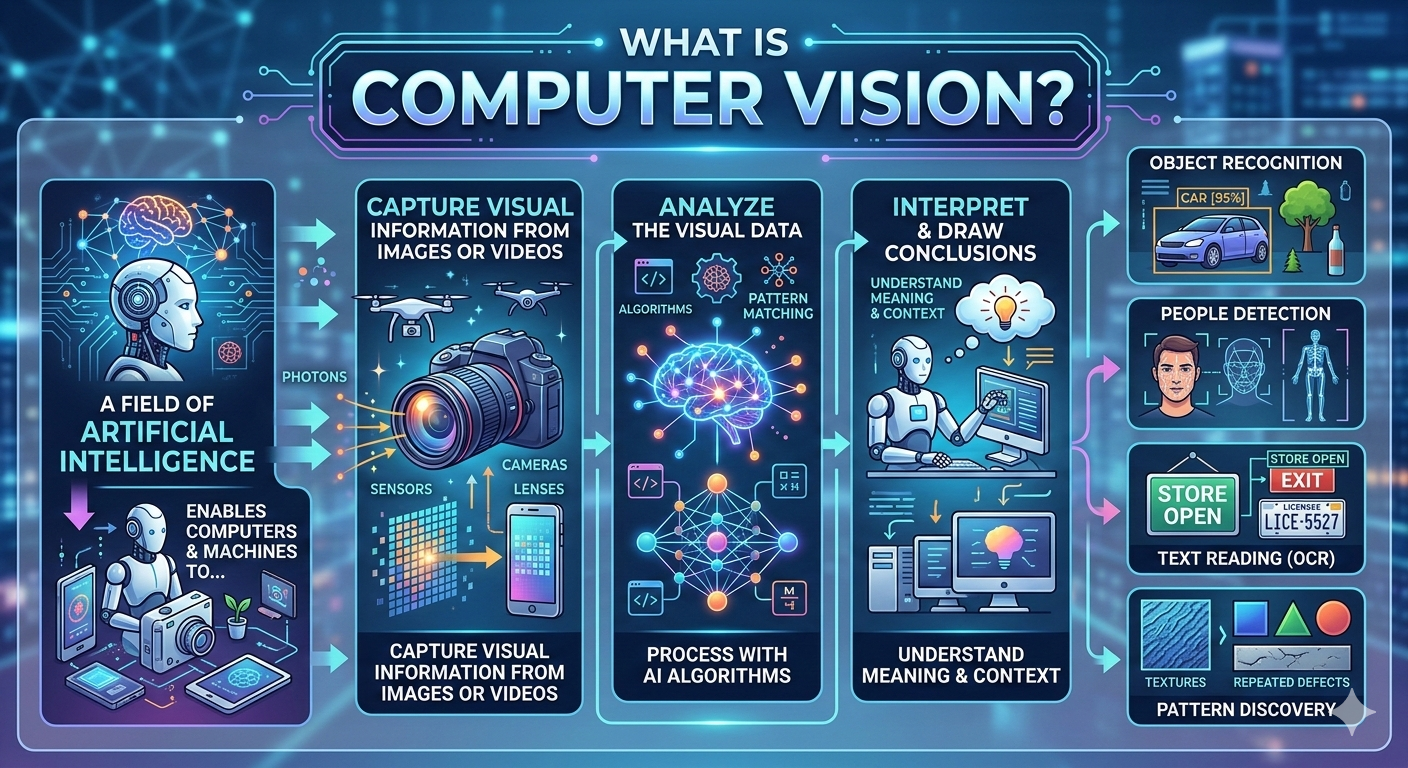
Computer Vision is a subset of Artificial Intelligence that allows computers to capture, analyse and interpret visual data to identify objects, people, text or patterns in real-life scenarios. The visual data is usually sourced from images and videos. Based on the interpreted data, the computer makes necessary suggestions or take suitable action.
For the purpose of visual data identification, Computer Vision makes use of cameras, algorithms, and technologies like Machine Learning and Deep Learning.
Just like humans see and perceive what’s happening around, CV enables the same in computers and machines.
Computer Vision Market Size and Growth Trends
According to the report published by Grand View Research, the international market size of Computer Vison was valued at USD 19.82 billion, as of 2024. By 2030, the value is expected to rise to USD 58.29 billion, achieving a growth rate of 19.8% (2025-2030).
The GVR report indicates that the fastest growing Computer Vision market is North America.
There are several factors that contribute to this rise in market value of Computer vision. Here are the major factors.
- Growing demand for industrial automation across diverse domains.
- Growing market need for self-driving vehicles.
- Technological advancements in the fields of AI and ML.
How is Computer Vision used in Retail environments?
There are several real-world use case scenarios of Computer Vision in retail settings. I’ve listed the major ones below.
1) Bulk scanning Self-checkout kiosks
Retail chains and establishments have to handle long customer lines at counters, especially in the peak shopping hours. Errors associated with barcode scanning, shoplifting scenarios affect checkout operations. These unwanted delays, unpleasant scenarios can adversely affect the retail experience, if not fixed or properly dealt with.
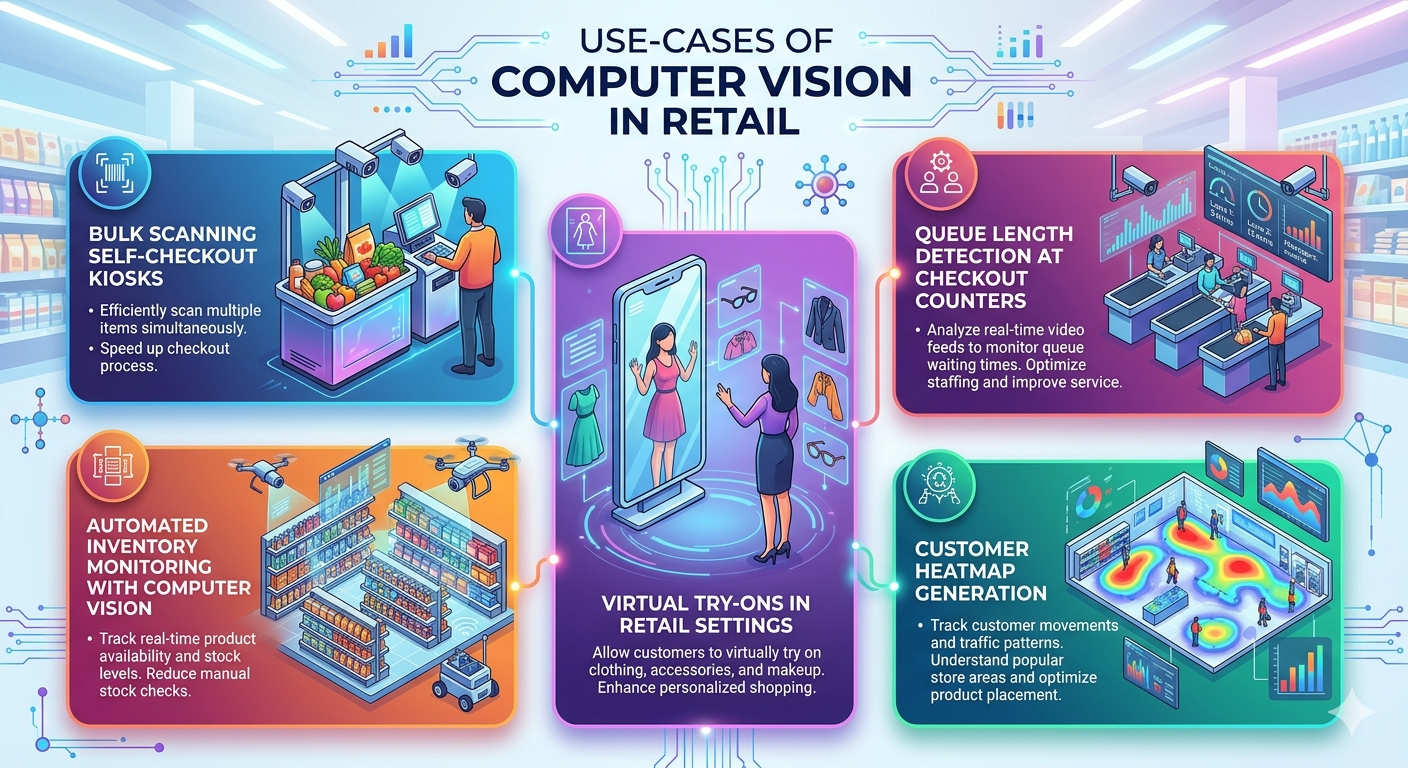
As the name suggests, Bulk scanning kiosk machines allow bulk scanning of products and items, eliminating the process of scanning the items one by one. These kiosk machines are equipped with multiple cameras that can instantly recognize items placed on the kiosk’s designated area.
Computer Vision algorithms detect and identify each product based on shape, packaging, and visual features. Hence, the bulk scanning self-checkout kiosk can produce itemized purchase bill in a matter of few seconds.
The integration of computer vision into the self-checkout machine significantly improves the checkout speed at counters, thus reducing the customer waiting time.
The Mashgin’s touchless checkout system offers a barcode-free, bulk scanning experience for retail customers. By reducing waiting time, faster checkouts help to accommodate a greater number of customers in retail stores.
What are the benefits of deploying AI-powered bulk scanning self-checkout kiosks?
Customer benefits
- Reduced waiting time - The Customers need not individually scan the items. They can scan all the items at once, pay and exit the store without any human intervention.
- Barcode-less checkouts adds convenience – Faster, efficient checkouts improve customer convenience.
- Reduces human errors – Reduces scanning errors like double scanning of items, missed items, etc.
Retailer benefits
- Improved checkout throughput – Retailers are able to serve more number of customers in the checkout counters in a given period of time. As a result, the retailers improve their customer volume capacity.
- Better loss prevention – Computer vision systems easily detect unscanned or misplaced items, and issues instant alerts to the store employees.
- Reduced labour requirements – improved checkout efficiency helps to reduce the staffing numbers. The existing staff members may engage in more productive tasks like shelf replenishment or marketing.
- Improved revenue generation – Improved checkout throughput reduces long lines and congestion in the checkout counters. Fast, efficient and hassle-free checkout experiences attract more visitors to the store, resulting in improved revenues.
2) Automated inventory monitoring with Computer Vision
Automated inventory monitoring powered by computer vision helps retailers track stock levels in real-time with a great degree of accuracy.
High resolution cameras with wide-angled lenses are installed on retail shelves. The wide angled lenses are aimed for maximum coverage.
These cameras capture images continuously, and they analyse certain patterns. These patterns include quantity of items, empty areas, and misplaced items.
The system instantly alerts the retail staff, in case of item shortage or when the shelves need restocking.
This automated inventory monitoring system reduces out-of-stock scenarios, and the need to manually check each and every shelf.
Hence, the shelves always have the required stock and remain well-organised.
Retail customers get what they need, every time they visit the store. Hence, an enhanced shopping experience for customers.
Additionally, the retailers can gather valuable insights into the analytical aspects of product movement and shelf performance.
As per retailer reports, Computer Vision-powered inventory tracking is estimated to enhance stock accuracy up to 30%.
The retail giant Walmart inspects its shelves with Computer Vision systems and shelf-scanning robots. The system monitors shelf availability, finds out-of-stock items, and checks product placement. It tracks the inventory in real-time, offering customers their desired items whenever they visit Walmart stores. This prevents lost sales scenarios caused due to limited stocks, thereby helping the retailer utilize every sales opportunity.
3) Computer Vision enables Virtual Try-on
Computer Vision with Augmented Reality is used in fashion and beauty stores for the purpose of product overlay.
Computer Vision analyzes live camera images and footages to detect facial features and body landmarks. The camera is usually integrated into a self-service retail kiosk. This feature enables AR systems to accurately place and track virtual products like makeup, lipstick shades, glasses, clothing, in real time.
Of course, the benefits are evident.
- Improved Customer engagement, thereby sales – Virtual try-ons improve customer engagement which enhances the chances of revenue generation.
- A confident customer and purchase – Trying the items virtually gives an instant visual feedback of the product’s appearance, fit and suitability.
- Improved decision-making – instant, real-time feedbacks help the customers take better purchase-related decisions.
- Reduced product returns – As the customers can virtually try on the products, the chances of product returns reduce.
- Reduced dependence on physical stocks – Retailers need not stock all their product sizes or colors in the physical store, as customers can engage in virtual try-ons easily. Hence, reduced inventory cost and better use of shelf space.
- Acquire critical customer and purchase-related insights – Retailers can acquire valuable insights related to customer preferences, product interaction times, etc.
Sephora’s Virtual ARTIST makes use of Computer Vision technology to offer a highly engaging and rewarding make-up try-on experience.
For example, the personal care and beauty products brand – Sephora’s customers can easily try on different shades and styles of lipstick in a minute. The transition to different shades happens in seconds which is highly convenient and time-saving for customers.
4) Checking queue length at checkout counters
Waiting in a lengthy queue at any retail store can cause displeasure among the customers. Most of them would think twice before they make any revisit. Long lines can adversely affect Customer Experience, and can even affect retail sales.
AI-powered cameras installed near checkouts can effectively track and identify long lines, and report the same to the manager instantly. As soon as the manager receives the report or alert, the person can decide to open a new counter at the earliest.
Long lines can occur in retail environments, but failing to resolve or manage them can lead to serious customer dissatisfaction.
5) Create Customer heatmaps
Conventionally, retail stores heavily relied on human employees to track customer movement in retail stores.
These days, it is not a feasible option to deploy human staff to track the movement of customers.
Computer Vision-powered cameras are installed at multiple spots and retail interiors to capture customer movements.
These cameras capture real-time video footages which are processed by Computer Vison algorithms. The algorithms identify and analyse customer movement inside the store, and the data gets converted into colour-coded heatmaps. Warmer colours indicate high activity zones and cooler colours signal reduced activity.
Heatmaps are graphical representations of data in which colors indicate the magnitude or density of values.
Customers move across aisles, interact with touchscreen devices like kiosk machines, engage with products displayed on shelves etc.
This movement may not be uniform across the store. Certain aisles get more foot traffic, owing to the display of high-demand products, discounted items, combo offers etc. While other aisles do not receive much foot traffic, maybe because the items are priced higher or they have lesser demand.
Even physical constraints can affect customer movement, like a dark corner, visibility issues, unprofessional retail décor etc.
Monitoring and analyzing this customer movement across the retail space is called Foot traffic analysis.
By conducting a Foot traffic analysis:
- Retailers can analyse these heatmaps to know where customers gather or concentrate, and know the traffic patterns.
- Locate areas where customers seldom visit or the dead zones areas.
- offers retailers relevant insights into the store layout, shelf installation, item placement etc.
- Based on the existing heatmaps, the retailers can optimise or restructure the layout, and then measure the results.
- Helps to capture certain key retail analytics like dwell time, foot fall numbers etc.
- Gather key insights on customer behavior and psychology.
- Elevate shopping experience
Japan’s largest Pet store, Coo & Riku, partnered with Milesight – a technology solutions provider, developed a heatmapping solution to optimize their store layout and fine tune staffing. The technology integration helped the pet store increase sales in key areas by 10%, and improved customer satisfaction by 15%.
Conclusion
Through the implementation of advanced technologies like Computer Vision, retail environments are soon becoming intelligent, data-driven environments.
You can integrate CV with your existing systems like POS, inventory management software, and self-checkout kiosks to improve your store’s operational efficiency.
CV technology integration could be an excellent option to counter retail shrinkage.
AI-powered self-service checkout terminals, automated inventory tracking, customer heat map generation, there are plenty of real-life use case scenarios. It’s clear that the technology helps retailers streamline their day-to-day operations and enhance the overall shopping experience.
During this era of intensified retail competition, implementing Computer Vision in retail settings is not anymore, a tech-powered luxury. In fact, it has become a retail necessity!
Frequently
Asked Questions
The Computer Vision technology can be implemented in diverse business environments like retail, banking, healthcare, logistics, and manufacturing. However, a proper digital infrastructure is required for the implementation.
Yes, Computer Vision detects suspicious behaviors at checkout counters like improper scanning and bypassing items, and issues real-time alerts to inform the employees. This reduces shrinkage in retail environments.
Of course. AI-powered self-checkout kiosks powered by Computer Vision is suitable for scanning multiple items at once. When the checkout kiosk is integrated with Computer Vision capability, the kiosk machine identifies multiple items simultaneously, reducing the checkout time.
The ROI lies in reduced labour cost, reduced losses due to retail shrinkage, and faster checkout times. This leads to improved store efficiency and enhanced revenue.
Of course. You may scale Computer Vision solutions for multiple store locations or in connection with expansion plans. Through cloud-based management, retailers can ensure operational consistency and performance across multiple stores.