

AI Smart Carts for Retail shops, Groceries, and Malls (2026)
What if your shopping trolley could think for itself? Yes, you read it right.
One such shopping trolley is the AI smart cart. The trolley that you use in groceries and supermarkets would soon become tech-enabled, instead of simple trolleys with wheels.
This AI-powered smart cart has the potential to redefine the in-store experience across Dubai’s fast evolving retail landscape.
The “thinking trolley” can automatically recognize products, track spending in real time, and even allows cart payments! This lets shoppers to skip the queue entirely.
For retailers and mall operators across Dubai, the smart cart adoption offers plenty of benefits.
This blog is all about the smart cart transformation.
Kindly read through.
What is an AI smart cart?
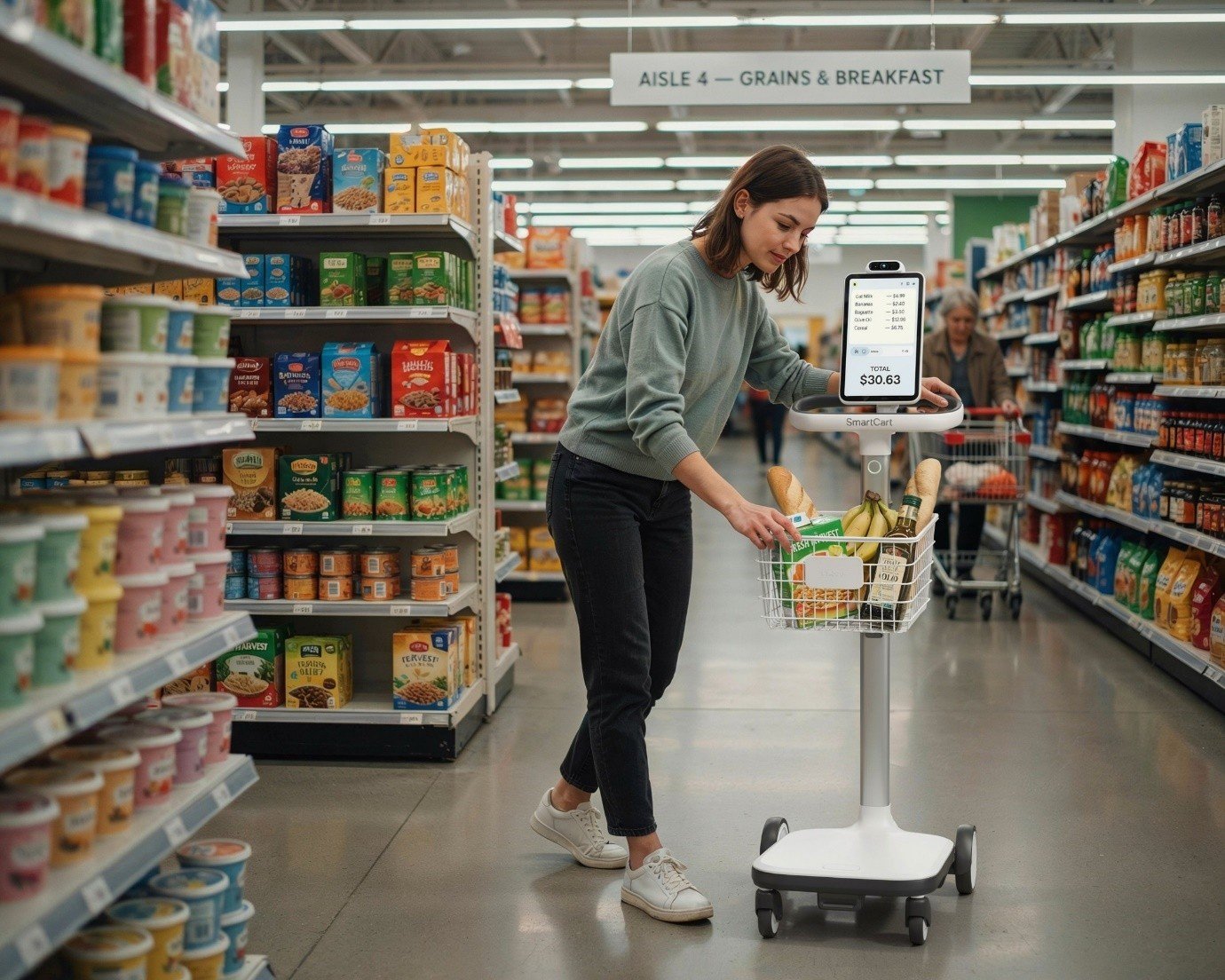
An AI smart cart is a tech-enabled shopping trolley that automatically scans your items, calculates the total items purchased, and lets you pay, without standing in lines.
The trolley offers a shopping experience similar to an e-commerce purchase, where the items are added to a virtual cart, followed by payment.
What are the features of an AI smart cart?
I have listed the main features of the AI smart cart below.
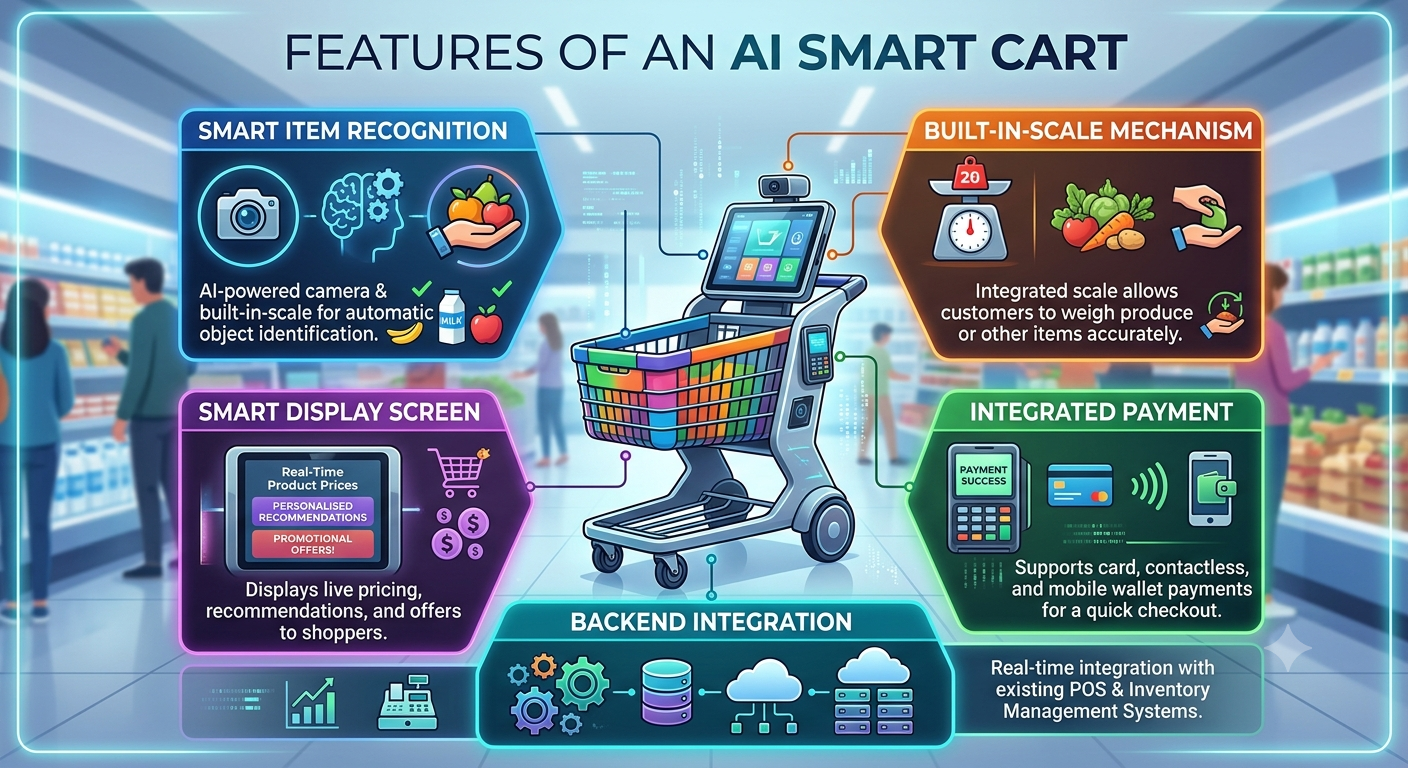
- Smart item recognition - The AI-powered smart carts are equipped with AI, camera and a built-in-scale mechanism, that facilitates automatic item recognition. The trolley instantly recognizes the item, once it is placed, so that the customers can watch their running total in real-time.
- Built-in-scale mechanism – the trolley is integrated with a built-in scale mechanism that allows customers to weigh produce or other items placed in the cart.
- Integrated payment – the AI-powered trolley has an integrated payment terminal that supports card, contactless, and mobile wallet payments. Therefore, the customers can pay directly at the cart, instead of paying at a manual counter or a retail checkout machine.
- Smart display screen – displays real-time product prices, product recommendations, and promotional offers. Hence, the customer remains well-informed about the pricing and discount offers. Additionally, the cart’s display screen can display the store’s layout map which helps customers easily navigate the store.
- Backend integration – real-time integration with existing POS and inventory management systems of the retail store.
How does an AI smart cart work?
The way these “thinking trolleys” work is pretty interesting.
- Pick the cart – Pick the cart and start shopping your favourite items in the store. The cart displays store layout maps, so that you can quickly navigate through the aisles.
- Place items in the cart – Pick your desired item/s and place or weigh it in the cart. The AI cart automatically detects the item placed, and instantly displays the item price on the display screen. You may continue shopping in similar fashion around the store.
- Payment – After you have completed shopping, you may pay for the selected items on the cart through any of the desired payment modes.
- Get payment receipt – A digital receipt of the transaction is sent instantly via SMS or email.
Thus, the customers can skip the checkout queue and make the exit in minimal time.
What are the key benefits of AI-powered smart carts?
The key benefits are listed in both customer and retailer perspectives.
Customer benefits
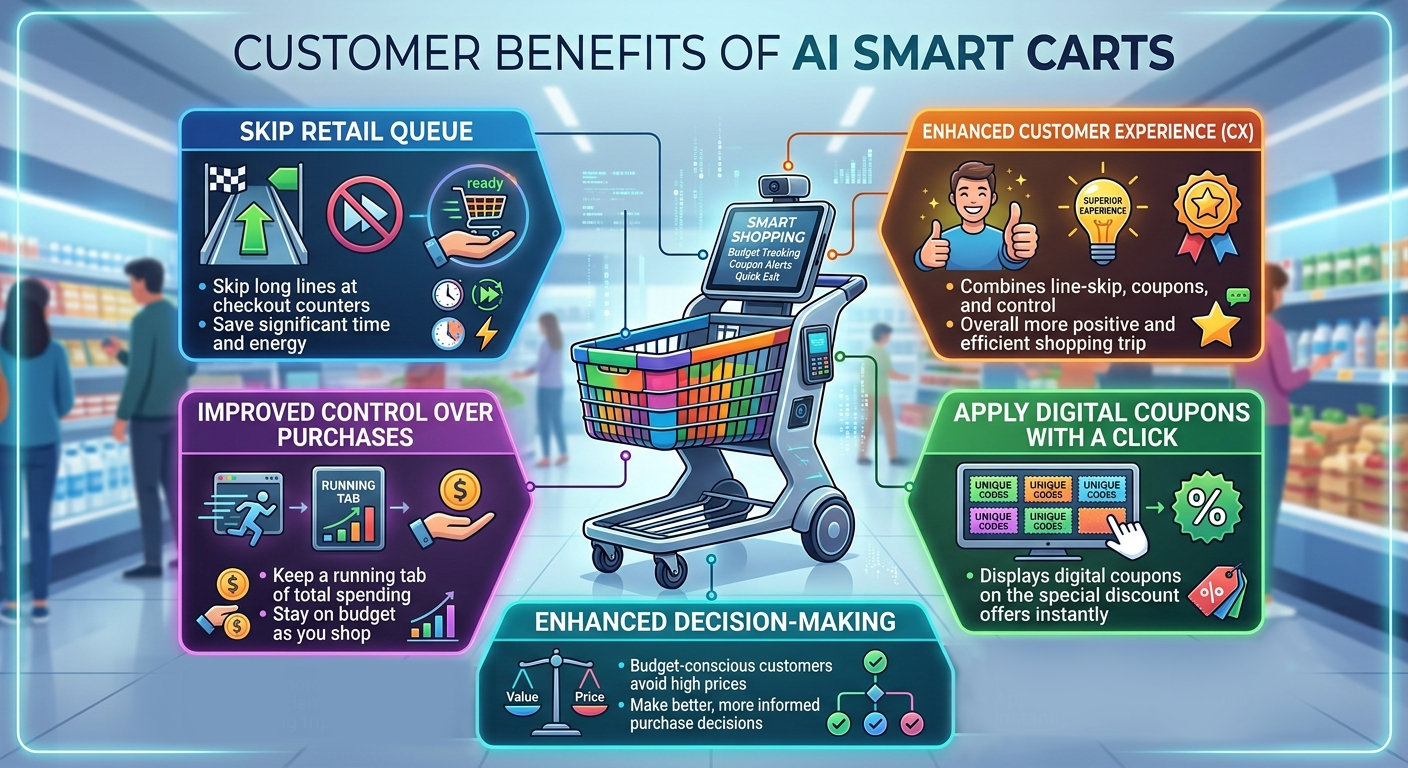
- Skip retail queue – the customers can skip the long lines at checkout counters which helps to save time and energy.
- Faster and convenient checkout – the customers can bypass the manual scanning of items and waiting at the checkout counter. The items are scanned automatically as soon as they are placed in the smart cart. Once the shopping is completed, the customer can easily do the checkout on the cart’s integrated touchscreen interface. This expedited checkout process helps customers shop even during peak hours.
- Improved control over their purchases – the customers can keep a running tab of what they're spending as they shop. Every time they place a product in the cart, the amount gets updated on the cart screen instantly. Hence, customers can keep track of their purchases.
- Enhanced decision-making – the budget-conscious customers can avoid shopping high-priced items, which helps them make better purchase-related decisions. The item can be removed from the cart, if the customer thinks price is way too high. With real-time price tracking, the customers can better manage their impulsive buying tendencies, thus creating a mindful, more controlled shopping experience.
- Apply digital coupons with a click – the smart cart displays digital coupons or special discount offers on the touchscreen. The customers an easily apply these digital coupons with a single click while shopping. The discount offer automatically applies to the order total.
- Enhanced customer experience (CX) – the line skip advantage, the convenient money-saving option through on-screen coupons, and the enhanced purchase control improve the overall shopping experience.
Retailer benefits
A smart city kiosk is equipped with a range of exciting features. Let’s have a look.
- Reduced shrinkage – Compared to traditional self-checkout kiosks, the smart product identification feature of smart carts reduces the incidence of theft.
- Larger basket sizes – By tracking what’s in the cart and identifying the aisle location of the customer, the smart cart displays personalised product recommendations. The product recommendations persuade the customer into adding more items which improves the Average Transaction Value (AVT).
- Improved coupon redemption – When the retailer delivers targeted digital offers to shoppers directly at the point of purchase, more customers are likely to redeem coupons. This facilitates improved coupon uptake and promotional ROI.
- Improved throughput – AI-powered smart carts bypass traditional checkout lanes entirely, facilitating faster store flow even during peak hours. Therefore, customers exit the store faster, resulting in enhanced throughput.
- Fewer staff interventions – Automated checkout helps retailer to reduce checkout lanes which results in fewer staff interventions in the retail environment. Even with reduced staff, the retailer will be able to manage peak hour requirements.
- Better sales – large basket sizes and improved throughput reflect in the form of better sales.
- Customer retention – By connecting loyalty rewards to the smart cart shopping experience, retail shops and groceries receive greater customer engagement, which improves customer retention.
- Acquire customer data – the retailer can acquire valuable customer data by identifying customer preferences, repeat purchases, coupon redemption etc.
- 3rd party ads – Retail establishments can display 3rd party ads via the cart screen, which contributes to ad revenue.
What are the drawbacks/challenges connected with the use of smart carts?
The major drawbacks or challenges associated with the use of smart AI carts are listed below.
- Technology cost – the technology integration cost is on the higher side, hence, large scale deployments in small to medium stores is going to be a challenge. ROI timeline for smaller retail establishments can be a lengthy affair.
- Early stage - As of now, not many retail establishments have deployed these AI-powered smart carts. Hence, data related to operational reliability, performance and efficiency are still unclear.
- Customer adoption barriers – Older customers and those who are accustomed to traditional checkout systems and practices may require onboarding assistance.
Which are the major brands that sell smart AI carts?
Caper (by Instacart)
Caper AI is a New York-based software technology company that develops and deploys AI-powered automated checkout solutions for retail establishments. The company is owned by Instacart since 2021.
Caper offers battery-operated smart carts powered by AI and Computer Vision that automatically scans items as soon as they are placed in the cart. The cart comes integrated with cameras, sensors, weighing scale and payment terminal, thus facilitating a seamless shopping experience for retail customers. The smart trolley is loaded with features like personalisation, advertising, gamification, omnichannel experience etc.
These smart shopping carts are deployed by more than 10+ retailers across the globe. They are deployed by some of the leading retailers and groceries in the US like Geissler’s Supermarket, Bristol Farms, and Wakefern Food Corporation.
Australia’s renowned retailer Coles Supermarkets has also deployed Instacart smart trolleys in its Melbourne store.
For more on Caper’s smart shopping carts, please visit their official website.
Shopic
Shopic is a retail tech company based in Tel Aviv, Israel. Shopic makes use of a clip-on device called Shop-E. The device is powered by advanced computer vision technology. When you attach the device to an ordinary cart, the cart becomes a smart cart. After you’ve competed shopping, you can easily unmount the device from the trolley, and return it to the clip-on shelf.
Major retail chains like Walmart, Chile and Dimar, Italy have deployed Shopic’s clip-on smart cart solution.
For more on Shopic’s clip-on smart cart, please visit their page here.
Amazon — Dash cart
Amazon’s Dash cart is an AI-powered trolley that allows customers to scan and weigh items, and understand the prices in real-time. The Dash cart makes use of CV and sensor fusion technologies for item recognition. Amazon claims that Dash cart users spend 10% more than the customers who would not prefer them while shopping.
Earlier, the use of Amazon Dash cart was limited to its stores. In 2024, Amazon revised their plan, and declared smart cart availability for 3rd party grocers.
The grocery industry news website, Grocery Drive reports that select retail stores in the US like Four Price Chopper and McKeever’s Market have started testing the Dash cart.
To Conclude
AI smart carts are no longer a glimpse into the future. These smart “thinking trolleys” are the new standard for retail and grocery excellence.
Today’s retail landscape demands more than well-stocked shelves. It demands intelligence, speed, and seamless experiences that keep customer coming back. AI smart carts deliver all three.
Smart carts redefine what it means to shop by slashing checkout queues, and delivering personalised, in-aisle experiences across the retail settings.
The shift is happening right now!
Frequently
Asked Questions
The AI smart cart price varies with several factors like the number of units you purchase, the technology integration etc. The clip-on-based technologies cost less compared to the fully-integrated smart cart experience.
Yes. AI smart carts are designed to identify both additions and removals. When you take the item out of the cart, the system will automatically update your running total.
As of now, smart AI carts are designed and developed by technology companies like Instacart Caper AI and Shopic. Please visit their official websites to gather a better understanding of the products and their differences.
Yes. Advanced AI smart carts are equipped to handle unpackaged items such as fresh produce. Shoppers can select the item category on the touchscreen, and the cart calculates the cost based on weight.
The following businesses and operators can invest in a smart shopping trolley.
- Supermarkets and grocery chains
- Hypermarkets and big-box retailers
- Shopping mall operators
- Technology resellers and retail solution providers