

Africa's Next Retail Wave: 4 Trends Every Business Should Know
Ever walked into a supermarket in Nairobi or Lagos and paid without touching a card or cash? Chances are you tapped your phone, scanned a QR code or checked yourself out at a kiosk. That’s African retail in 2026, and it’s moving fast.
From self-checkout lanes replacing long queues to AI predicting stock outs before they happen, retailers across the continent are betting big on technology. Kindly read on, because we’re breaking down the biggest retail tech trends in Africa right now, backed by real numbers and real examples from real markets.
Let us dig in…
Africa retail market size
I have listed few quick facts on Africa retail market size based on the findings of 6Wresearch.
As of 2024, the African retail market stood at USD 845.2 billion. The market value is on track to reach USD 1,276.3 billion by 2031, indicating a CAGR of 6% during the forecast period 2025 – 2031.
Here are the key market drivers.
- The Gen Z factor – Rise in Gen Z population and their consumption needs. Gen Zs represent 30% of the overall African population, says UNDP Africa.
- Smartphone adoption – As per GSMA reports, the mobile internet proliferation in 2025, accounts to 28%. And, it is growing at a fast pace. Of course, the percentage varies with regions.
- Global retailers – The entry of global retail chains significantly helps the market growth.
Changing customer preferences – Growing preferences for branded retail products and home appliances.
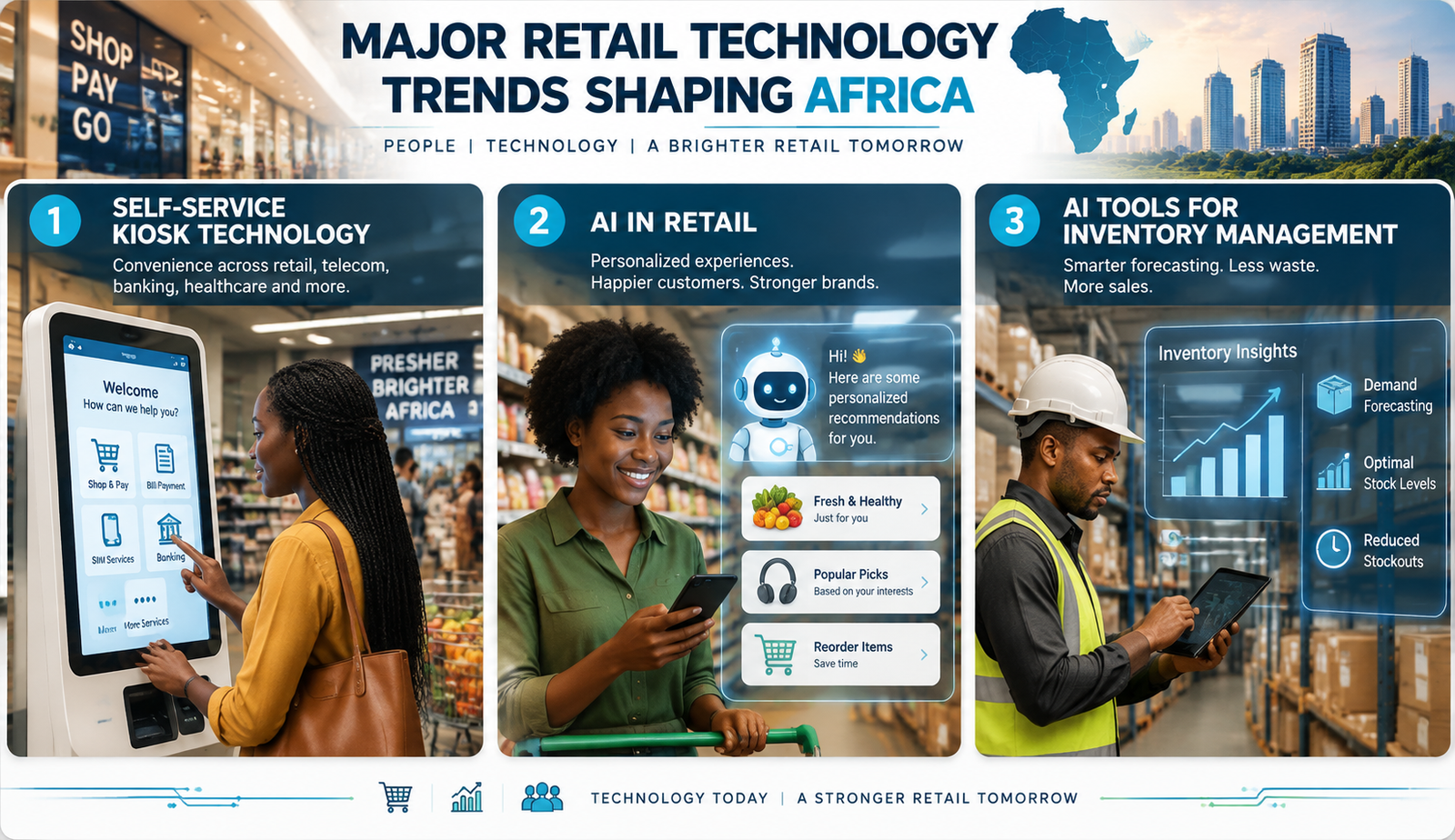
What are the major retail technology trends shaping Africa?
1) Self-service kiosk technology
Gone are the days when self-service was a novelty reserved for flagship stores trying to look modern. Across Africa, it’s becoming the baseline customers expect, not a nice surprise when it shows up.
South Africa is leading this shift. Walk into any major supermarket, pharmacy or fast food outlet today and a self-service kiosk machine is likely waiting for you. Self-service is no longer about impressing customers. It’s about not disappointing them.
Shoprite Group (largest retailer in South Africa) implemented Africa’s first RFID-based self-checkout solution at its UNIQ clothing stores, in the mid-2023. The RFID-assisted drop-and-go solution, named AdvanGo, expedites the payment process and offers a cashless shopping experience.
Carrefour Kenya launched Kenya’s first self-checkout service at Westgate Mall, Nairobi, in March 2023. Since then it has rolled out self-checkout machines across multiple locations in Kenya.
But adoption isn’t staying confined to checkout lanes or fast food chains. Kiosks are showing up across telecom (SIM registration, plan changes), utilities (bill payments), banking, healthcare and government services.
Vendors like Q-SYS already run active kiosk deployments across Kenya, Uganda, Nigeria, Congo, Tanzania, Zambia and Ghana, which tells you this isn’t isolated experimentation.
Panashi, a Dubai-based end-to-end kiosk supplier, is fast-expanding its reach to key African markets. Panashi’s Airport check-in kiosks, designed to streamline key airport functions like passenger check-in, boarding pass issuance are already deployed in Angola’s leading airport.
2) AI in retail
According to a recently published McKinsey and ICSC report, agentic commerce could add up to $5 trillion to global retail revenue by 2030. Right now, the African continent is well-placed to capture this revenue share.
Here are the key factors that would facilitate this transformation.
- the young Gen Z population
- increase in smartphone adoption
- mobile-first consumerism
The retail businesses, retail technology solutions providers, and even the policymakers in Africa should be aware of these key factors.
AI-powered retail assistants
With a young, mobile-first population, the continent is fertile ground for AI shopping assistants. The major developments in this field happen in the far-south, in South Africa.
The South African retail business, Pick n Pay, on July 6th 2026, launched their AI shopping assistant to improve the overall grocery shopping experience. The shopping assistant enables customers to easily create grocery orders using natural voice, text or images, avoiding manual selection.
The tool also provides personalised suggestions, recipes, weekly menus, item swaps or alternatives, etc. which help improve customer engagement.
The AI-powered assistant is named Penny, and is powered by Google’s Gemini AI. Penny is integrated directly into the Pick n Pay Asap app. The technology integration in retail is aimed to boost Pick n Pay’s online visibility and reach.
AI-powered personalization
Traditionally, the African business owners knew the needs and preferences of the individual customers. This understanding on a personal level served as a catalyst for sales and customer retention. This worked for several decades, but had its limits. The retailers could not scale. No single shop owner or team can maintain rapport with thousands of customers at once.
Here comes the role of AI.
AI gathers certain key customer-related insights like browsing history, purchase preferences, information related to customer demography, etc. Based on the gathered data, the AI offers highly personalised recommendations, special offers, establishing a personal “connect” with the customers. Each and every customer feels relevant or they are heard.
This AI-driven personalisation maintains the same level of customer rapport and extends it to thousands or millions of customers, at the same time.
Moreover, personalised recommendations cut the one-size-fits-all messaging pattern.
Hence, casual browsers or visitors become buyers and buyers become genuine brand loyalists.
If successfully implemented, the end results of AI-driven personalisation are:
- Enhanced sales
- Improved customer retention
- Increase in Average Revenue Per Customer (ARPC)
AI tools for inventory management
African businesses usually rely on the conventional practice of inventory management. Yes, you guessed it right. Manually counting units and keeping records by hand.
However, the traditional practice comes with few challenges.
- Human-intervened inventory management can result in errors.
- Reduced accuracy in gathering the exact sales data.
- Reduced data accuracy affects demand forecasting which leads to understocking or overstocking.
- Understocking is simply a missed sales opportunity. Studies show that understocking alone can lead to a loss of up to 25% in sales.
- Overstocking drives up storage expenses, sometimes as high as 30% of the total inventory value.
- Stockout scenarios adversely affect customer satisfaction.
- Human-intervened inventory management becomes time-consuming and resource-centric when it has to deal with several warehouses.
AI-powered inventory management systems can gather crucial data pertaining to sales, real-time inventory, etc. analyse the data, and come up with useful trends and patterns. Retailers can make use of this information to optimise/modify the existing stock levels, helping them prevent both understocking and overstocking scenarios.
NeuroptikAI – an AI automation solutions provider – recently implemented an AI-powered inventory management solution for an apparel business based in Lagos, Nigeria.
The AI-assisted inventory management solution is actually a custom-built demand forecasting engine. It makes use of certain key data like POS data, mobile payments, and weather data, to ensure product availability, thereby avoiding stockout scenarios.
Instead of a manager guessing “we’ll probably need X units next month” from memory or gut feel, the system blends “what we’ve sold before,” “how much money is moving in the market,” and “what the weather’s about to do” into one forecast. Based on this gathered information (not assumption), it tells the business what to reorder and when, before shelves actually go empty.
The largest retailer in Africa – Shoprite – is reported to have achieved a yearly cost-cutting of USD 1 million, after implementing an AI-powered inventory management solution. The retailer managed to effectively handle both overstocking and understocking scenarios. And that’s exactly where the cost-cutting kicked in.
3) Africa's E-commerce Boom: Is the Continent Finally Catching Up?
Is Africa’s e-commerce sector actually growing, or is it just hype? As per the data, it’s real, and it’s fast.
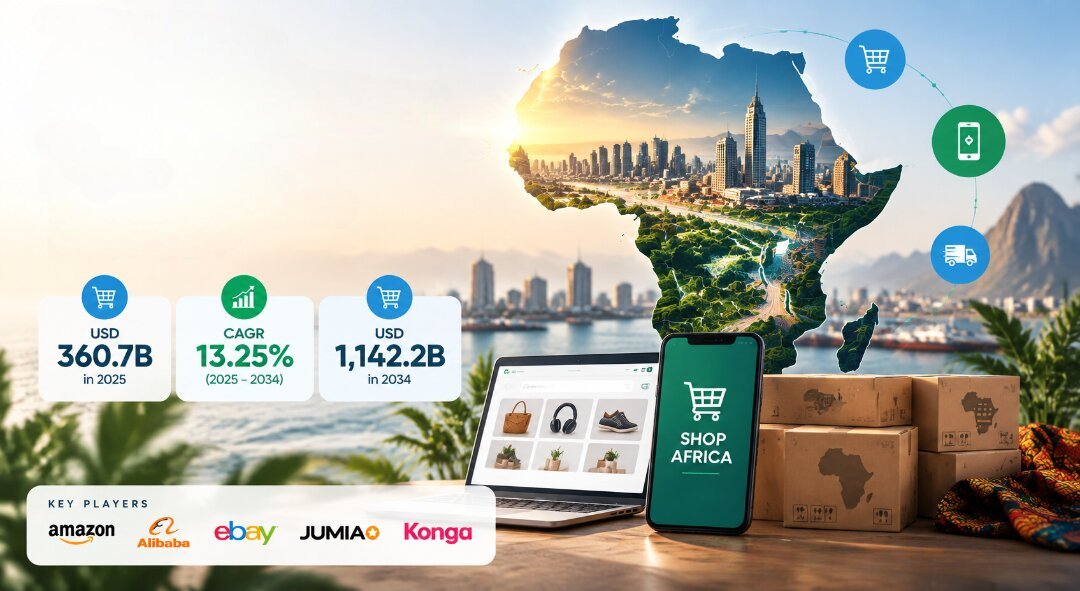
As per IMARC GROUP research, Africa’s e-commerce market size was valued at USD 360.7 billion in 2025. By 2034, the value is expected to reach USD 1,142.2 billion, indicating a CAGR of 13.25%.
According to the Mordor Intelligence research, South Africa’s e-commerce market alone is valued at US$41.86 billion in 2026. The value is expected to reach US$63.06 billion by 2031.
That’s not a small jump!
Mobile money is the real engine here. The Africa mobile payments market has hit US$198.8 billion in 2026, letting shoppers pay through QR codes and apps instead of hunting for cash. It is estimated that around 78% of Sub-Saharan African SMEs now sell through WhatsApp, and you start to see why traditional shopping isn’t the only path to growth.
Jumia, an e-commerce platform based in Lagos, Nigeria, reported a 34% increase in revenue in Q4 2025 after narrowing its focus to West and East Africa, where mobile-first buying is already the norm.
Yaga – a South Africa-based online shopping and selling platform for used clothing materials is right now planning to expand to Kenya and Nigeria. Yaga customers can purchase used apparels with (50-80) % price reduction compared to the branded ones. The online fashion store initiative also works in favour of sustainable fashion, which reduces wastage.
Some of the key e-commerce providers in Africa are:
- Amazon.com, Inc.
- Alibaba Group
- eBay Inc
- Jumia Technologies AG
- Konga Online Shopping Ltd
4) Cash to Card: The Quiet Digital Shift in Southern Africa's Informal Trade
Cash has long dominated informal retail across Southern Africa, but that’s changing fast. Two companies, Yoco and Kazang, are leading the shift from cash to digital payments among small and informal traders.
Yoco gives South African merchants, from market traders to salon owners, an easy way to accept card payments through its Yoco Go, Neo, Khumo, and Khumo Print machines. Yoco’s transaction rates are on the lower side with no fixed monthly fees. Over 200,000 businesses now use the platform.
Whereas, Kazang started its services by allowing informal traders like spaza shops to resell air time, electricity, and bill payments, through its POS devices. Kazang handles around 100,000 active POS micro-billing devices across South Africa, Namibia, Botswana, and Zambia. The fintech solution provider has since added card acceptance to nearly 60,000 of those terminals, turning everyday shops into micro-banking points.
It’s not a trend happening only in the Southern regions of Africa.
Kenya’s Lipa na M-Pesa shows the same shift happening further north, backed by a projected 22% growth in Africa’s mobile payments market in 2026 alone.
These examples show that the cash-heavy informal economy is getting rewired device by device.
And, the benefits are:
- Reduced cash-handling risks.
- Improved financial inclusion for traders and the customers alike.
To conclude - what does this mean for retail in Africa?
Self-service kiosks, AI-driven store operations, rapid rise of e-commerce, and informal traders moving from cash to card – one thing is clear! Retail across Africa is changing fast, and technology is the common thread. Undoubtedly, businesses that adapt early are the ones who would capture most growth.
Each trend feeds into the next: kiosks and AI improve the shopping experience, e-commerce expands where customers shop, and digital payments make it all possible for even the smallest trader.
It’s time to explore what these shifts mean for your own business. Stay tuned.
Frequently
Asked Questions
Yes. We provide barcode and weighing scale-assisted self-checkout machines, product information kiosks, digital signage solutions, wayfinding and store navigation kiosks, AI-assisted shopping agents, and several other solutions designed specifically for Africa’s retail sector. Visit our retail kiosk solution page for more.
Not entirely, but RSA is surely ahead. Carrefour Kenya launched East Africa's first self-checkout service at a Nairobi mall in 2023. Since then the self-checkout service expanded to other stores in Kenya. Formal retail is smaller in most other African markets. So, kiosk adoption tends to follow those locations that have the strongest supermarket and fast food footprint.
As per the trajectory these companies are already on – yes. Keep in mind that adoption factors vary with several factors like market, infrastructure development, smartphone penetration, and retail density of the region. Stay tuned! This is a place that’s moving fast.
Yes. Panashi supplies digital signage solutions for a wide range of industries in Africa, including the retail, hospitality, transportation, tourism, banking, healthcare etc.
Yes, absolutely. Our AI avatar kiosks powered by NLP help shoppers to interact with a digital assistant in real-time. The shoppers can make use of voice commands to interact with the AI avatar to clear their queries regarding store wayfinding, customer service, product information, etc.
The digital avatar can offer real-time product recommendations and perform upselling in the preferred language of the customer. All these features make the overall interaction highly interactive and productive.