

Rwanda's Irembo Platform: How Self-Service Kiosks Can Extend Digital Government Services to Every Citizen
Imagine a government portal that offers you over 200 services, from renewing your ID to registering for health insurance, all from a single, unified platform. Now imagine that you don’t own a smartphone, or that the nearest reliable internet connection is far away from home.
This is the quiet contradiction sitting at the heart of Rwanda’s digital government story. It’s exactly the gap self-service kiosks are built to close.
Self-service kiosk machines can play a key role in extending digital government services to every citizen of Rwanda.
Read through the blog to learn the features and benefits of a government self-service kiosk machine, and understand its scope in Rwandan perspective.
Irembo: A brief introduction.
Irembo – is a core national infrastructure project, backed by Rwanda’s broader Vision 2050 strategy and the $200 million Rwanda Digital Acceleration Project (RDAP).
Irembo currently offers more than 200 online government services to the Rwandan citizens.
Citizens can apply for a national ID, register a birth or marriage, enrol in Mutuelle health insurance, apply for a driving licence, or request a business permit, all without physically visiting a government office.
Each of these transactions is tied to a citizen’s 16-digit National Identity Number (NIN), issued and managed by NIDA (the National Identification Agency) through the National Population Register.
Some of the major services offered on the Irembo portal are listed below.
Family-related services
- Issuance of various certificates like Certificate of Succession, Certificate of Widow/Widower, Certificate of Residence, etc.
- Birth services
- Marriage services
- Divorce services
- Death services
- Record of Recognition
Immigration and emigration services
- Recovery of Rwandan nationality
- e-passport application
- Resident ID card
- Permit and visa transfer
Services related to Identification
- Applying for National ID
- Change of Name
- Certificate of Nationality
- Certificate of Being Alive.
Land-related services
- First land registration
- Title transfer
- Land merging
- Authentication for loan agreement
Police
- Issuance of duplicate driving license
- Traffic fines
- Driving license application/renewal
- Driving test registration
Health
- Community-based health insurance
- Lab tests
- Health facility licensing
Utilities
- Request for water connection/ reconnection
Postal services
- Register/renew an ePoBox Address
- Change ePoBox postal office
There are several other services Irembo offers via their online portal. Visit Irembo official website for more.
The gap between coverage and digital fluency
Let’s start with the numbers, because they tell a story of genuine ambition.
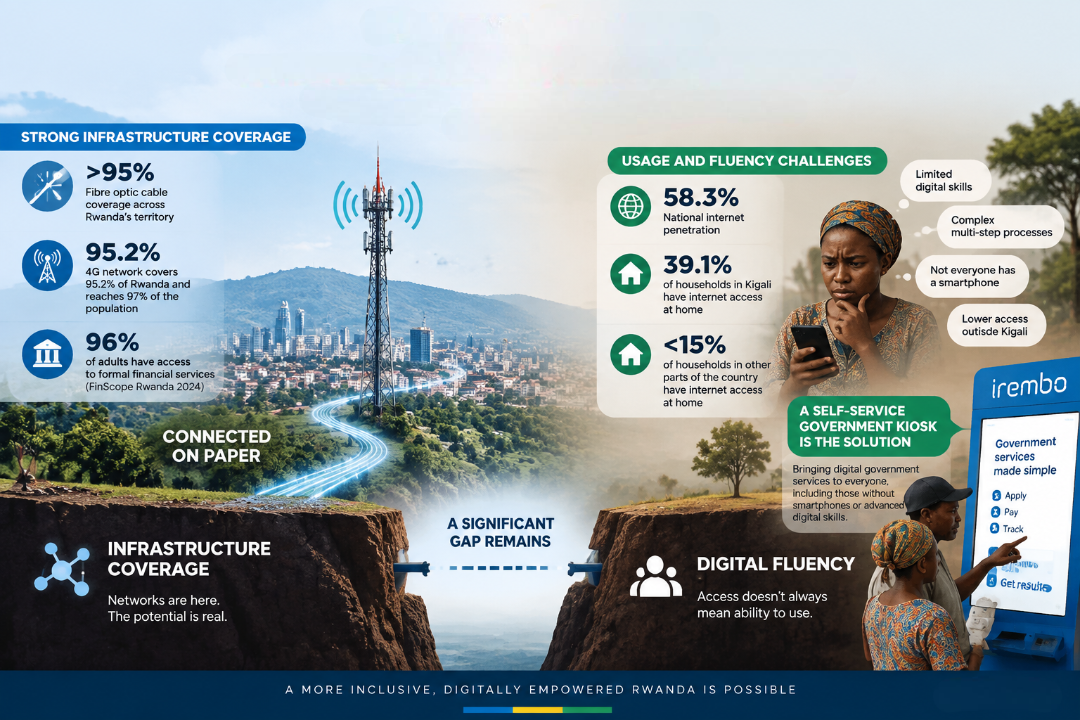
Rwanda’s infrastructure coverage is, on paper, close to universal.
Fibre optics cable coverage – extends to more than 95% of Rwandan territory.
4G network – covers 95.2% of Rwanda and reaches 97% of the total population
According to the 2024 FinScope Rwanda Survey, nearly 96% of adults have access to formal financial services.
Even though the financial inclusion statistics are favourable, the national internet penetration sits at 58.3%.
In Kigali city, the percentage of households with internet access at home is 39.1%. In other parts of the country, the value drops to less than 15%.
In other words, a large share of Rwandans is connected in the infrastructural sense, within reach of a network. They have mobile money wallets, and are registered in the National Population Register.
Navigating a multi-step digital government transaction on a personal smartphone may not be possible for an average Rwandan.
That’s not a criticism of the Irembo project.
It is due to the fact that there is a considerable gap between digital infrastructure and smartphone-based digital fluency, especially outside the capital.
A self-service government kiosk is the perfect solution to serve such a population.
What is a self-service government kiosk?
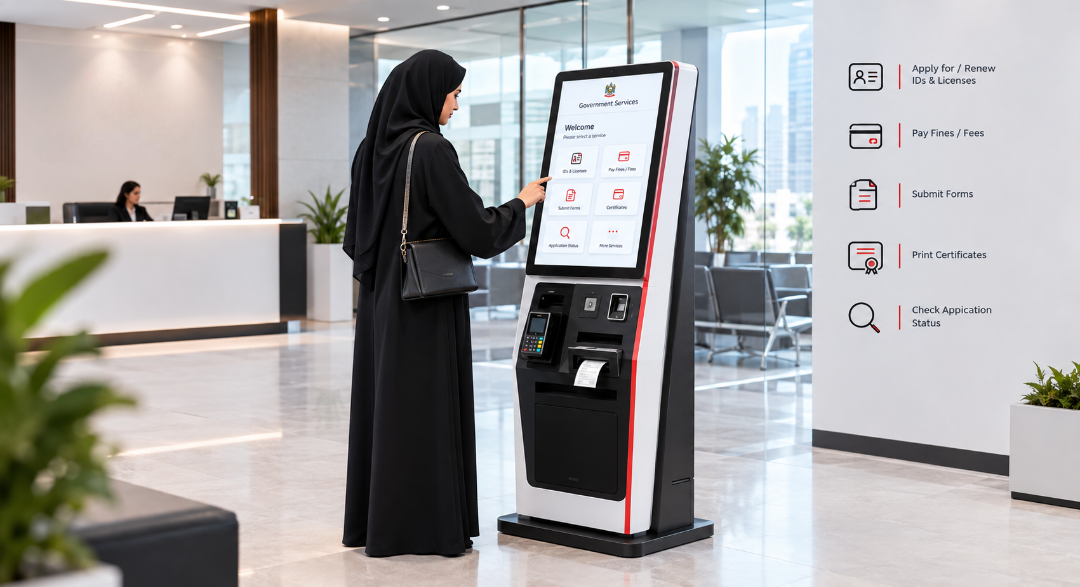
A self-service government kiosk is a public-facing terminal that lets citizens complete government transactions and access services without needing a staff member. The services include applying for or renewing IDs and licenses, paying fines or fees, submitting forms, printing certificates, or checking application status, and many others.
It typically uses touchscreens, document scanners, biometric verification, and payment integration to handle the full transaction on the spot. This reduces long lines in government departments and agencies, cutting down queues and freeing up government staff for more complex cases.
What are the features of a Panashi government kiosk machine?
The government self-service kiosk machines are equipped with all the necessary features to streamline government services.
- Intuitive touchscreen – Panashi’s large, intuitive touchscreen helps Rwandan citizens to easily navigate the kiosk machine.
- Instant issuance of ID cards – the citizens can easily apply for and renew existing ID cards via the kiosk machine. For example: Resident ID card, National ID, etc.
- Biometric authentication capability – facial recognition or fingerprint scanning for fast and secure authentication.
- Bill payment processing – handles bill payments connected with multiple government departments like land, police, immigration and emigration, family, health, education, etc.
- Payment mode options – the citizens can make use of their preferred payment modes, like cash, card, mobile money services, etc.
- Multilingual interface – the users can select their preferred language for kiosk navigation like Kinyarwanda, English, French, or Swahili, whichever convenient.
- Digital signature pad – facilitates digital signing of documents or other consent forms.
- Accessibility for disabled individuals - our kiosk machines for governments are equipped with accessibility features like screen magnification software, tactile keypads, etc.
- Remote monitoring – the government kiosk or the kiosk network can be monitored from a centralised location by an admin.
How Rwandan government can benefit from our e-government kiosk machines?
Panashi government kiosk machines would serve as the perfect extension of the Irembo portal. The kiosk terminal would serve as a physical access point, offering NIN-verified services with guided step-by-step instructions, for citizens who would otherwise need external help.
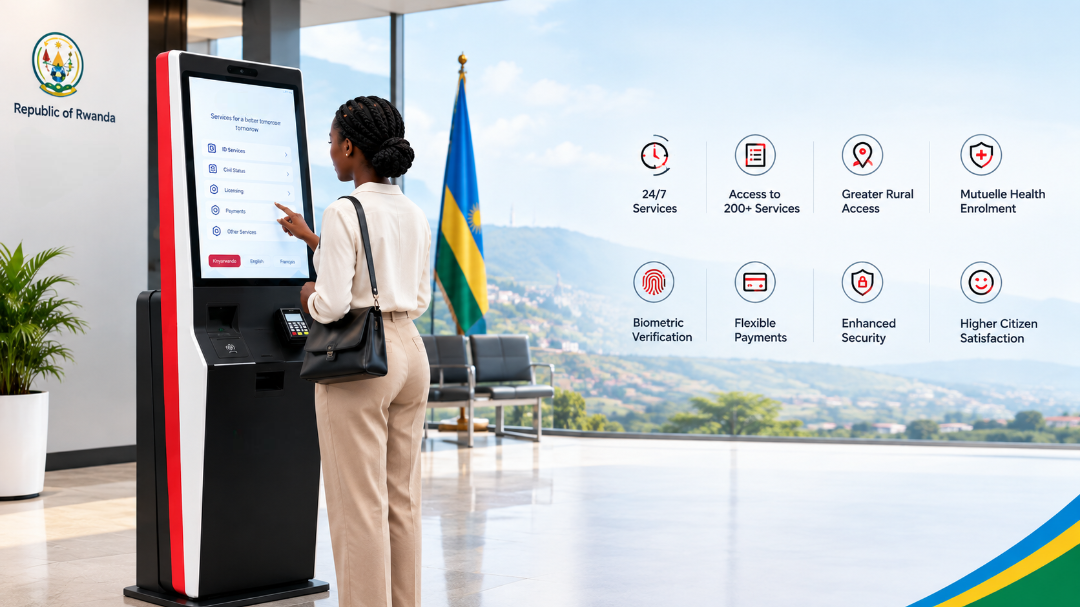
- 24/7 services – the citizens need not adhere to the office hours for service-related interactions. Instead, they can choose their most convenient time, as the kiosk machines operate 24/7.
- Improved service delivery – the citizens of Rwanda can easily access 200+ services, submit forms, and complete various transactions, including payments without visiting physical offices or agent centres.
- Improve rural and peri-urban access – A kiosk installed at a district office or a high-footfall public venue can offer the exact same NIN-verified services (ID applications, civil status certificates, licensing) through a large touchscreen, with the help of clear prompts and multilingual support. Citizens without smartphones and limited internet can easily access the kiosk machine.
- Mutuelle health insurance enrolment (Mutuelle de santé) – Locally known as Mutuelle de santé, Rwanda’s national health insurance scheme, run in partnership between local communities, healthcare providers, and the government. Health insurance registration through Irembo is one of the more commonly used citizen services.
A kiosk at a health centre or community hub could allow a citizen to enrol or renew coverage on the spot. The kiosk machine instantly issues a digital or printed confirmation, closing a transaction that might otherwise require a follow-up visit.
- Biometric services – Panashi kiosk machines equipped with fingerprint and facial recognition hardware are built to support Rwanda’s transition toward its new biometric Digital ID. The feature expedites citizen identity verification and also reduces identity-related frauds.
- Payment completion – Many Irembo services require payment as a final step. As the kiosk accepts cash, card, and mobile money, the citizens can complete the payment process with ease, which removes the last friction point.
- Improved security – the end-to-end encryption protects citizens from data theft, fraud, and unauthorised access, especially when it comes to sensitive government transactions.
- Convenient deployment – government agencies can roll out self-service access quickly, at district offices, public venues, or underserved rural areas, without heavy infrastructure investment or long installation timelines.
- Enhanced citizen satisfaction – 24/7 operations, and easy, prompt-based self-service with multi-language and payment capabilities improve citizen satisfaction.
Why This Matters Beyond Rwanda?
Rwanda’s approach offers a useful lesson for governments across the region. Countries like Kenya (with e-Citizen and Huduma Kenya), Tanzania (with its own NIDA-linked services), and Ghana (with the recently payment-enabled Ghana Card) are all pursuing versions of the same idea. And the idea is to consolidate government services into a single digital identity and platform.
In every one of these markets, the same structural gap tends to appear. Coverage and digital identity infrastructure move fast. Smartphone-based fluency, particularly outside major cities, takes longer to catch up.
Conclusion
Rwanda’s dream to become a knowledge-based economy is set for 2035. In order to achieve this dream, the country plans to invest in technology and innovation.
Rwanda has already done the hard part: building the network, the identity system, and the payment rails needed to support a truly cashless, digitally-administered society. What remains is making sure every citizen, regardless of smartphone ownership, location, or digital confidence, can actually use what’s been built.
Panashi’s self-service kiosks are built for the same cause, to build a digitally-inclusive Rwandan society.
For anything related to government kiosk consultation or implementation in Rwanda, feel free to get in touch with Panashi Africa team.
Frequently
Asked Questions
Self-service kiosk price in Rwanda varies with various factors, including kiosk design format (outdoor, indoor or semi outdoor), technology integration, customisation requirements, etc. Give us your detailed requirement, we’ll send you the best price at the earliest.
Government kiosk purchase in Rwanda is simple and straightforward. Write an email, or get in touch via WhatsApp or simply call us directly. Let us know your kiosk-related requirements, number of units required, customisation demands, etc. Our team would get in touch with you at the earliest with the most feasible kiosk recommendation.
Yes. We offer both remote assistance (including software fixes, updates, troubleshooting) and onsite technical assistance (if the situation demands), based on a service level agreement.
Yes, absolutely. Panashi kiosks support mobile money integration through APIs, so citizens can pay for government services like ID renewals, license fees, or land registration charges directly at the kiosk.
You may install an Irembo kiosk terminal at any convenient location in Rwanda, including district administration offices, NIDA service points, land registration centres, and across other underserved sectors.
Yes, absolutely. Panashi’s expertise in outdoor kiosk deployment is well-documented in our project case studies. We offer IP65/IP67-rated outdoor kiosk enclosures to protect kiosk components from heat, sunlight, dust, and humidity.