

What Makes Capacitive Touchscreens the Smart Choice for Kiosks?
Have you ever noticed how naturally you tap, swipe and pinch on your smartphone? You never stop to think about it.
That effortless feel comes from capacitive touchscreen technology. And it is the same technology powering many of today’s self-service kiosks.
From burger counters in Dubai malls to self-checkout lanes in Riyadh supermarkets, customers expect kiosks to respond like their phones. A laggy or unresponsive screen can turn a quick order into a frustrating wait.
So, what makes capacitive touchscreens so popular for kiosks? Kindly read on to find out.
What is a capacitive touchscreen kiosk?
A capacitive touchscreen kiosk makes use of a highly responsive capacitive touchscreen for interactions. This interaction is possible with a finger or conductive stylus.
Capacitive touchscreens are employed in all scenarios where responsiveness and intuitiveness are necessary. A user can perform multi-touch gestures, such as swiping and pinch-to-zoom, on a capacitive touchscreen, which makes it highly suitable for complex interactions.
The working principle of capacitive touchscreen
A typical capacitive touchscreen makes use of the electrical capacitance to detect and understand human touch.
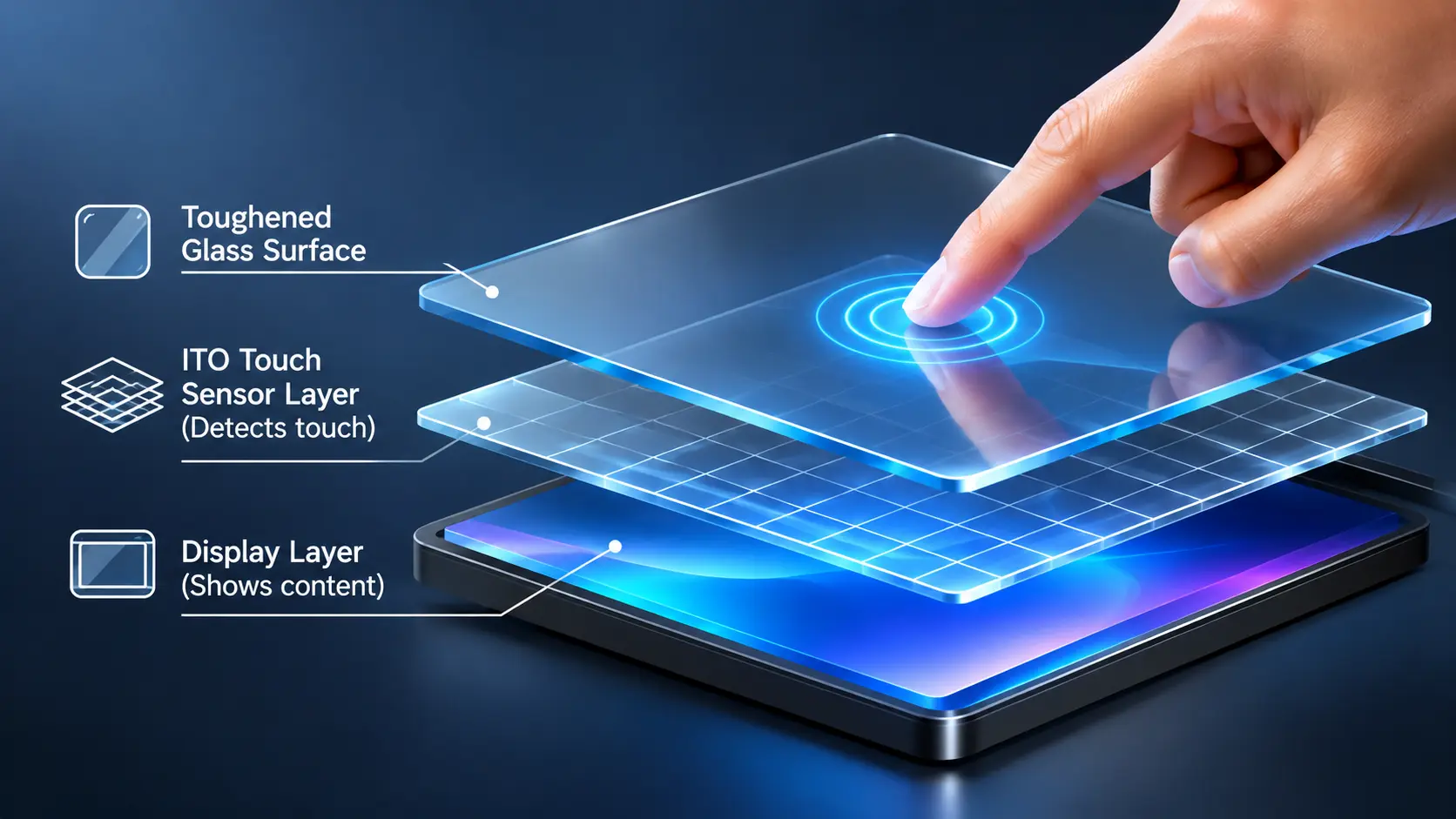
The multi-layered capacitive touchscreen has glass as the base layer. The glass layer is covered with indium tin oxide (ITO), which is conductive in nature. A small voltage is applied to this coating, which creates an even electric field across the screen.
When your finger touches the screen, it draws a small amount of that charge towards it.
This creates a small change in the electrical field at the exact spot you touched. The screen spots this change straight away.
In Surface capacitive screens, sensors sit at the four corners of the panel. Each corner measures how much current has moved. A controller compares these readings and works out the touch point.
Multi-touch screens or Projected capacitive screens (PCAP) go a step further. They use a fine grid of ITO electrodes arranged in rows and columns. The controller constantly scans every point where these lines cross. So, the screen can track two or more fingers at once. The pinch-to-zoom and swipe work in this fashion.
The touchscreen needs only a light touch. Capacitive screens are responsive, durable, and clear. And, that’s the reason why they’re used in smartphones, tablets, ATMs, and self-service kiosks.
What are the different types of capacitive touchscreen?
There are 2 types of capacitive touchscreens. And they are:
-
Surface capacitive – This is the simpler, older version.
And, they support single touch only. Therefore, businesses do not use them for complex tasks and requirements. -
Projected capacitive (PCAP) – The projected capacitive screens are widely used in modern kiosk machines.
The advantage of PCAP touchscreen is that they support multi-touch gestures like pinch-to-zoom and swipe. Hence, they are used for complex kiosk interactions.
Why capacitive touchscreen kiosks are ideal for retail and QSRs?
Capacitive touchscreens now sit at the heart of retail and restaurant self-service. I have listed the major applications below.
- Self-ordering kiosks in QSRs – Customers browse the full menu, customise their meal and pay in one go. Swiping through burger combos feels as easy as scrolling on a phone. Bright PCAP screens also make food photos look tempting.
- Self-checkout in supermarkets – Shoppers scan items, check prices and pay without waiting for a cashier. The responsive screen keeps queues moving during peak hours.
- Endless aisle kiosks – In fashion and electronics stores, shoppers can explore products that are not on the shelf. They can zoom into images, compare sizes and order for home delivery.
- Price-check and product information kiosks – Customers scan a barcode and see details, reviews and offers on a sharp, easy-to-read display.
- Loyalty and gift card kiosks – Shoppers can join loyalty programmes, check their points or buy gift cards in seconds.
- Drive-thru ordering – Outdoor capacitive screens with toughened glass let customers order without stepping out of the car.
Why do businesses prefer capacitive touchscreens?
Capacitive screens win on two fronts. They delight customers, and they make life easier for operators. Here are the benefits.
Customer perspective
- Fast, light response - A gentle tap is all it takes. Customers move through menus quickly, without repeated pressing. What they are searching for can be accomplished with few taps on the kiosk screen.
- Familiar feel - The screen behaves just like a smartphone. Even first-time users know what to do.
- Bright, clear display – PCAP (Projected capacitive) screens offer excellent clarity. Food photos, food menu, and other images look sharp and appetising. The feature is highly rewarding for restaurant and retail sectors.
- Natural gestures - Customers can swipe through menus or zoom into product details with ease.
Business perspective
- Longer life - The sensor sits behind glass, so there is no soft top layer to wear out. Fewer replacements mean lower running costs.
- Easier cleaning - The smooth glass surface wipes clean in seconds. That matters a lot in busy food outlets.
- Vandal resistance - Thick, toughened glass handles knocks and scratches.
- Stable accuracy - PCAP screens rarely need recalibration. So, your team spends less time on maintenance and more time on customers.
What are the applications of a capacitive touchscreen kiosk?
Capacitive touchscreen kiosks are used wherever people need fast, intuitive self-service. Some of the key sectors are:
- Retail – Self-checkout, product catalogues and endless-aisle browsing, price checks, loyalty sign-ups, and click-and-collect pickup.
- Food and hospitality – Self-ordering in quick-service restaurants and food courts, hotel check-in and check-out, and digital room keys.
- Banking and finance – Bill payment, cash deposit and withdrawal, cheque deposit, account opening, and card issuance.
- Healthcare – Patient check-in, appointment booking, queue management, insurance verification, and payments.
- Government and public services – ID and document applications, utility payments, permit renewals, smart city kiosks, and citizen information portals.
- Transport and travel – Airport check-in and bag-drop, ticket vending at metro and bus stations, parking payments, and car-rental pickup.
- Telecom – SIM card issuance with ID verification, recharges, and bill payments.
- Wayfinding and information – Interactive maps in malls, hospitals, campuses, and exhibitions.
- Education – Fee payments, student registration, library services, and campus directories.
- Entertainment – Cinema and event ticketing, gaming, and photo booths.
- Corporate – Visitor management, meeting-room booking, and for employee self-service.
How big is the capacitive touchscreen market?
The numbers speak for themselves.
As per the research conducted by Future Market Insights, the capacitive touchscreen market hit about USD 16 billion in 2024. It is expected to reach nearly USD 38.9 billion by 2034. That is a CAGR of 9.3%.
Some of the key findings of the research are shared below.
- The demand for affordable capacitive touchscreens connected with consumer electronics is on the rise.
- As more people adopt smartphones and tablets, demand for ITO-based PCAP touchscreens continues to climb.
- The high manufacturing cost of capacitance touchscreen can affect its wider adoption in price sensitive markets.
What are the drawbacks of capacitive touchscreens?
As you may know – no technology is perfect. Capacitive touchscreens too have certain limitations.
- The use of glove and stylus – Standard capacitive touchscreens require the use of finger (skin contact) or a conductive stylus.
- Water on the screen – heavy rain drops or water drops may confuse the screen which might signal a false touch.
- Higher upfront cost – compared to the resistive screen types, modern PCAP panel costs are on the higher side.
For indoor QSR and retail environments, rain water or the use of glove won’t be a problem.
The good news? Modern PCAP controllers can be tuned for glove use and water rejection. Hence, businesses have more options now.
Conclusion
Capacitive touchscreens have become the standard for modern self-service. They are fast, familiar, easy to clean and built to last. For retail and QSR brands, that means happier customers and lower running costs.
Undoubtedly, the brands that invest in quality touchscreens today will lead the self-service race tomorrow.
Panashi provides highly responsive and reliable touchscreen kiosks and interactive display solutions for a plethora of industries. We are an established capacitive touchscreen kiosk manufacturer in the Middle East, Africa, Europe, and Asia.
For any queries or support regarding kiosk installation, kindly get in touch with Panashi’s technical team.
Frequently
Asked Questions
Yes, Panashi provides capacitive touchscreen kiosks for a wide range of industries and businesses in Saudi Arabia. Let us know your requirements regarding the type of industry/business, number of units required, outdoor or indoor installation, etc. Our team will come up with the most feasible solution ASAP.
Yes. PCAP screens handle direct sunlight with ease, thanks to high-brightness panels and anti-glare, anti-reflective coatings. They are durable, and offer protection from scratches, impacts, and even vandalism. Industrial-grade PCAP screens can support temperature variations ranging from (-30 to 70) 0°C.
Wipe the screen with a soft microfibre cloth and a mild, non-abrasive cleaner. Isopropyl alcohol solutions are generally safe for most cover glasses. Never spray liquid directly onto the screen. Spray it onto the cloth instead. Avoid using harsh chemicals for cleaning the kiosk touchscreen.
There is no fixed price tag. Capacitive touchscreen prices vary with screen size, technology type – PCAP and surface capacitive, glass thickness, anti-glare coatings, vandal-proof protection, brightness levels, etc.
Yes. Panashi supplies capacitive touchscreen kiosks in Dubai and all the other Emirates. We offer touchscreen terminals and interactive display solutions for a plethora of industries in the Middle East. For prices and other queries, please visit our official Panashi website.