

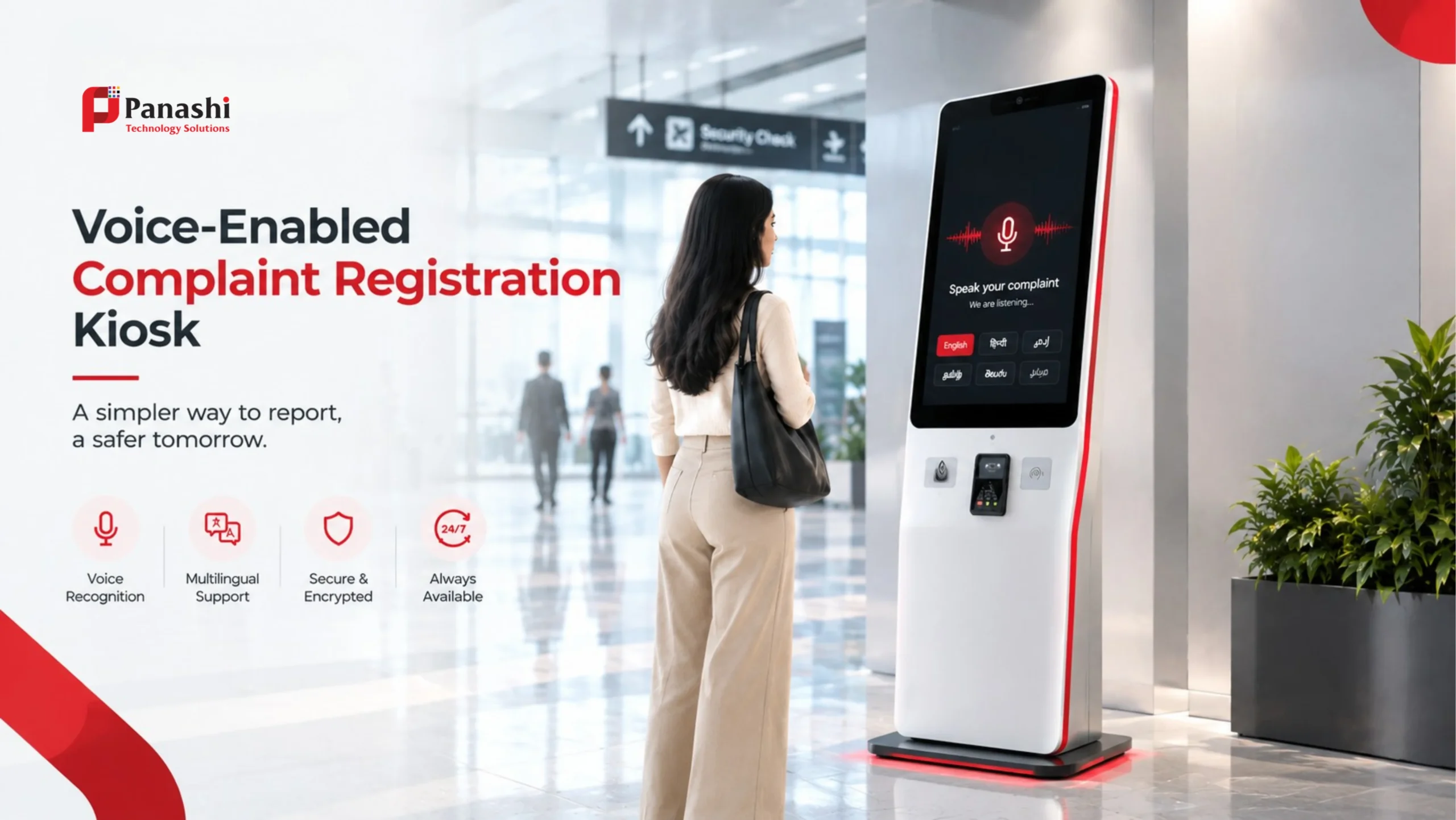
Voice-enabled Complaint Registration Kiosks for India’s Law Enforcement Agencies
Have you ever tried filing a police complaint in India? For many people, the very thought is stressful. You have to find the right police station, wait for your turn, explain the matter to an officer, and sometimes go back more than once before the complaint is even registered.
And for someone who can’t read or type confidently, even an online complaint portal can feel like a closed door.
What if you could just walk up to a kiosk and speak your complaint? No forms. No typing. No waiting.
Kindly read on to understand how voice-enabled complaint registration kiosks work, and why they matter for India’s law enforcement agencies.
What is a voice-enabled complaint registration kiosk?
In simple words, it is a self-service terminal that lets citizens register a police complaint just by talking to it. The kiosk asks a series of voice prompts, listens to the answers, and uses speech recognition to turn them into text.
The system then fills in a digital complaint form on its own, generates an acknowledgement, and sends the complaint to the right police authority. The citizen doesn’t have to type, write, or wait for an officer to take down the details.
Think of it as a police help desk that never closes, speaks your language, and keeps a clean digital record of every complaint.
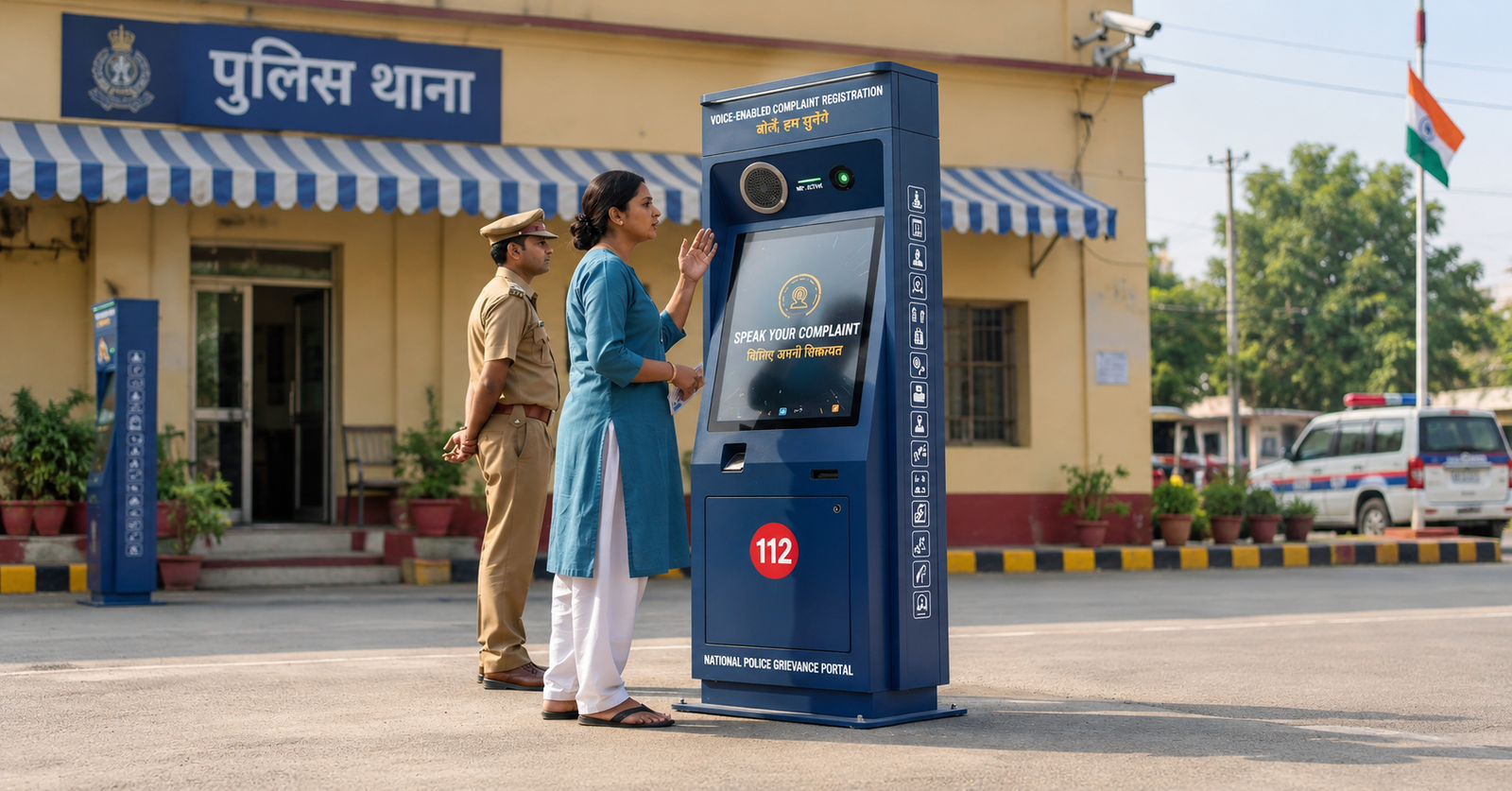
Key features of a complaint registration kiosk
- Touchscreen interface – an interactive touchscreen guides the user through the complaint registration process.
- Multilingual interface – the users can choose their preferred language for complaint registration.
- Microphone and camera – to capture complainant photo and record sessions.
- Printing device – instantly prints acknowledgement receipt.
- SOS or Emergency button – the user can make use of the SOS or emergency button for urgent help.
- Remote monitoring – the e-complaint kiosk can be monitored from a centralised location by a remote admin.
- CCTV – 24/7 surveillance.
How does the e-complaint kiosk work?
The complaint registration process via the kiosk is quite simple and straightforward. Let’s see how it goes.
- Select a language – the user selects their preferred language, either English, Hindi, Tamil, Telegu, Marathi, or any of the regional languages.
- Answer the voice prompts - the kiosk asks for the complainant information like name, contact number, the actual complaint, and where the incident took place.
- Speech becomes text - Speech recognition converts each spoken answer into text, which appears on the screen.
- Check before you submit - The kiosk reads the text back, so the user can confirm that everything was captured correctly.
- Automated form filling - The system automatically completes the digital complaint form.
- Get a unique ID and acknowledgment - Every complaint receives a unique identification number and a timestamp. The user also gets an acknowledgement slip with the complaint details, the police station assigned to the case, and a QR code to track its status.
- Secure storage - The complaint record is encrypted and sent to a central server.
That’s it. A few minutes, a few spoken answers, and the complaint is officially on record. Yes, it’s that simple.
What are the benefits of a voice-enabled complaint registration kiosk?
The value of a voice-enabled complaint kiosk becomes clearer when you look at it from both sides of the counter. Here are the benefits.
Citizen perspective
- No police station visits – Citizens can register a complaint via a kiosk machine deployed at transport terminals or other high traffic locations, without visiting a police station.
- Language not a barrier – the users can select their preferred language for complaint registration which is highly helpful for travellers, tourists, or other state visitors.
- Beneficial for the elderly and non-tech savvy - Since there's no typing or reading of complex forms, the kiosk works well for elderly citizens and people with limited digital experience.
- An anxiety-free, convenient first step - As you may know, many people hesitate to walk into a police station. A kiosk offers a less intimidating way to report an issue.
- Transparency - The unique ID, timestamp and QR code let citizens track their complaint instead of wondering what happened to it.
Law enforcement perspective
- Faster complaint processing – the complaint reaches the authorities almost instantly which avoids unwanted delays in complaint processing.
- Cleaner records - With every complaint captured in a standard digital format, there's no more struggling with poor handwriting, missing details, and manual entry errors.
- More policing time - When officers spend less time on paperwork at the front desk, they can focus on investigation and field duty. It also helps to improve the productivity of the police force.
- Built-in accountability - Timestamps and tracking make it easier to monitor response times and follow up on pending cases.
- Gather useful data and patterns on crime - Over time, complaint patterns by location and type can help police plan patrols and prevention efforts better.
Where to install a police complaint registration kiosk?
Law enforcement bodies and government agencies can install the e-complaint kiosk at multiple locations.
- Major railway junctions, bus terminals and metro stations – Lakhs of passengers visit high footfall railway and metro stations every day.
- Tourist hotspots and pilgrimage centers – People who visit tourist hotspots and pilgrimage centers are usually not aware of the nearest police station.
- Mall, markets, and retail centers – Petty crime, fraud, and other illegal activities are often reported in high-traffic commercial centers.
- Rural, city suburbs, and semi-urban areas – can be installed in rural or semi-urban areas where police stations are located far away.
Who can benefit from voice-enabled e-complaint kiosks?
In a general sense, the citizens can benefit from the e-complaint kiosk machines.
To be more specific:
- Travellers, visitors, or passengers - The passengers who visit the transportation hubs, like bus stations, metro stations, railway stations, etc. Now imagine a traveller who has just lost a phone at a crowded railway station, with a train to catch in 20 minutes. Visiting a police station is simply not an option.
- Person with disabilities - For someone who can't read or type confidently.
- Citizens with limited digital literacy – For citizens with inadequate digital literacy, sending an online petition could be a challenging task.
- Elderly citizens – For elderly citizens, visiting a police station or filing an online complaint may not be practical.
- Hesitant citizens – people who are hesitant to go to a police station can make use of a police complaint kiosk. This can include women, victims of sensitive crimes, first-time complainants, members of marginalized communities, etc.
- People with everyday complaints – victims of petty crimes, people reporting lost documents, residents reporting civic/public nuisance, missing person complaints connected with transit hubs, etc.
The e-complaint kiosk deployment in Visakhapatnam, Andhra Pradesh
In September 2026, the Visakhapatnam Police installed two voice-enabled complaint registration kiosks, one at the Visakhapatnam Railway Station and the other at the RTC Complex.
The main aim of the deployment was to make police services more accessible to the public.
The Home Minister of Andhra Pradesh, Anitha Vangalapudi, had inaugurated the kiosk launch event. During the kiosk launch she stated that the kiosk-assisted complaint registration would help to enhance speed and transparency of police services.
She added, “Passengers can now lodge complaint through the kiosk without approaching the police station. The system allows users to register their grievances through voice in Telegu, English and Hindi.”
She also stressed the importance of using technology in dealing with crimes and investigation.
The e-complaint kiosks are integrated with the state’s Public Grievance Redressal System (PGRS). The integration helps in faster handling and resolution of complaints.
Few practical considerations before a wider rollout
- Vandalism – For outdoor kiosk installations, the kiosk enclosures should be IP65/IP67-rated, so that the machine remains protected from vandalism and external elements.
- Misuse – Phone number verification and CCTV integration prevent prank complaints and false claims to a good extent.
- Privacy – Speaking a sensitive complaint aloud in public isn’t easy. A semi-enclosed booth can make users more comfortable.
- Upkeep – Kiosks that are installed in public places require regular kiosk maintenance to ensure service consistency.
Final Thoughts
With voice-enabled complaint registration kiosks, a citizen can now speak a complaint in their own language, confirm it on screen, and walk away with a trackable acknowledgement in hand.
All it takes is a few minutes.
If the Visakhapatnam rollout becomes a success, voice-enabled complaint kiosks could soon become a familiar sight across India’s public spaces.
Undoubtedly, the initiative from the Government of Andhra Pradesh will certainly help to bring the police a little closer to every citizen
Frequently
Asked Questions
You can report a wide range of issues via the e-complaint kiosk. These include theft, lost phones or documents, harassment, and missing persons.
The complainant gets an instant acknowledgement with a unique complaint number. The number can be used to track the complaint later. Many kiosks also print a receipt or send the details by SMS.
A well-designed kiosk stores complaint digitally and sends them through secure, encrypted channels. Only authorised police officials can access the complainant details.
e-complaint kiosks take police services beyond station walls and working hours. Citizens can file complaints at busy public spots, any time of day. This eases walk-in pressure at stations and frees officers for field work.
The kiosk uses the incident location the complainant shares through the kiosk machine. Based on jurisdiction mapping, the complaint goes straight to the station concerned. Senior police officials can view all the complaints on a central dashboard.