

Saudi Arabia’s Giga Projects and the Rise of Self-service Economy
Saudi Arabia is not just building new cities. The country is reimagining an entire way of life. The Kingdom’s Vision 2030 program is one of the most ambitious national transformation initiatives in modern history.
The program is designed to branch out the economy away from oil dependency. The initiative would position Saudi Arabia as a global destination for tourism, business, and innovation.
These mega-projects aren’t just about spectacular architecture or record-breaking tourism numbers. They’re creating a massive, fast-growing demand for smart technology. At the heart of this technological shift is the self-service kiosk and automation market.
In this blog, we’ll explore Saudi Arabia’s most exciting giga-projects and then zoom in on why the Kingdom is becoming one of the most promising self-service technology markets in the world.
The Giga Projects powering Saudi Arabia’s Transformation
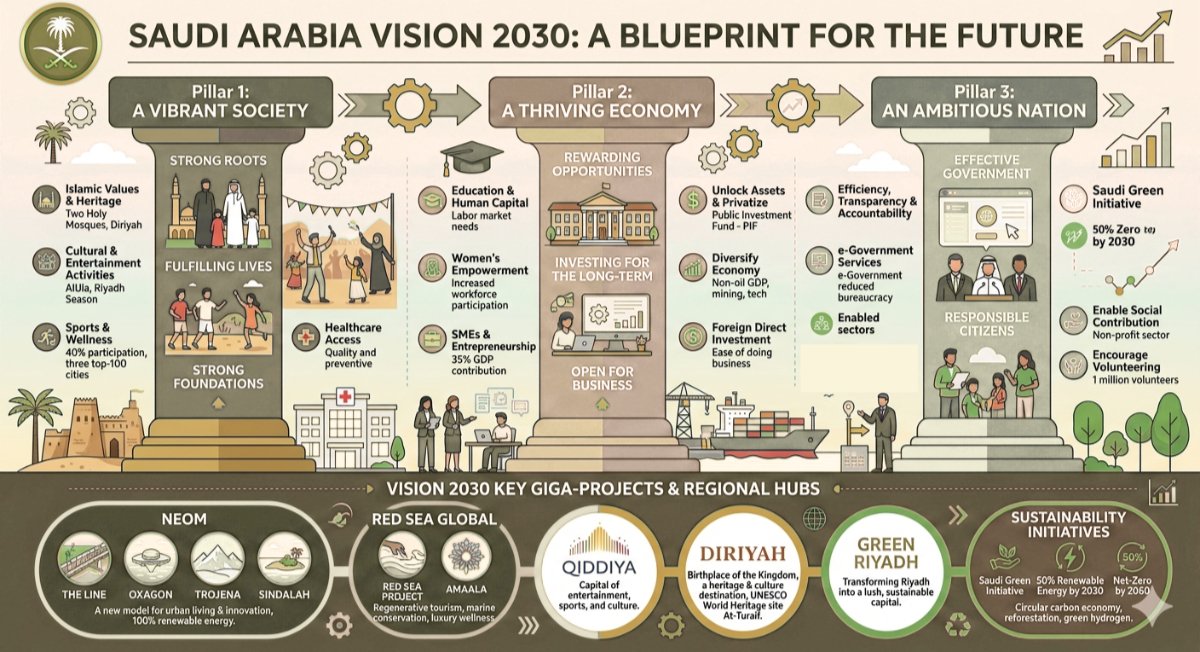
As part of the Vision 2030 program, Saudi Arabia has launched a series of infrastructure and development projects. They are commonly referred to as “Giga projects”.
Now, these are not ordinary real estate developments.
They are entire cities, ecosystems, and experiences being built from scratch, and are designed to attract millions of residents and visitors over the coming decades.
As of 2025, Saudi Arabia has more than 25 giga projects in various stages of construction, planning, and design.
The most anticipated infrastructure projects in Saudi Arabia are listed below.
Qiddiya
The Qiddiya City claims to be “the world’s first city built for play”, as per the information published on the Qiddiya official website.
Qiddiya is the city specifically meant for recreational activities, sports and entertainment. Yes, it is all about fun and energy. It’s a proven fact that entertainment and recreational activities are indispensable for our physical and mental well-being.
The city is easily accessible as it is located very close to Riyadh – the capital city. Located in the Tuwaiq mountains, Qiddiya is ideal for travelers, sports and fitness enthusiasts, bike lovers, and for all fun-loving folks. The entertainment city boasts of 400 local attractions, 12 theme parks, 275 rides, and 2000 art installations which makes it a must-visit for people of all age-categories.
Qiddiya City is a meeting point of art, entertainment, and cultural experiences – and is sure to make an impact on the world tourism map.
Diriyah
Located on the banks of Wadi Hanifah, in the outskirts of Riyadh, Diriyah is the perfect spot to explore and experience the cultural and historical past of Saudi Arabia. The city takes tourists into the olden times with neatly preserved streets, heritage spots and museums that offer a clear picture of the past.
A perfect destination for history enthusiasts, culture-explorers and solitude-seekers, Diriyah also offers wonderful culinary experiences too. The UNESCO-registered Al-Turaif World Heritage Site showcases palaces and mosques built out of mud bricks, reminiscence of the Islamic architecture.
Roshn
Roshn is a real-estate and infrastructure development project in Saudi Arabia and the project aims to improve the housing needs of the residents. By 2030, the project would build homes for 2.2 million residents. It is estimated that by the completion of the project, around 70% of the Saudi citizens would have their own homes. Of course, the ultimate aim of the Saudi government is to improve the quality of life of its citizens.
The residential communities built under the Roshn project satisfy the requirements and financial capabilities of a wide range of citizens, and hence they cater to all. Greenery embellishes public spaces and pavements, creating a pedestrian-friendly environment combined with all the necessary amenities for a peaceful and healthy life.
The residential communities included in the Roshn project are Sedra, Alfulwa, Alarous, and Warefa.
Sedra and Warefa are located in Riyadh, Alarous in Jeddah, and Alfulwa in the Eastern Province.
For more information regarding the Roshn, please visit :https://www.vision2030.gov.sa/en/explore/projects/roshn
NEOM
NEOM is an extensive region of land (around 26,000 sq kms), situated along the north-west of the Kingdom of Saudi Arabia, east of Red Sea and South of Jordan. It’s a futuristic giga-city project, located in the Tabuk Province, developed as part of the Vision 2030 initiative. And it’s huge – almost 33 times the size of New York city!
NEOM is a sustainability-friendly city that would be powered by renewable energy sources and it also boasts of zero carbon emissions. A global business hub with a people-first and nature-friendly approach – all set to revive smart urban living.
The project is expected to bring in investment funds in the domains of technology and innovation and would serve as a catalyst to project Saudi Arabia as a prominent global power.
The NEOM project is a community project that comprises travel, luxury and logistics destinations and they are listed below:
- The Line – a 170 km long stretch of land with zero carbon emissions, designed for travel and tourism industry.
- Oxagon – an industrial city located along the coast of Red sea, an ideal manufacturing ecosystem that supports technology, innovation and logistics.
- Trojena – known by the name of “Mountains of NEOM” – a mountainous terrain with plenty of hospitality and entertainment amenities, including skiing and other outdoor activities.
- SIndalah – A luxury island and yachting hub in the Red sea. Offers luxury tourism, entertainment, dining, shopping and golfing experiences.
Red Sea Global
A rich blend of marine ecosystem, mesmerizing beaches and archipelago comprising of more than 90 islands located at the west coast of Saudi Arabia, the Red Sea would boost the travel and tourism sector of the country. The region is spread across an area of 28,000 sq kms. Red Sea Global is also home to a variety of land terrains and formations like mountain canyons and dormant volcanoes offering a unique, enigmatic, out-of-the-world experience for the travelers.
Visitors who are into marine tourism may explore the world’s 4th largest barrier reef in Red sea. More than marine and beach tourism experience, there are enough stuffs to explore in a historical and cultural context too. Yes, it’s a complete package. Plenty of accommodation facilities – around 50 hotels, 8000 rooms, and 1000 residential properties, the region has no dearth of facilities.
For additional reading, please visit the official website of Red Sea Global.
“It is my pleasure to present Saudi Arabi’s vision for the future. It is an ambitious yet achievable blueprint, which expresses our long-term goals and expectations and reflects our country’s strengths and capabilities. “- Mohammed bin Salman
The Self-service kiosk market: Saudi Arabia’s next big opportunity
Now, here is where things get exciting for both businesses and investors.
All of these giga projects with their millions of expected visitors, residents, and daily transactions need smart, efficient, scalable service solutions.
And, that’s exactly where the self-service kiosk and automation market steps in.
Certain key market insights
Saudi Arabia’s interactive kiosk market is growing at an impressive pace, suggests recent market studies.
- According to the research conducted by Grand View Horizon, in 2024, Saudi Arabia’s interactive kiosk market revenue was valued at USD 951.3 million. By 2030, the revenue is projected to reach USD 1458.5 million at a CAGR value of 7.5%.
- IMARC Group conducted a study on Saudi’s retail market. According to their research, in 2025, the retail market in Saudi Arabia was valued at 293.6 billion. By 2034, the value is projected to reach 411. 7 billion, achieving a CAGR of 3.83%.
- In 2024, Saudi Arabia contributed 2.7% to the global interactive kiosk market revenue.
The major industries that implement self-service kiosk terminals in Saudi Arabia are listed below.
- Healthcare
- Hospitality
- Education
- Retail
- Food and Beverage
Why the Giga Projects are driving self-service demand?
Considering the scale of these projects, it is not feasible to rely on manpower alone to streamline the day-today operations.
The projects have the potential to attract visitors not only from the middle-east but the entire globe.
How would the authorities manage millions of visitors to Qiddiya when it opens 12 theme parks and 275 rides? And how about the ticketing, food-ordering, and retail operations?
How would the everyday transactions go about in the futuristic NEOM?
How would the hospitality sector operate in the Red Sea Global? How would they manage check-ins, concierge services?
Self-service kiosk automation is the most feasible solution to effectively handle these challenges.
The versatile and durable kiosk machines available in outdoor, indoor and semi-outdoor design formats would play a key role in handling those operations.
Here’s why these projects are natural catalysts for kiosk adoption.
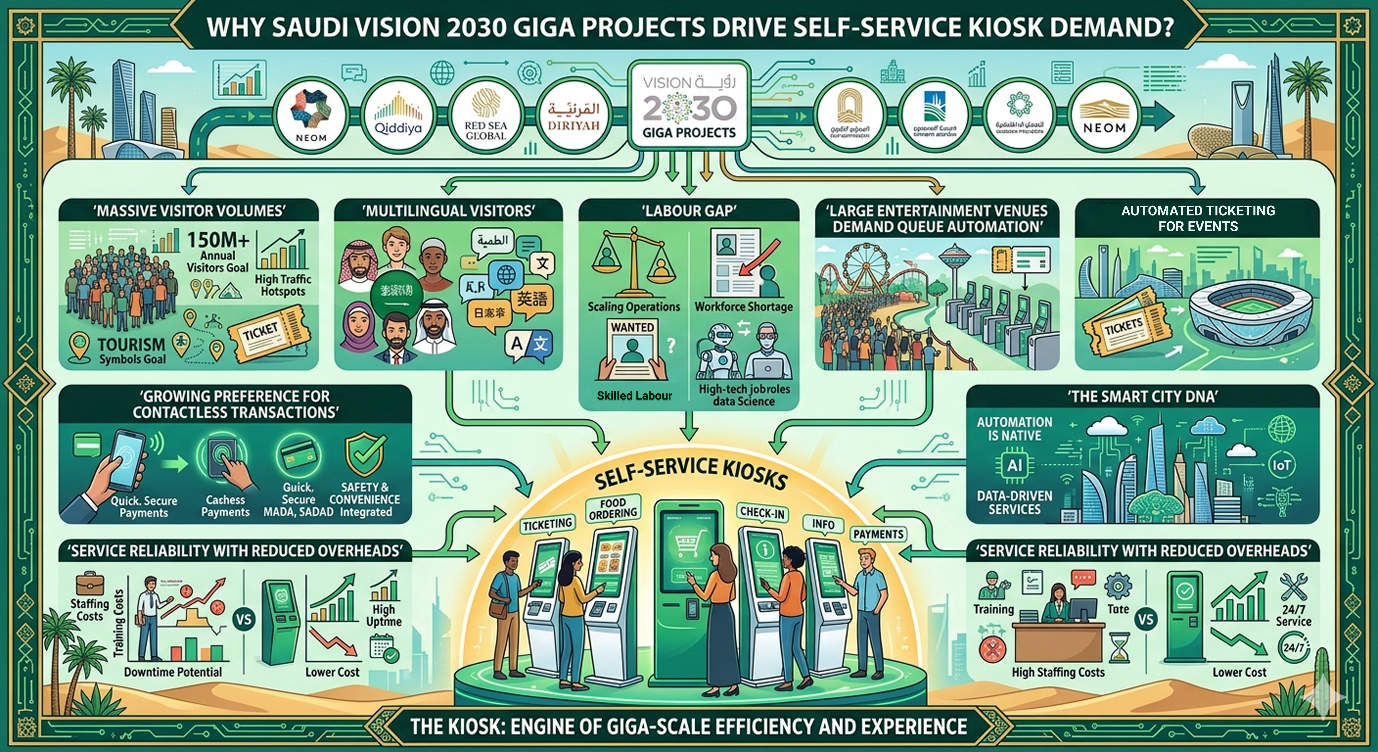
Massive visitor volumes – Saudi Arabia’s tourism sector is targeting a whopping 150 million visitors annually, by 2030. Projects like Qiddiya and Red Sea Global are designed to attract visitors in huge numbers. When these visitors occupy airport terminals, retail establishments, malls, smart cities etc, it becomes extremely difficult to manage this visitor volume via human-staffed counters alone. Kiosks terminals offer speed, scalability, and 24/7 availability. They serve as viable solutions to manage check-ins, wayfinding, guest registrations, food-ordering etc.
Multilingual visitors – it’s almost impossible for a front-desk agent to manage Arabic, Mandarin, Hindi, Spanish or any other language all by himself. Self-service kiosk machines are equipped with multilingual interfaces which eliminate language barriers. The users can easily select their preferred language for the purpose of kiosk navigation. This improves the overall Guest Experience.
The advanced AI-powered kiosk machines are one step ahead as they facilitate voice-based interactions. To add on, AI-powered systems can provide personalized recommendations and real-time translations for international visitors.
For example: AI-powered Voice recognition is implemented in drive-thru restaurants to facilitate a touch-free, food-ordering experience. The customers can engage in human-like conversations with the kiosk, and order their preferred food in less time, eliminating the long lines.
Labour gap – A lack of skilled labour force, a comparatively lesser population, and the need for a large-scale transformation, will have implications for Saudi Arabia’s labour market. Self-service kiosk providers and manufacturers can seize this structural gap as a long-term market opportunity. Rather than positioning kiosks merely as convenience tools, they can reframe them as essential workforce infrastructure.
The Saudi Nationalisation Scheme or Nitaqat is a government policy that directs private companies to hire a minimum percentage of Saudi nationals as part of employee recruitment. Certain service-related roles connected with giga projects might not be able to attract national talents. And, the scenario is quietly likely to create labour shortages.
Thus, project operators, especially in the hospitality and entertainment sectors, can leverage self-service kiosk technology to deal with such scenarios.
Large entertainment venues demand queue automation – Events and large venues nowadays make use of AI to reduce queuing times, and improve navigation. This improves Visitor Experience.
Qiddiya- Saudi Arabia’s entertainment and cultural destination features amusement parks, cultural venues, sport facilities, and more. Here, ticketing kiosks, self-checkout stations, and interactive wayfinding units serve as reliable and efficient operational infrastructure.
Growing preference for contactless transactions – The post-pandemic world has shifted consumer expectations. Guests appreciate contactless, self-directed interactions rather than spending time at a manual counter or reception.
The Smarty City DNA – NEOM is referred to as the world’s first cognitive city. It makes use of AI, robotics, and human-machine integration to offer improved predictive intelligence and faster decision-making. NEOM’s futuristic urban environments are predicted to outperform the present-day smart cities by collecting user behaviour data and applying AI to anticipate people’s needs. Here self-service kiosks are not an add-on, they are the primary service layer.
Service reliability with reduced overheads – Kiosk automation helps businesses maintain exceptional service quality while managing operational expenses.
Conclusion
Saudi Arabia’s giga projects are not just a real estate initiative or building cities. In fact, these projects are building entirely new economies, new customer behaviours, and new technology ecosystems.
Whether it is the entertainment wonder of Qiddiya, or the historic magic of Diriyah, or the marine splendour of Red Sea Global, each project generates huge demand for smart, scalable solutions.
Right now, Saudi Arabia presents one of the most exciting market opportunities for businesses in the self-service kiosk and automation industry. A supportive government, robust digital infrastructure, changing customer preferences towards cashless and contactless operations create a highly favourable environment for kiosk manufacturers and integrators.
Whether you are a technology provider, an investor, or simply a curious observer, now is the right time to pay close attention to Saudi Arabia’s self-service market.
Frequently
Asked Questions
Saudi Arabia's Giga Projects are large-scale infrastructure and development projects launched under the Vision 2030 program. The major ones include:
- NEOM
- Qiddiya
- Diriyah
- Red Sea Global
- Roshn
These projects are designed to diversify the economy, attract global tourism, and create entirely new urban ecosystems built from scratch.
Several industries in Saudi Arabia make use of self-service kiosks to streamline their operations and improve Customer Experience. Healthcare, hospitality, retail, education, food and beverage, and banking are the key industries. As the Giga projects become fully operational, the demand for automated kiosk machines are expected to rise significantly.
Of course, we do. Panashi designs purpose-built kiosk solutions that are capable enough to transform the retail experience across the GCC. From self-checkout to wayfinding, bill payment, Virtual Fitting and Try-on Kiosks, our kiosk solutions enhance CX and ensure leaner operations. Whether you're a standalone retailer, a franchise chain, or a large shopping mall operator, Panashi has the right kiosk solution for your needs.
Absolutely! Panashi is fully equipped to supply kiosk machines in large volumes to support Saudi Arabia's Vision 2030 initiative. Here's how we can help:
- end-to-end kiosk solutions designed for large-scale deployments across government, retail, hospitality, healthcare, etc.
- purpose-built kiosk solutions with Arabic-language interfaces, high-temperature durability for outdoor deployments, and compliance with regulatory standards.
- Diverse kiosk portfolio from self-service payment to healthcare, charity, wayfinding, etc.
- operational and logistical readiness to handle large-volume, multi-site rollouts efficiently.
- full after-sales support, including installation, maintenance, software integration, and on-ground technical assistance.
Yes indeed. We supply ticketing kiosks for mega events, festivals, exhibitions, etc in Saudi Arabia. We designed and engineered ticketing kiosk terminals for the renowned Sheikh Zayed Festival held in Abu Dhabi. The kiosk solution streamlined ticketing services 24/7, reducing congestion at the entry gates.