

Kiosks vs. Mobile Apps: What Africa's Consumers Actually Prefer — and Why Both Matter
What does the future of service delivery look like across Africa’s high-growth economies? Is it a smartphone in every hand or a self-service kiosk at every corner?
Africa’s digital transformation story is more nuanced than you think.
Mobile penetration is climbing in Africa. Even self-service infrastructure is on the expansion phase. The technology providers, retailers, banks, and government agencies face a pivotal question: do you build for the phone, the kiosk, or both?
The answer, backed by data and lived reality across the continent, is clear. Africa’s consumers don’t choose between kiosks and mobile apps. They use whichever channel works best for them in that moment, in that location, for that transaction.
Hence, smart technology providers are building for both, and they are winning too.
Why Does Africa's Digital Landscape Demand a Different Conversation?
Most global discussions about self-service technology are shaped by North American or European realities. A mature digital infrastructure, over 95% smartphone penetration, populations comfortable with app-based interactions – you know it!
Africa is a different landscape entirely. Therefore, it demands a different strategic conversation.
Now, consider these numbers.
- 416 million people now use mobile internet in Africa. Even then, 75% of the African population remains unconnected – reveals GSMA Mobile Economy Africa 2025 Report.
- Mobile internet penetration in Sub Saharan Africa reached only 27%, by the end of 2023. However, the vast majority of the population lives within mobile network coverage range.
- A striking 60% usage gap persists in Sub-Saharan region. Expensive devices, unaffordable data plans, limited digital skills contribute towards this gap.
- 14% of the African population lacked mobile broadband coverage, as of 2024. The percentage rises to 25% in rural areas.
- As of 2024, 57% of the city dwellers used internet compared to 22% of rural residents. This is a clear indication of urban rural divide.
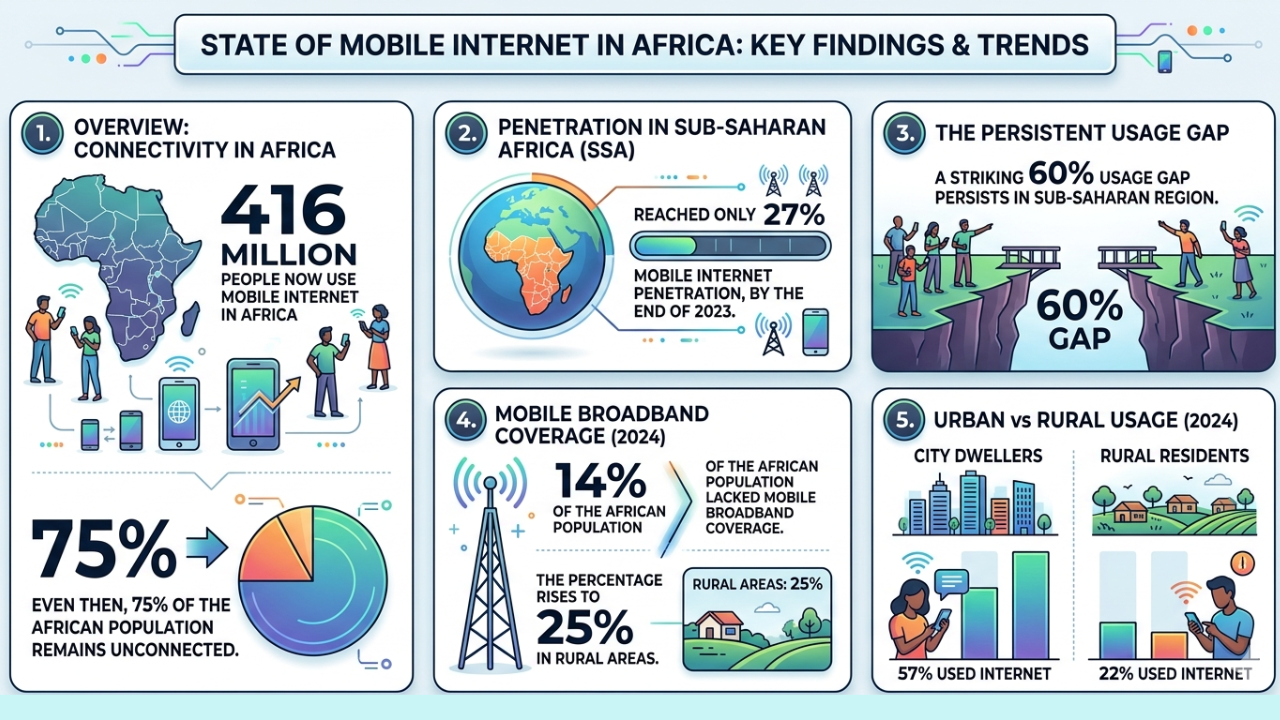
Actually, what listed above are not failure statistics. It’s the ground reality. The technology providers and businesses should be aware of the same.
The key takeaway is that a mobile-app-only strategy leaves a significant portion of potential customers behind. Whereas, a kiosk-only strategy misses the urban, smartphone-savvy majority. The winning approach is omnichannel, human-centred, and built for the full spectrum of African consumers.
Where Mobile apps Win?
Africa, in many respects, is a mobile-first continent.
The fixed broadband market penetration in Africa is estimated to be around 1%, which is considered very low. It is evident that mobile is the dominant pathway to digital services, in most regions.
According to Mordor Intelligence market study, the market size of fixed broadband internet, as of 2025, was USD 7.65 billion. By 2030, the value is estimated to reach USD 13.44 billion, achieving a CAGR of 11.94%.
Where mobile apps have a clear edge:
Financial services and payments – Africa leads the world in mobile money adoption. Kenya’s M-Pesa and Nigeria’s OPay have expanded across the continent, embedding mobile payments into the daily economic lives of millions of African users.
As per the survey conducted by GeoPoll (2025), 98% of the survey respondents across Ghana, Kenya, Nigeria, and Uganda were active smartphone users. This means a near-universal adoption.
Favourable Youth demographics – 70% of the African population are under the age of 70, which shows the representation of a young and vibrant youth. Young consumers based in Africa’s urban centers are comfortable with app-based interactions connected with banking, shopping, food delivery, and government services.
Speed and convenience for repeat users – mobile apps excel when it comes to frequent, less complex transactions. For example: checking a balance, reordering a product, or booking a ride, etc. Here, the user already knows what they want, and just needs the path to be short.
Improved Data and personalisation – Mobile apps build a detailed user profile based on multiple aspects like previous purchases, browsing history, location, preferred products or services etc. They continuously collect and remember user information over multiple uses. This allows them understand user behaviour and personalize the experience.
Where Kiosks Win
Here is the strategic reality that many technology providers underestimate.
A significant percentage of the African population is either unable or unwilling to perform transactions exclusively via a smartphone.
Self-service kiosks are not a backup channel for these consumers. In fact, they are the primary channel.
Where kiosks have a decisive advantage:
- The unbanked, underserved consumers – When it comes to world’s digital divide, Africa occupies the first position. An estimated 900 million people in Africa are not yet online.
Most of these consumers live in peri-urban and rural areas.
A kiosk machine deployed at these locations would serve as the most accessible point of contact for the unbanked and underserved.
The automated kiosk terminal helps these consumers to access various services related to governments, banking, healthcare, and more.
- Device cost, data expenses – Of course, smartphone penetration is climbing in Africa. However, smartphone prices and data costs remain a barrier for a significant percentage of the population.
The digital divide is evident in Sub Saharan Africa. GSMA’s study on mobile internet usage among adults in rural and urban areas is useful to understand this divide. The study points out a 49% reduction in mobile internet usage of rural adults when compared to urban adults.
According to GSMA report, 350 million people worldwide are devoid of mobile internet. And, half of this figure lives in the Sub-Saharan region.
A self-service kiosk removes the device and data cost barriers entirely.
No device ownership required, no data plans needed too.
-
High-stakes, first-time transactions – Kiosk machines are far more welcoming than mobile apps when it comes to complex, high-value transactions. The larger screen, guided interface, and physical presence of a kiosk reduce anxiety and error rates.
For example: While performing tasks like opening a bank account, registering for a government service, users feel far more relaxed and confident, when it becomes kiosk-assisted. - Literacy and digital skill gaps – Digital literacy varies across Africa's 54 countries and countless communities. Kiosks with intuitive, icon-led interfaces and local language support capability serve populations that are not yet comfortable navigating a smartphone interface.
- Healthcare access in underserved areas - Health kiosks are gaining significant traction in Nigeria, South Africa, and Kenya, offering various diagnostic services. This includes blood pressure, glucose, BMI, ECG, etc. Mobile apps cannot serve as an alternative to these kiosk machines. Healthcare kiosk machines are highly effective in areas where specialist medical staff are unavailable or limited.
Are Kiosks and Mobile Apps Competing — or Complementary?
For Africa’s most successful technology deployments, kiosks and mobile apps are not rivals competing for the same users. They complement each other by serving different segments of a diverse population. They also support the same customer at different stages of their journey.
For example: Consider a retail bank expanding across West Africa. In Lagos or Nairobi, their urban, smartphone-owning customers use the mobile app for daily banking. In peri-urban areas, a kiosk machine installed at a high-footfall location, handles account opening, cash deposits, and bill payments for customers who have never downloaded an app. Both serve the bank’s mission of financial inclusion. This means, neither is sufficient alone.
You can even consider another example, this time – government.
A government agency offers a plethora of citizen services. A mobile app serves urban users who need to renew documents or access records. Government kiosk machines deployed in post offices, markets, and transport hubs serve the broader population. This includes the elderly, the rural, and the digitally excluded who need the same services but who are less likely to use a smartphone for the same.
What Should Africa's Technology Providers and Businesses Do?
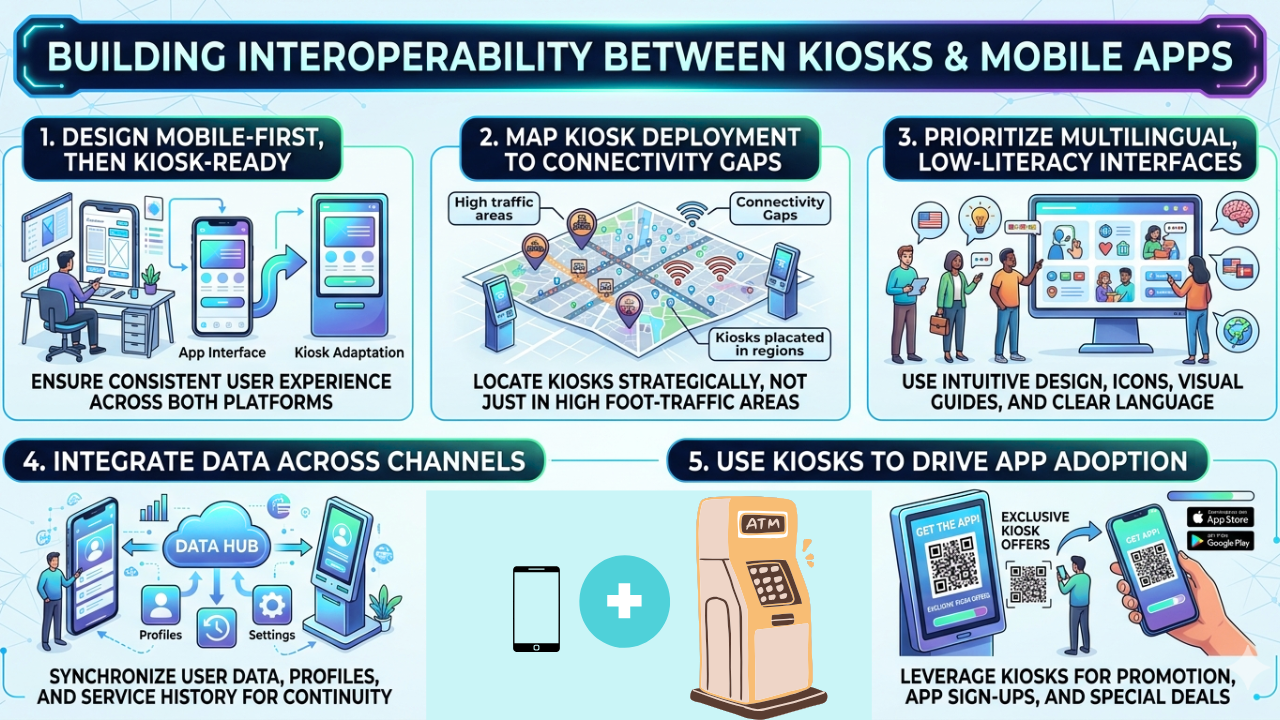
Whether you are a technology solutions provider, an innovative startup, or an established enterprise serving African markets, the opportunity lies not in choosing one channel over the other — but in building interoperability between them.
Here is what to do:
- Design mobile-first, then kiosk ready – Your core service logic should be platform-agnostic. This allows the same transaction flow to be surfaced through a smartphone app or a kiosk interface without rebuilding from scratch.
-
Map your kiosk deployment to connectivity gaps, not just foot traffic – High footfall regions matter. Equally important is deploying kiosk machines at locations of reduced mobile connectivity and smartphone ownership.
For example: A kiosk in a well-connected urban mall adds convenience. While, a kiosk installed in a community health centre fills a genuine service gap. - Prioritise multilingual, low-literacy interface - Africa is home to thousands of languages and wide literacy variation. Local language support is crucial. Instead of a text-heavy interface, prioritise visual aids like icons, audio assistance, and easy navigation. This helps users with limited reading, writing or digital skills navigate the kiosk interface.
- Integrate data across channels - A user/customer who begins an onboarding process at a kiosk should be able to continue it on a mobile app, and vice versa. Data portability between channels removes friction and builds loyalty.
- Use kiosks to drive app adoption – Businesses can use kiosk interactions to introduce their customers to mobile apps.
For example, when a customer uses a kiosk, the kiosk can:
- display or print a QR code that opens the app download page
- help the customer install the app
- connect the customer’s kiosk account with their mobile app account
- guide them on how to continue future services through the app
Which industries are leading the Kiosk-Mobile shift in Africa?
Retail and e-commerce – major grocery chains and retail operators are deploying kiosks for endless-aisle browsing, price checking, and self-checkout. Retailers in Africa use mobile apps for a wide range of purposes like product delivery, shopping, pre-ordering and personalised promotions. Carrefour, one of the world-leaders in food commerce, launched Kenya’s first self-checkout to expedite the checkout process.
Banking and financial services – The South African digital-only bank named GoTyme Bank and Kuda in Nigeria are showing how digital-first banking can scale rapidly. However, the banks that achieve true financial inclusion are the ones that combine app-based services with physical kiosk touchpoints to effectively reach underserved communities.
Healthcare – Diagnostic and patient check-in kiosks are transforming primary healthcare in Nigeria, Kenya, and South Africa. And, they are complimenting mobile health apps used by more connected urban patients.
Government and citizen services – With the implementation of national digital identity systems like the Huduma Namba in Kenya, Bank Verification Number in Nigeria (BVK), governments now have far effective ways to streamline public services. Both kiosks and mobile apps are becoming critical front ends for government service delivery, while each platform reaching different citizen segments.
Hospitality and food service – Self-ordering kiosks are expanding in urban African restaurant chains, reducing wait times and improving operational efficiency. While mobile apps handle pre-ordering, loyalty, and delivery.
World-renowned restaurant chains like Mc Donald’s has a full-fledged store in Casablanca, Morocco, with automated ordering facility.
The South Africa-based seafood restaurant chain Ocean Basket, at their Rosebank store in Johannesburg makes use of countertop restaurant kiosks to improve the food-ordering experience.
The Bottom Line: Africa’s Digital Future is Omnichannel
Africa’s consumers don’t live in a single channel. They live in a complex, dynamic environment where connectivity, device access, digital literacy, and service availability vary immensely. The technology providers and businesses that will win this market are those that meet consumers wherever they are. Whether your customer is on a smartphone in Nairobi’s CBD, or at a kiosk in a Lagos market, your business should be able to connect.
Kiosks and mobile apps are the two strongest tools in Africa’s self-service toolkit. Deploying them together intelligently, inclusively, and with genuine understanding of local consumer reality would help to transform the African economy.
Looking to deploy self-service kiosk solutions across African markets? Connect with Panashi’s kiosk solution partner in Africa ASAP.
Frequently
Asked Questions
Yes. The evolution of tablet-based and modular kiosk hardware has made entry-level kiosk deployment significantly more affordable. Many SMEs across Africa are deploying kiosk solutions for customer queuing, payment processing, and product browsing at a fraction of the cost of traditional infrastructure.
Yes. We provide customised kiosk solutions in Kenya and other East-African countries. We have an authorised franchisee to handle our operations on our behalf in Africa.
Of course. We supply kiosk machines in Nigeria in all design formats and customisation for banking, healthcare, governments and several other industries. Let us know your requirements including the number of machines, so that our team can work out the best deal.
Yes, the trust is growing rapidly among the African customers. With banking kiosks already leading the global self-service market, and mobile money embedded in consumer behaviour across sub-Saharan Africa, African consumers are increasingly comfortable completing financial transactions through self-service channels. Having a clear interface, credible branding, and transaction confirmation would help to improve trust.
The answer depends on your primary customer segment. If your customers are urban, smartphone-owning, and transact frequently, start with a mobile app. If your customers include peri-urban or rural populations, first-time service users, or demographics with limited smartphone access, kiosks deliver better results. For most African businesses with ambitions to serve the full market, the answer is to plan both from the start and build for interoperability.