

Smart AI Vending Machines – Features and Benefits (2026)
Gone are the days of product jams and delays when customers are unable to dispense their desired products from vending machines.
A new generation of vending machines – the AI vending machines – are quietly rewriting the rules, especially in the retail and hospitality sector.
Artificial intelligence has entered the vending industry, and the impact is bigger than most people realise.
This blog explores how AI vending machines work, what makes them fundamentally different from their predecessors.
Here is why forward-thinking businesses and vending operators should consider making the switch.
What is an AI Vending machine?
An AI vending machine is a next-generation retail solution that combines AI, Computer Vision, smart sensors, and seamless connectivity to dispense a wide range of products. The result is a faster, smarter, and far more personalised buying experience.
Smart AI vending machines can identify products through built-in cameras and computer vision. These machines can track inventory levels in real time and deliver personalised interactions through intuitive digital interfaces.
For operators, this means tighter inventory control, fewer stockouts, and data-driven decision making. For customers, it means a seamless, self-service retail experience — with the right product, available at the right time.
What are the features of an AI vending machine?
Here are the key features of an AI vending machine.
- Computer Vision-assisted product recognition – the built-in cameras and AI identify the item/s picked by the customer.
- Grab and Go checkout - Customers can open the machine door, grab the preferred product or multiple products, and simply leave. The payment is automatically charged through customer’s payment method.
- Multiple payment modes – the users can make use of diverse payment modes like card, mobile wallets like Apple Pay or Google Pay, QR payments etc.
- Remote monitoring – A backend admin can monitor multiple aspects related to inventory, sales and operations like inventory status, machine health, temperature etc.
- Real-time inventory tracking – the machine monitors the stock levels 24/7, and alerts the operators when items are running low or need refill.
- Personalised recommendations – offers personalised product recommendations and promotions.
- Data and Analytics – offers useful business-related insights to the operators like peak-hour usage, best-selling item, SKU-based revenue, purchase trends, patterns etc. through an Analytics dashboard.
- Product selling flexibility – AI vending machines can sell a wide range of products like cosmetics, electronic accessories, pharmacy items, etc. thus not limiting sales to snacks and drinks.
What are the benefits of an AI vending machine?
I have listed below the benefits of AI vending machines in both the business and consumer perspectives.
Business perspective
- Better control over the inventory – the businesses can track the inventory in real-time, which reduces out-of-stock scenarios. You receive instant notifications or alerts regarding stockouts. When the stocks are replenished effectively, better the sales.
- Acquire customer insights – Smart vending machines offer crucial information regarding customer preferences, frequently ordered products, etc.
- AI-assisted demand prediction – the AI analyses purchase trends over a period of time. Based on the data, the business can tweak or adjust the inventory, as and when needed. Data-assisted inventory control prevents both overstocking and understocking scenarios.
- Minimize wastage – the stocks remain accurate based on demand prediction. This helps businesses effectively control wastage.
- Improved sales – the business gets to sell multiple products in a single transaction, which improves product sales.
Consumer perspective
- Improved convenience – the customers get the desired product/s in less than 30 seconds. No mechanical issues like coin jams,
- Save time – Of course, fast and reliable operations save customer’s precious time, particularly in transportation settings like airports, transit hubs, hospital facilities, etc.
- Personalised product recommendations – based on user history or preferences, the smart AI vending machine is capable of offering personalised product recommendations or suggestions to the customer.
Compare traditional vending machine with AI vending machine
You may make use of the below comparison to understand the differences between traditional and AI vending machines.
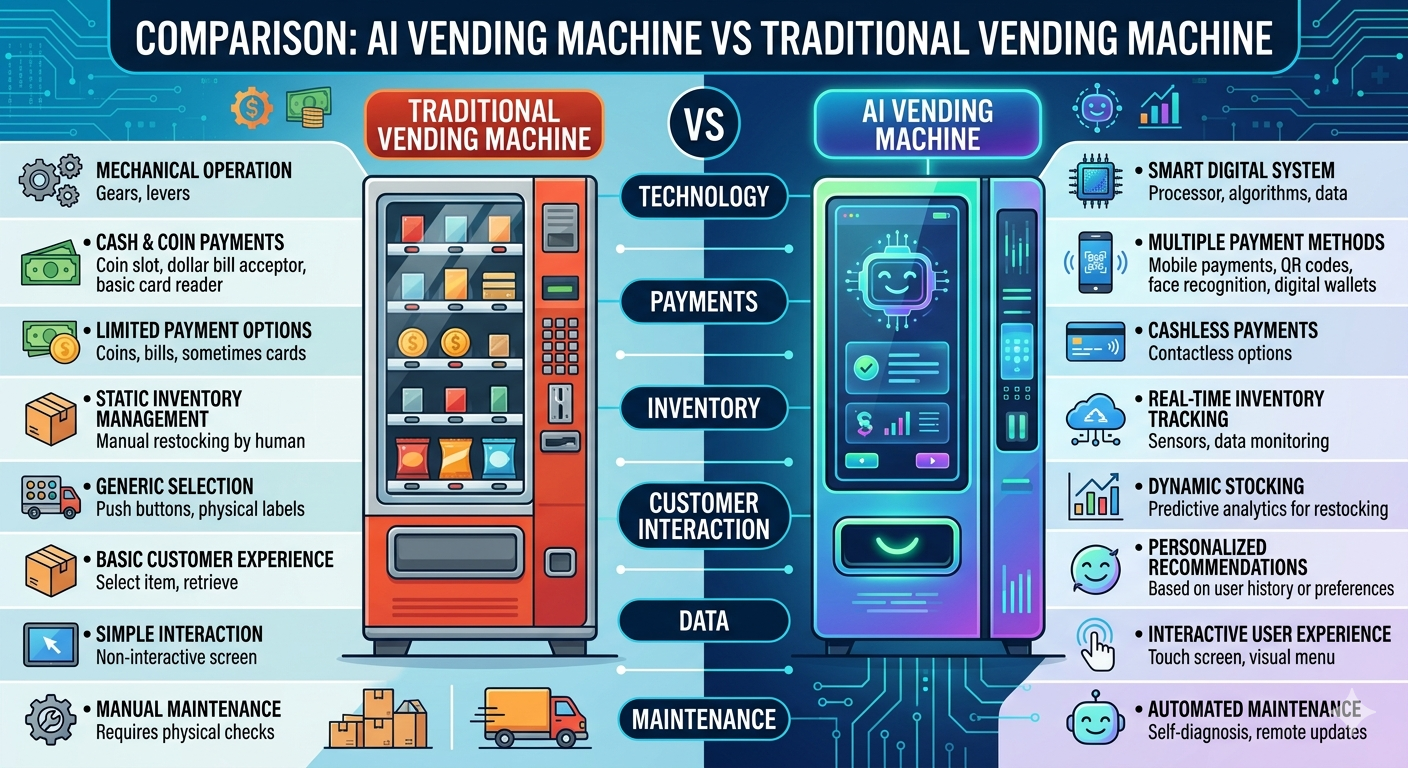
Technology used
Traditional vending machines make use of basic electromechanical systems, sensors, and product dispensing mechanisms. Once the product is selected, and payment is verified, the machine activates its dispensing mechanism. You might have seen the rotating spiral coil system that rotates the coil to push the product forward, until it gets dropped in the collection area.
Great to see them moving, isn’t it?
Elevator systems are used to handle more fragile products, to avoid the impact of dropping.
Once the product is dispensed into the collection area, the user opens the collection door to collect their purchased item.
On the other hand, Smart AI vending machines are much sophisticated. They make use of multiple technologies like AI, Computer Vision, machine learning algorithms, cameras, weight sensors, etc. to automate and optimise operations.
User interface
The user interface of a traditional vending machine consists of keypads, buttons or touchscreens, that allow the customers to select their desired product. In most cases, the users select a product by entering a code or pressing a button.
Whereas, AI vending machines are loaded with an advanced touchscreen interface with excellent customer-centric features like intuitive navigation, product search, personalised product recommendations, etc.
Advanced AI vending machines offer the “Grab and Go” experience with minimal user interaction.
Payment
Traditional vending machines accept payments in cash, coins, debit/credit cards, or mobile app payments.
Smart AI vending machines support a wide range of digital payments including contactless cards, mobile wallets, QR code payments, biometric authentication, and app-based payments.
Inventory management
If you own or operate a traditional vending machine, you know it. The machine should be regularly restocked and maintained by a service agent. Depending on the foot-traffic, historical demand, special days, you need to physically inspect the stock levels. If your customers find multiple product spirals empty or a fully sold-out machine, it’s bad for your business!
Whereas, an AI-powered vending machine offers real-time inventory tracking with the help of cameras, sensors, and AI. The technology-packed system automatically generates low-stock alerts, predicts demand, and even optimises replenishment schedules.
Data & Analytics
You don’t receive much data from the traditional vending machines. The operational data mainly involves sales transaction and machine status data.
Whereas, a smart AI vending machine offers a plethora of data related to customer behaviour, product performance, purchase trends, etc. Businesses can make use of this data to tweak their operations, product categories, and marketing strategies.
- Reduced order errors – Customers can access the kiosk machine, take their time, go through the menu options, perform the needed customization, and even confirm the order before making the payment. Hence, any chances of order-related errors are reduced to a great extent.
- Modifying the portion sizes – Customers can even adjust or modify the portion sizes to their preferences, reducing chances of uneaten food waste
- Real-time inventory management – the kiosk terminal can be integrated with Restaurant inventory management systems, thereby, restaurants can promote meals based on inventory levels. For example: items that are closer to expiry date, can be promoted on the menu, or offered at a discounted rate. This reduces chances of food waste.
- Data-driven menu adjustments – restaurants can gather powerful insights related to customers preferences, and make use of these insights to optimize menu items. For example: From most popular dishes to the less-ordered ones, restaurants can effectively track customer preferences, and modify recipes and source ingredients accordingly.
AI vending machine – use case scenarios
Businesses, retailers, restaurants and even governments can install AI vending machines in all high foot-traffic areas.
- Retail stores – AI vending machines can serve as additional sales channel in a retail environment. This helps to reduce retail queue and congestion.
- Airports – 24/7 instant access to essentials, food, and beverages in high-footfall transit spaces.
- Malls – mall visitors go for impulse purchases when the purchase process becomes fast and convenient.
- Corporate dining areas – fast, unattended access to snacks, drinks, or meals for employees throughout the day.
- Education institutions – offer students and staff convenient access to refreshments and essentials without requiring additional staff.
- Healthcare institutions – round-the-clock availability of food, beverages, and personal care items for patients, visitors, and staff, avoiding counters and dedicated staff.
- Smart city projects – offer data-driven, retail self-service platform that aligns with smart city’s connected infrastructure.
How does an AI vending machine work?
The way these smart vending machines work is pretty interesting.
- At first, the customer is authenticated – the customer walks towards the machine, scans a QR code, or taps a debit/credit card, or uses a mobile app to unlock the machine. Here, the customer’s payment method is authenticated within few seconds.
- Customer selects the product/s – The customer opens the machine door (some brands offer automatic door-opening) and picks the desired item/s.
- AI recognizes the selected product/s – The technology plays the crucial role here. Multiple AI cameras and dedicated sensors track which items are taken or returned to the shelves.
- Automatic billing – The AI system identifies the selected items precisely and calculates the total amount.
- Payment processing – The payment is automatically charged via the customers’ selected payment method.
- Transaction ends – A digital receipt is generated instantly and sent to the customer’s email/WhatsApp. Meanwhile, the system updates the inventory levels.
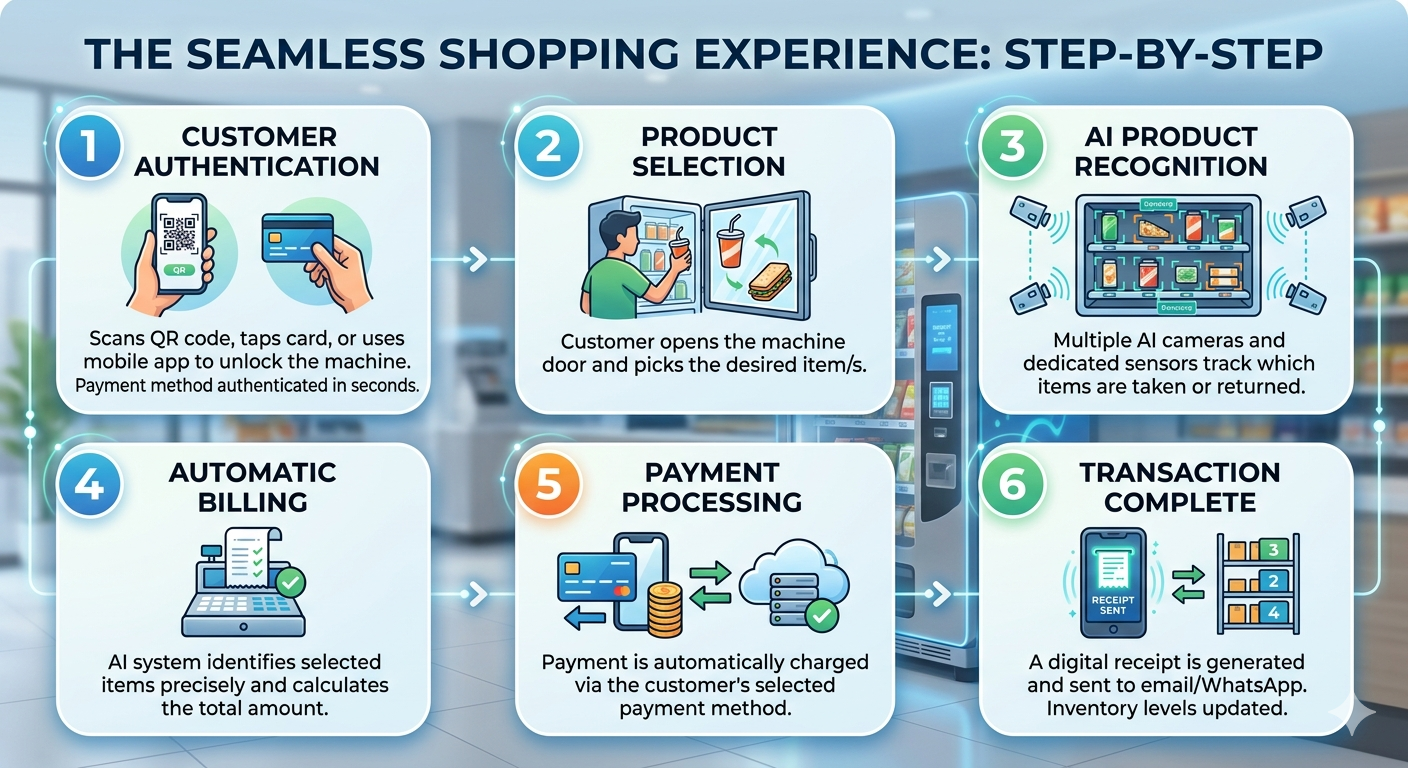
After all, manual scanning process is bypassed, no waiting at the bill counter – a grab and go shopping experience that enhances the overall CX.
AI Smart Vending machine market in UAE
As per the research conducted by Data Bridge Market Research, the United Arab Emirates AI Vending machine market revenue was valued at USD 156.23 million, in 2024. As of 2032, the market value is estimated to rise to USD 328.58 million achieving a CAGR of 11.21%.
The key drivers of the UAE vending machine market are listed below.
- Thriving hospitality and retail sector of the UAE – As per the performance indicators for the first half of 2025, UAE airports received 75.4 million passengers. This indicated a percentage passenger increase of 5%. And, these passengers require 24/7, reliable product vending support.
H1 2025 also witnessed flight launches to new destinations across Asia, Africa, Europe, and the middle-east.
UAE as the leading aviation hub of the region is attracting a huge number of passengers and visitors across the globe on a day-to-day basis.
In terms of highest average hotel occupancy rates, Dubai frequently enjoys the top position, globally (Average occupancy rate – 80%). The Gulf News reports that the UAE received more than 32 million hotel guests in 2025, generating a revenue of more than Dh49.2 billion.
- Product diversity – Compared to traditional vending machines, smart AI vending machines can dispense different product types, ranging from snacks, cool drinks to specialty beverages, fast food, fresh produce, baked goods, and more. This product diversity benefit is highly appealing to the retail industry.
- Digital transformation and Vision 2031 – A supportive government, the government’s push for AI adoption and technology integration, Vision 2031 initiative, etc. have created a favourable environment for retail automation.
- Changing consumer habits – The young, expatriate, tech-friendly population that demands fast and convenient access to products ranging from snacks to cosmetics and electronics.
To Conclude
The UAE is not simply adopting AI vending machines. It is transforming what retail convenience looks like in a smart economy.
Cashless payments, real-time inventory alerts and predictive restocking, etc. – these intelligent kiosks are built for a market that refuses to stand still.
Irrespective of your business domain, a mall operator, an F&B brand, or a corporate facility manager, the opportunity to automate, personalise, and scale is right in front of you – literally. In 2026 and beyond, the question is no longer if AI vending fits your business. It is how soon you deploy it.
Frequently
Asked Questions
The price of a smart AI vending machine ranges from $3000 to $8000, and even higher based on the technology used, shelf numbers, product capacity, customisation requirements etc.
Yes. AI vending machines can be customised based on the screen interface design, branding elements, product categories displayed, and promotional content shown to customers.
AI vending machines support secure, contactless payment methods including NFC cards, mobile wallets, QR codes, and biometric authentication. The payment data is processed through PCI-DSS compliant gateways. Even the customer interaction data remains anonymous when used for analytics purposes. However, businesses should check whether their vendor complies with applicable data protection guidelines pertaining to the deployment region.
Airports are one of the most ideal locations to install Smart AI vending machines. You may install AI vending machines in transit terminals, airport concourses, waiting areas, departure lounges, airport hotels & connected facilities, duty-free zones, arrival halls, etc. These smart machines offer a strong ROI, particularly in airport facilities, improving passenger experience.
Of course. We supply AI vending machines in Dubai and all other Emirates. For pricing and configuration details, get in touch with our technical advisors.
Of course. Panashi provides AI vending machines for a wide range of industries and businesses across Saudi Arabia. Let us know your requirements, we’ll come up with the best deal possible.