

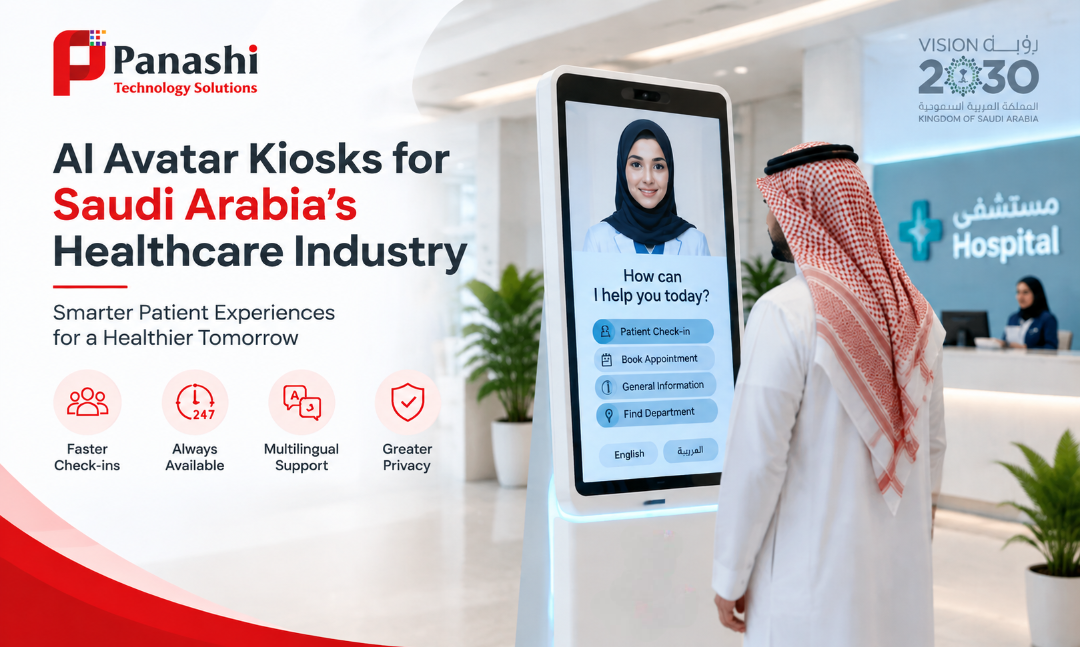
AI Avatar Kiosks for Saudi Arabia’s Healthcare Industry
Have you ever imagined walking into a Saudi hospital and being greeted by a lifelike AI avatar instead of a tired receptionist? Sounds futuristic, right?
But it’s already happening. As Saudi Arabia pushes hard on Vision 2030 and its healthcare digitisation goals, AI avatar kiosks are stepping in to handle patient check-ins, appointment bookings and basic queries, all without a single human touch.
You get faster service, hospitals get reduced staff burden, and the whole system runs smoother. In simple words, these kiosks would change how Saudi patients experience healthcare from the very first interaction.
Kindly read on to know more.
What is an AI Avatar kiosk for healthcare?
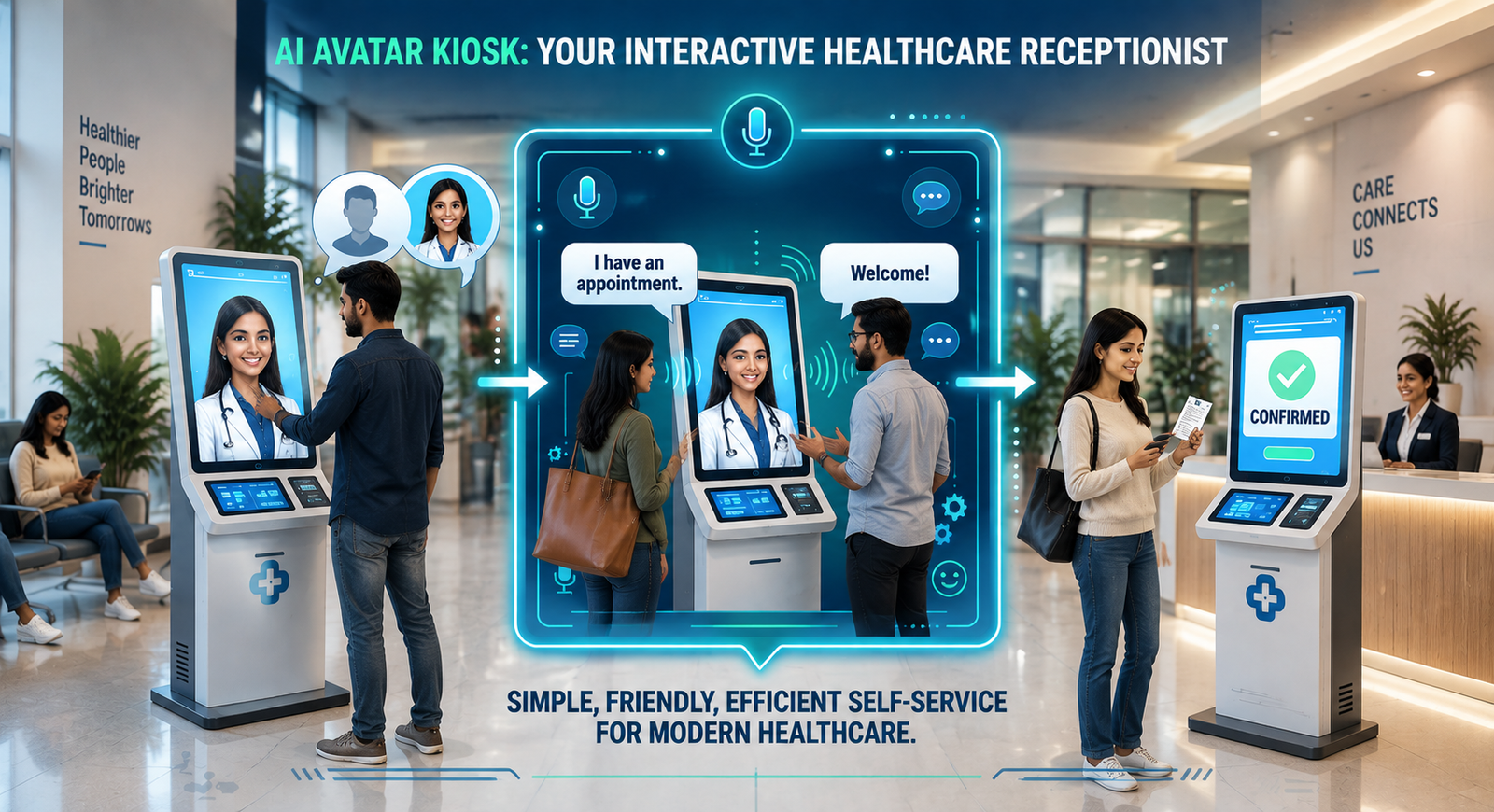
An AI avatar kiosk is a self-service terminal that features a lifelike, human-style digital avatar on screen instead of a plain menu. The digital avatar listens and responds to patients in real time, almost similar to a human receptionist.
A confused, anxious patient who wants to check-in can straightway walk up to the digital avatar kiosk, and simply say “I want to check-in”. AI avatar kiosk can guide patient through check-in, book appointments, answer basic medical queries and even direct them to the right department.
The patient need not wait in long lines at the reception, thus saving precious time and energy.
Why does Saudi healthcare need them?
It’s the right time for healthcare automation in Saudi Arabia. The key reasons are:
KSA Vision 2030 – Saudi Arabia’s Vision 2030 has put digitisation and smart healthcare at the centre of its national agenda. Gone are the days when a hospital could operate on manual, paper-based check-ins and long lines at the reception. Modernisation is no longer optional for Saudi’s healthcare industry.
Rise in population – As of 2026, the population of Saudi Arabia is approximately 36 million, compared to 32.2 million in 2022 (2022 census). This means around 12.5% increase in population in a span of 4 years. The Kingdom’s population is growing, and so is the demand on its hospitals and clinics.
Healthcare Staffing shortages in Saudi – Many healthcare institutions in Saudi Arabia are already facing staffing shortage issues, with receptionists and administrative staff juggling calls, walk-ins, and paperwork all at once. Issues like inefficient workforce distribution, dependence on expatriate healthcare workers – all these challenges affect Saudi’s healthcare industry.
The key technology stack behind an AI Avatar kiosk
The natural conversation with the patients is made possible by leveraging certain key technologies. And they are:
- Automatic speech recognition (ASR) – Converts what a person speaks into text the system can process.
- Natural language processing (NLP) – Interprets the meaning and intent behind the text, which allows the avatar to understand context.
- Large Language Model (LLM) - generates context-aware, nuanced responses (conversational intelligence) drawing on medical or hospital information rather than scripted replies.
- Text-to-speech with voice synthesis - Converts the generated response back into natural-sounding speech.
- Emotion and sentiment recognition – Some advanced systems use a built-in camera and computer vision to read facial micro-expressions and emotional cues from the patient. The system then adjusts its response accordingly, for example, softening its tone for a frustrated or anxious patient.
- Edge computing – Edge computing helps to process the data on the device itself or on a nearby local server, instead of sending it to a distant cloud server. Hence, the interaction with the digital avatar becomes fast, and feels natural with minimum latency.
How AI avatar kiosks benefit the patients?
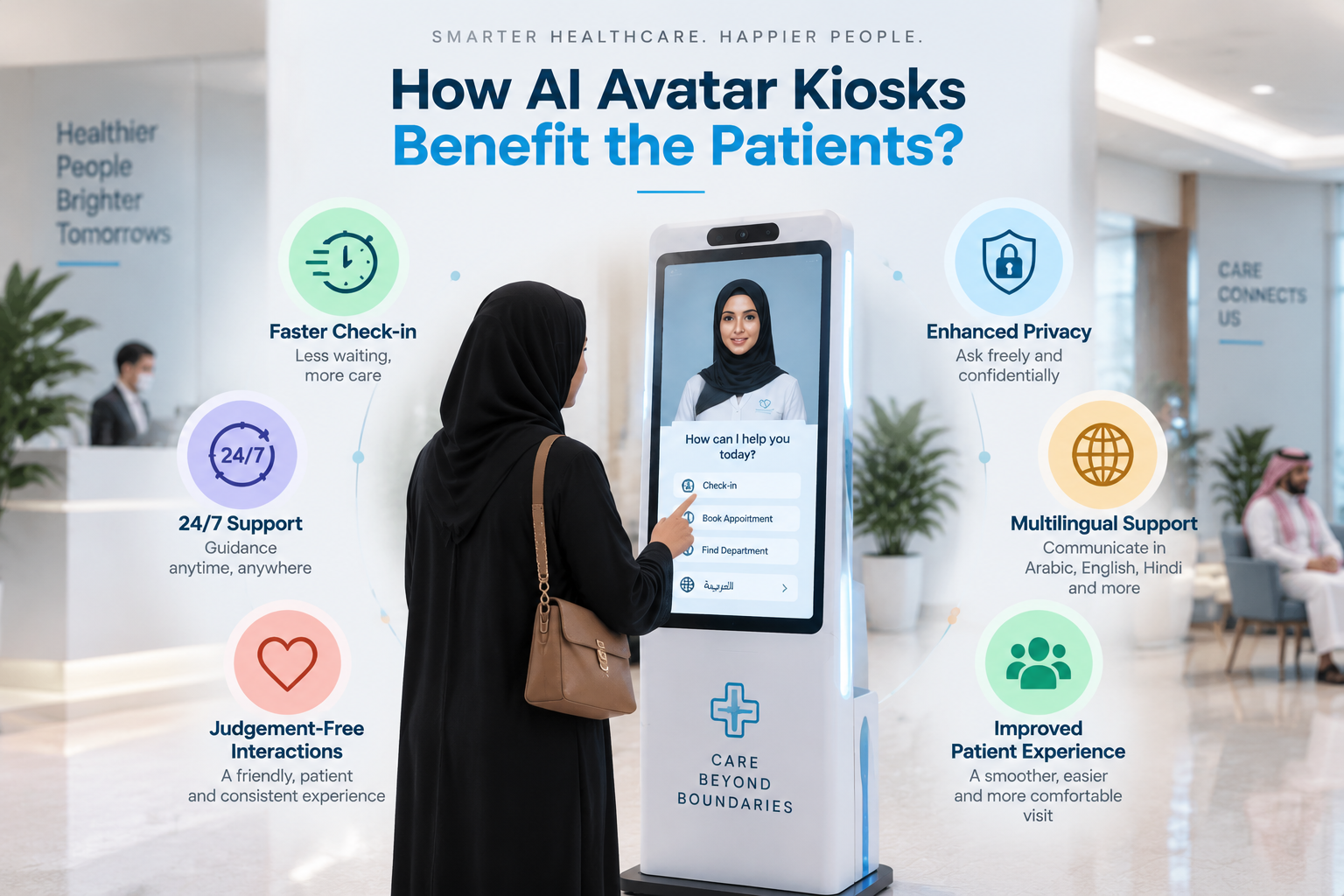
- Faster patient check-in and reduced wait times – Patients can easily conduct the front desk formalities like registration, appointment confirmation at the kiosk without queuing at the reception.
- 24/7 patient support - Unlike a receptionist, an avatar kiosk doesn't clock out. Patients arriving early, late, or outside standard hours still get guided support instead of facing a closed desk.
- Judgement-free interactions – Patients who are nervous, confused, or in pain sometimes feel rushed or judged by busy human staff. A digital avatar interacts patiently and consistently, repeating instructions as many times the patient wants.
- Enhanced patient privacy – Enhanced privacy while asking health-related questions, administrative queries, or other sensitive medical matters.
- Multilingual support – The digital avatar can easily shift between Arabic, English, Hindi or other languages which immensely helps the diverse patient population of Saudi Arabia.
- Improved patient experience – Fast and smooth check-in, multilingual support, human-like conversations, heightened privacy, etc. enhance the overall patient experience.
How hospitals benefit from AI Avatar kiosks?
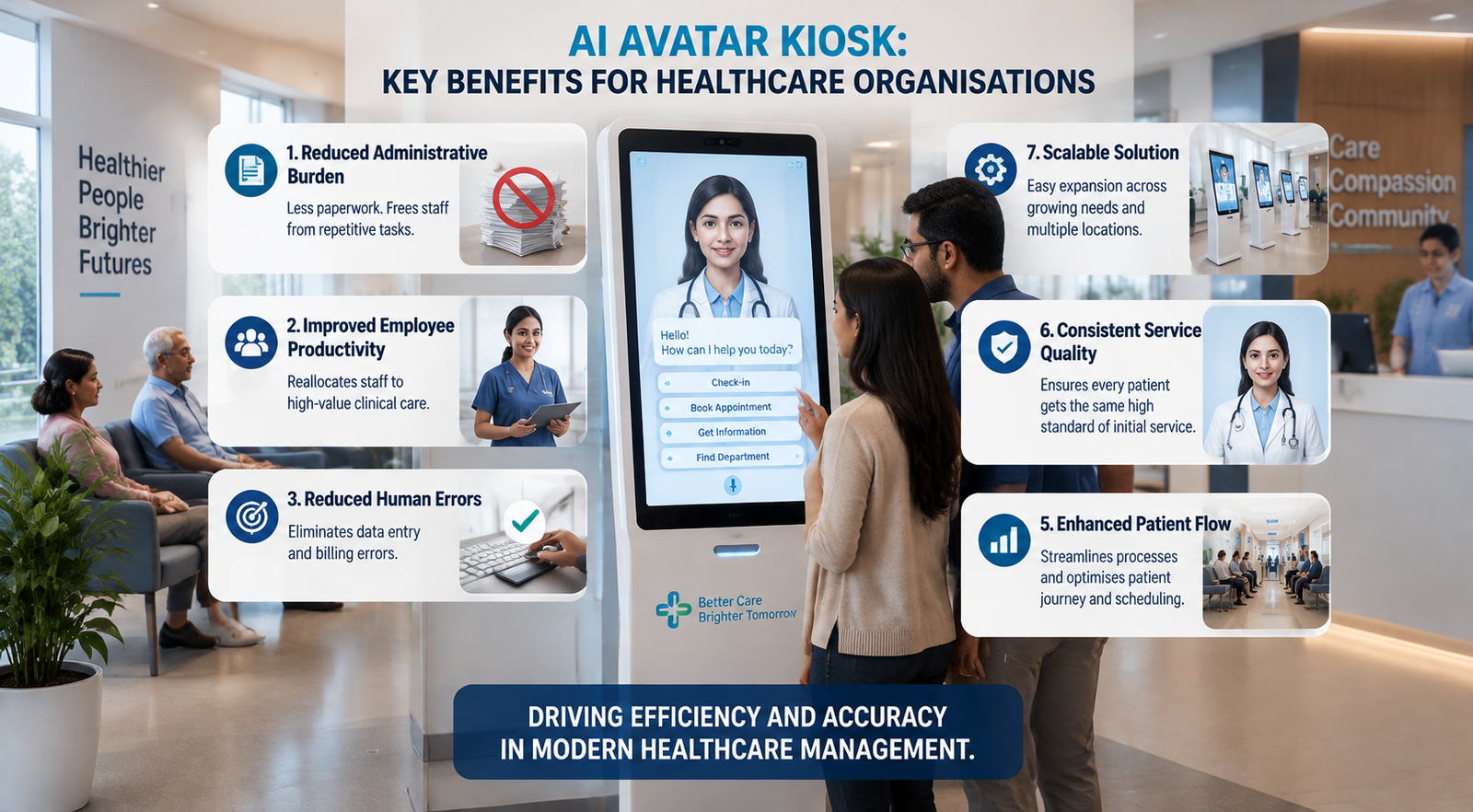
- Reduced administrative burden – Front-desk teams get relieved of repetitive tasks like check-in, appointment confirmation, and basic queries. Hence, they can focus more on complex issues where human attention matters.
- Improved employee productivity – Reduced administrative burden, especially during the peak hours, means improved employee productivity.
- Reduced human errors – The AI avatar kiosk handles the workflows with top-notch efficiency, minimising human errors significantly.
- Data analytics – Gather valuable data like patient query patterns, patient flow, peak hour patterns, etc. which helps to plan staffing and resources better.
- Enhanced patient flow - Automated check-in reduces bottlenecks at the front desk, meaning patients move faster. It also reduces overcrowding during peak hours.
- Consistent service quality - Unlike human staff, whose tone and accuracy can vary with fatigue or experience level, an avatar delivers the same standard of service every time, 24/7, across every branch.
- Scalable solution – The hospitals can implement the AI avatar kiosks at new locations or departments, wherever required.
Which are the other industries that can implement AI avatar kiosks?
- Banking and Finance – banking customers can gather a wide range of information via the digital avatar kiosk regarding banking products and services without waiting at a token counter. The digital avatar kiosk greets the customer, confirms identity, and routes them straight to the right service, like account opening, loan enquiry or cash withdrawal, improving the service efficiency.
- Retail – Retail customers need not depend on the staff to navigate the store or check product availability. The customers can straight away interact with the digital avatar through voice interactions and get to know more about the product features, compare options, etc. The meaningful interaction helps customers take well-informed decisions, which improves conversion.
- Hospitality – Kiosks with AI avatars provide interactive maps, step-by-step directions around the property, details on amenities, etc. Avatar kiosks integrated with a hotel’s property management system let guests handle bookings, check-in and room key card issuance without any human intervention.
These digital avatars are extremely useful for high footfall hotel lobbies and resorts, so that the guests can place food-orders, make dining reservations at their preferred time and convenience.
- Airports – Digital avatars integrated into airport kiosks help passengers navigate terminals, which reduces congestion and improves overall passenger flow. The wayfinding feature is particularly helpful for large multi-terminal airports where digital signage alone can’t help.
Digital avatars can offer real-time flight and boarding information to airport travellers, thus avoiding congestion at counters.
- Governments – Digital avatar kiosks handle routine government transactions, ID services, permit queries, at service centres and other government departments. Thus, citizens can easily access government services, ask conversational queries, or get their doubts cleared, without waiting at the government counters.
- Religious tourism (Hajj and Umrah) – AI avatar kiosks can be installed at multiple locations to offer guidance for millions of pilgrims annually. The locations include hotels, transit hubs, airports, and other high footfall areas. The avatars can offer guidance on directions, wayfinding, ritual information, accommodation, etc. in the pilgrim’s preferred language.
- Education – Reputed universities and training institutes across Saudi Arabia can implement digital avatar kiosks for student-centric requirements. It involves campus wayfinding, admission queries and other student services. If properly implemented, the initiative would perfectly align with Saudi’s Vision 2030 Human Capability Development Program.
- Entertainment and events – Avatar kiosks can handle registration, wayfinding, and brand engagement at entertainment or exhibition venues, bypassing human-intervened counters. Installing these avatar kiosks at exhibition or event premises can reduce congestion and streamline guest flow.
Conclusion
So, what do AI avatar kiosks mean for Saudi Arabia’s healthcare industry?
AI avatar kiosks are not just a novelty add-on for hospitals looking to appear modern or sophisticated. They solve real problems, long queues, staffing pressure, language barriers, and the growing demand on the Kingdom’s healthcare system.
Major hospitals in Riyadh, Jeddah, Mecca, Madinah, can surely leverage the benefits of these AI avatar-powered kiosks.
As Saudi Arabia continues pushing towards its Vision 2030 healthcare goals, technologies like these will only become more common across hospitals and clinics.
For more insight about the latest trends in healthcare, please do subscribe to Panashi blogs.
Frequently
Asked Questions
Reputable kiosk manufacturers follow strict data protection protocols and comply with local healthcare regulations. However, hospitals should always verify compliance standards with their chosen kiosk manufacturer before deployment.
Yes, certainly. Vision 2030 puts healthcare digitisation at the centre of its national agenda. AI avatar kiosks directly support this by modernising patient interactions across hospitals and clinics.
Yes. High foot-fall clinics can implement AI avatar kiosks at reception halls, so that the patients can easily perform check-in, booking confirmation etc, without having to interact with a human staff. The digital avatar serves as a 24/7, digital receptionist for clinics.
Yes. You can integrate AI avatar kiosks with a hospital's existing Electronic Health Records (EHR), appointment scheduling, queue management and billing systems through secure APIs. Through integration, the kiosk can verify patient identity, book appointments, issue queue tokens and confirm insurance coverage in real time.
No. The goal is not replacement but support. Avatars handle repetitive, time-consuming tasks, so human staff can focus on complex cases that genuinely need a human touch.