

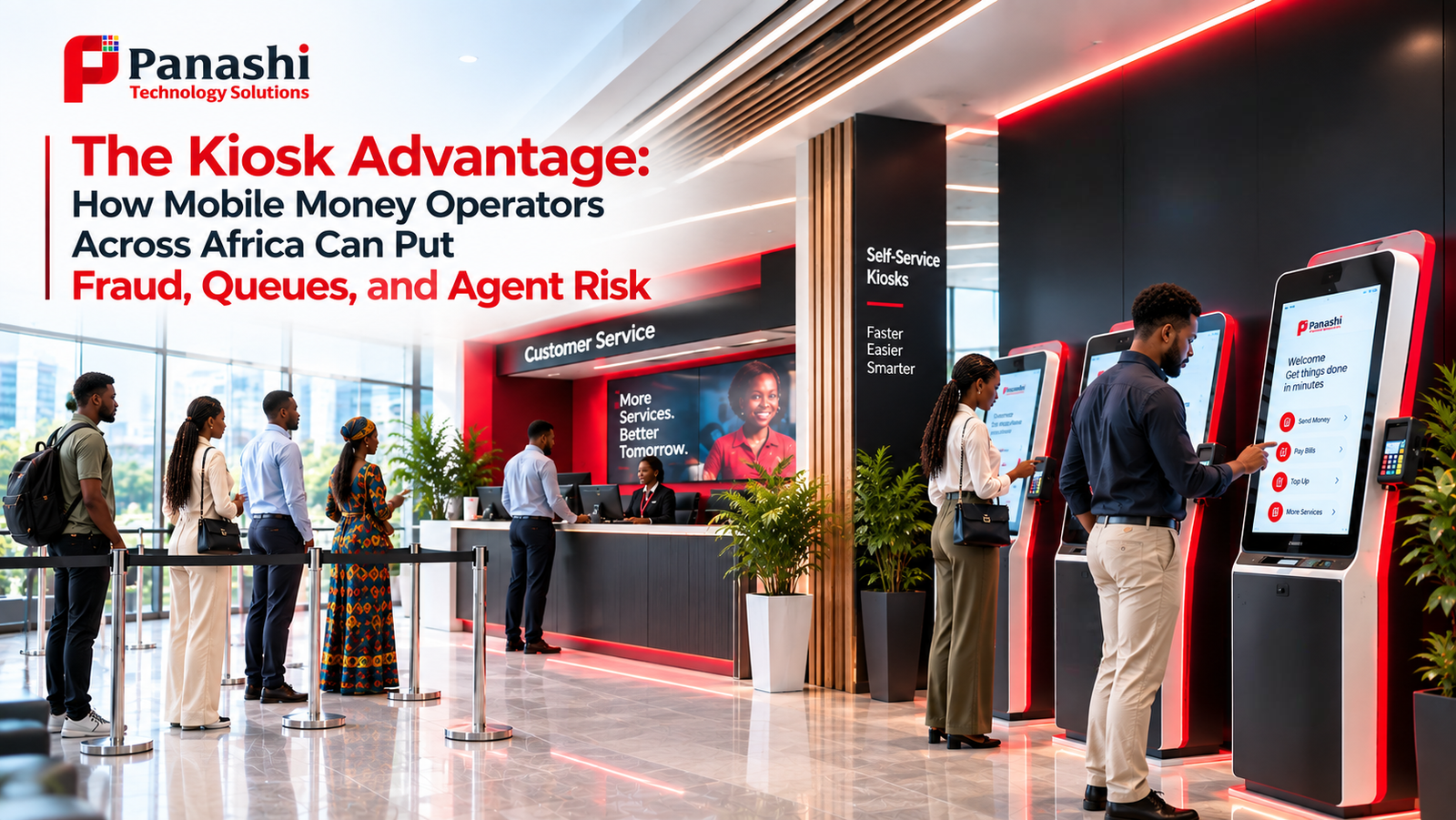
The Kiosk Advantage: How Mobile Money Operators in Africa Can Cut Fraud, Queues, and Agent Risk
Can a mobile money agent point in Africa survive on a plastic table and an umbrella forever?
Across Africa, that’s been the default setup for nearly two decades, ever since Safaricom launched M-Pesa in Kenya back in 2007.
But now the scenario has changed drastically.
Safaricom’s M-Pesa alone runs close to 300,000 agents across Kenya, serving over 35 million customers, as per Safaricom’s own FY25 disclosures.
That’s a lot of agents, a lot of cash handlings and transactions. Even the competition between operators are immense. All these factors put too much pressure on the operators to make each agent point faster, safer, and more reliable.
In simple words, African mobile money has outgrown the conventional mobile money operations.
Kindly read on to see exactly how self-service kiosk solutions help operators across the continent keep up.
Mobile money transactions in Africa
The State of the Industry Report on Mobile Money 2026 reveals that the global mobile money transactions in 2025 had crossed the $2 trillion mark.
GSMA’s State of the Industry Report on Mobile Money 2026 indicates that sub-Saharan Africa alone processed $1.4 trillion in mobile money transactions in 2025.
This means, around 66% of the transactions are processed by Sub Saharan African countries.
It is evident that the major chunk of global mobile money transactions comes from the Sub Saharan Africa.
Africa mobile money market size
As per IMARC Group, Africa’s mobile money market hit USD 9.18 billion in 2025. The value is projected to reach USD 67.18 billion by 2034, growing at a CAGR of 25.30%.
The driving factors are:
- Rising financial inclusion plans and strategies.
- Increase in the use of smartphones.
- Rising agent community.
- Growth in government digitisation schemes.
Kenya alone holds close to a quarter of that market, anchored by M-Pesa’s ecosystem.
The major mobile money platforms in Africa
M-Pesa
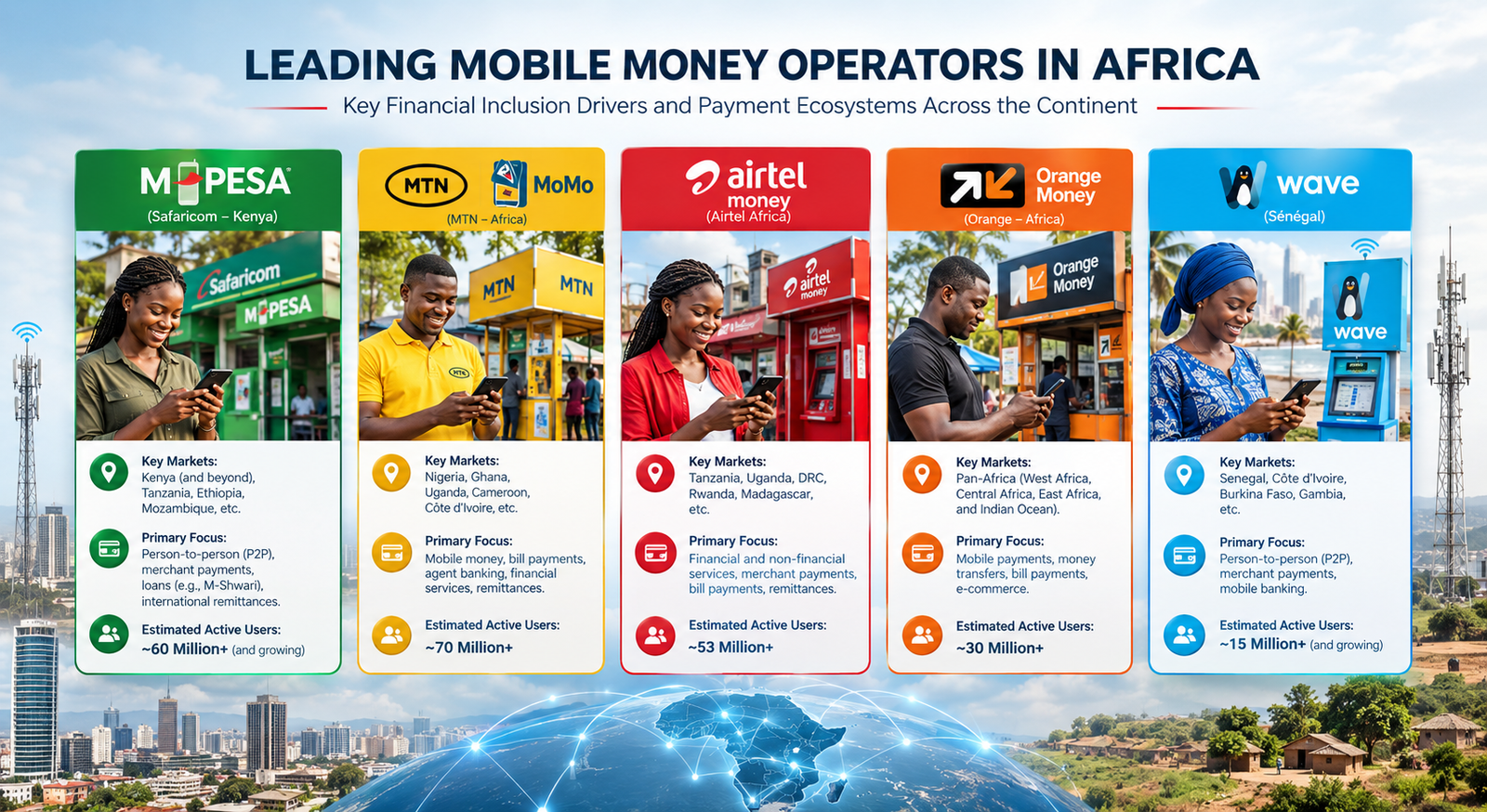
M-Pesa is a renowned mobile banking provider, particularly in East Africa. The mobile money service is a joint venture of Safaricom and Vodacom. Launched in Kenya, the service provider has now expanded to other East African countries like Tanzania, Mozambique, Lesotho, Ghana, Egypt, and DRC.
Safaricom PLC’s FY2025 press release put M-Pesa’s transaction volume at approximately KSh 38.3 trillion, which converts to approximately USD 296.8 billion.
M-Pesa serves more than 60 million users across various East African countries like Kenya, Tanzania, Ethiopia, DRC, and Egypt. It is considered as the largest mobile money service provider by transaction volume in Africa.
Airtel Money
Airtel Money has approximately 56.5 million customers in Africa across 14 African countries. The mobile money service provider, owned by Airtel Africa, boasts of 2.4 million active agents. https://www.airtel.africa/mobile-money
According to Airtel Africa’s Annual Account and Reports 2025, Airtel Money’s total transaction volume (TPV) was USD 136.5 billion in FY2025.
The service provider has strong presence in countries like Nigeria, Kenya, Tanzania, Uganda, Zambia, and beyond.
Orange Money
Orange Money serves around 47 million active mobile money users across 17 African countries, based on the information published on their website. The mobile money provider is supported by more than 400,000 points of sale across Africa. Cameroon alone accounts for over 11 million customers.
Wave
Founded in Senegal in 2018, Wave is now the region’s most valuable startup. The mobile money operator operates across West and East African countries like Côte d’Ivoire, Senegal, DRC, Uganda, Niger, The Gambia, Mali, Sierra Leone, and Cameroon. It serves more than 23 million monthly users through 150,000+ agents. Wave controls over half of the mobile money market in Senegal. It’s well-positioned in Côte d’Ivoire offering significant competition to other established operators. The key attraction of Wave is their very low transaction fee.
What are the services provided by African mobile money providers?
Here are the services common across major African mobile money providers.
- Cash-in / cash-out - Depositing and withdrawing cash through agent networks.
- Peer-to-peer (P2P) transfers - Sending and receiving money between individual users.
- Bill payments - Utility bills, electricity, water, and similar recurring payments.
- Airtime and data top-ups - Buying mobile airtime or data bundles directly from the wallet.
- Merchant payments- Paying shops, restaurants, and other businesses via mobile money.
- International remittances- Cross-border money transfers, particularly diaspora-to-home transfers.
- Micro-loans and credit- Short-term borrowing based on transaction history and mobile money usage.
- Bulk disbursements- Salary payments, government subsidies, and NGO cash transfers to multiple recipients at once.
- Account-to-bank transfers- Moving funds between a mobile wallet and a linked bank account.
What are the major challenges faced by the mobile money operators in Africa?
Africa’s mobile money operators face several challenges. The major ones are listed below.
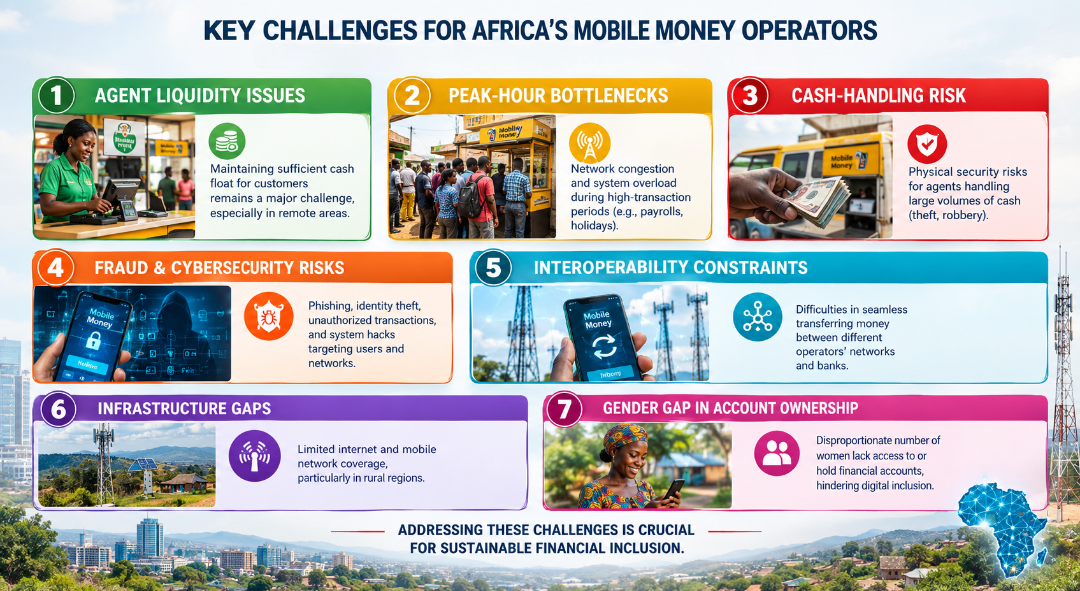
- Agent liquidity issues – Agents often lack enough cash for withdrawals or float for deposits. This disrupts service, especially in remote areas.
- Peak-hour bottlenecks – Agents experience peak-hour bottlenecks on salary days and market days, which causes service delays.
- Cash-handling risk – Incidents of attacks, attempts of robbery and even armed robbery is a cause of concern for the agents.
- Fraud & cybersecurity risks - As wallets get more connected, fraud, SIM swaps, phishing, and agent-driven fraud are rising faster than continent-wide security standards can keep up.
- Interoperability constraints – Transferring funds between an MTN MoMo user and Orange Money user would still face difficulties across several African nations.
- Infrastructure gaps - Weak telecom coverage and inconsistent digital ID systems in many areas limit reliable access.
- Gender gap in account ownership - Women remain underrepresented in mobile money adoption across several markets.
- Device and data affordability - Many potential users still can't afford a capable smartphone or consistent data. This affects the reach of digital-first channels.
What are the benefits of deploying kiosk machines for mobile money operations?
A kiosk-assisted touchscreen interface walks customer through a cash transfer in a fraction of the time, when compared to an agent who manually input information on a phone.
Here are the core benefits of deploying kiosk solutions for mobile money operations:
For operators
- Multi-operator support in one unit - A single kiosk can be built to process Orange Money, MTN Mobile Money, Moov Africa Money, and Wave transactions side by side. This helps operators to serve a wider customer base without running separate setups for every provider.
- Float consumption data – the operator gets live float consumption data in real-time.
- Self-service cash-in and cash-out - Customers deposit or withdraw funds directly through the kiosk, cutting the agent's manual cash counting. The manual cash counting is a real safety concern.
- Bill payment and airtime top-up - Utility payments, airtime, and data bundle purchases move to self-service. This frees up the agent to handle more complex requests or higher-value customers.
- Reduced fraud - Fingerprint or facial recognition at the kiosk speeds up KYC checks and reduces identity thefts, SIM swaps, and other agent-driven malpractices.
- Cleaner transaction data – Kiosks generate consistent, digital transaction logs, instead of relying on manual agent records.
- Brand differentiation – A kiosk machine can be conveniently deployed at any public location. A secure, branded mobile money kiosk machine stands out on a street where three or four competing operators might be within sight of each other.
For agents
- Reduced cash-handling risk – Reducing cash-handling brings down personal exposure to robbery. Panashi outdoor kiosk enclosures are rugged, vandal resistant, and offers IP65/IP67-rated protection from external elements like sunlight, heat, humidity, water, and dust.
- Manage float liquidity – serves as a 24/7, convenient, float top-up point for agents.
- Reduced fatigue, improved productivity - Automating repetitive, high-volume transactions leaves agents to handle complex requests or higher-value customers.
For customers
- Multi-lingual self-guided interface - Customers complete transactions at their own pace, without needing external help.
- Faster transactions – No manual entering of information, no waiting on agent to finish another customer’s transaction.
- Reduced waiting, delays – Efficient queue management reduces waiting time during peak-hours, salary days and market days. Therefore, customers need not have to wait in a long, disorganised line.
- Improved financial inclusion – The customers can easily access various financial services and products via the kiosk machine, thereby improving their financial independence and literacy. This works in favour of women empowerment too.
Conclusion
Self-service kiosk solutions won’t replace the African mobile money agent, the corner shop, the market stall or the neighbourhood shop that built the industry from ground up.
But they will certainly decide which operators can scale their agent networks across the continent.
As competition between operators intensifies from West Africa to East Africa, the ones who move their busiest agent points onto proper kiosk infrastructure are the ones who’ll be ready for what comes next.
It’s time to explore what a kiosk-enabled agent network could look like for your operations. And Panashi can certainly help you in that endeavour.
Frequently
Asked Questions
Not at all. In fact, smaller or regional African operators may benefit the most. A kiosk levels the playing field, letting a smaller operator offer the same speed and reliability as a market leader with a much bigger agent footprint.
Yes. Biometric verification and secure, encrypted transaction processing protect customer identity and funds at every step.
The kiosk machine price in Africa varies with several factors like the deployment type (outdoor or indoor), technology integration, operator’s customisation requirements etc. If you have any plans regarding kiosk installation, let us know your requirements. Our team will get back soon with the pricing details.
A kiosk brings cash handling, identity verification, and transaction processing into one secure, self-service machine. This standardises service quality in a way a manual counter simply can't.
Yes. A self-service kiosk transaction removes the social discomfort some women report when transacting through a male agent in a small, public setting. This opens a more comfortable path to account ownership and regular use.