

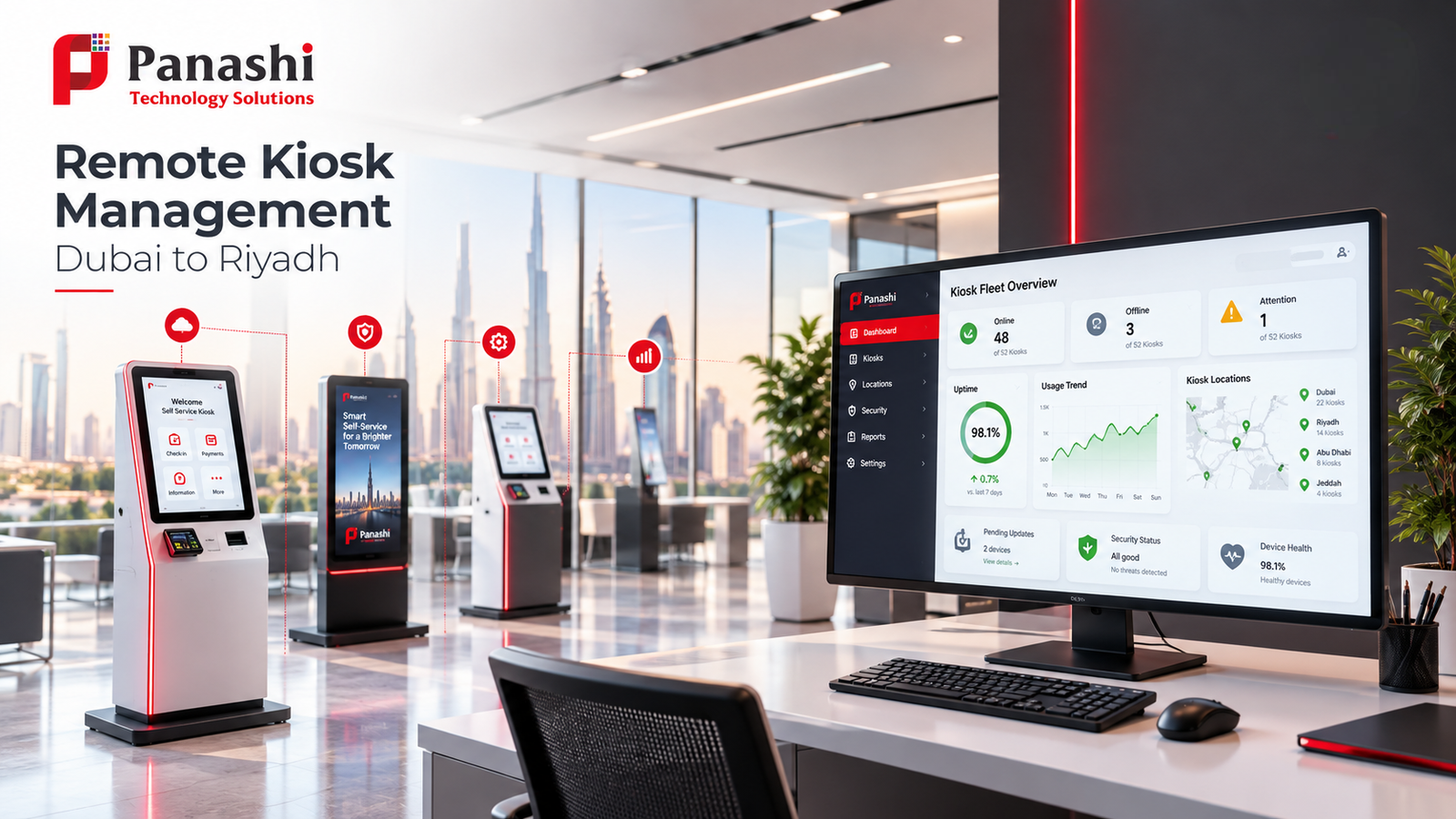
From Dubai to Riyadh: Why Remote Kiosk Management is a Must
If you are a service provider that makes use of a self-service kiosk to enhance the operational efficiency of your business, you might very well associate the relevance of remote kiosk management.
Diverse industries in the Middle East deploy self-service kiosks to streamline their operations and boost revenue. And many of these machines are deployed in scenarios where they receive least attention. Therefore, in order to ensure optimum performance of the kiosk machine, the performance of both the hardware and software components has to be monitored effectively. This monitoring process is easily made possible by Remote management capability.
Let’s explore!
What is Remote Kiosk Management?
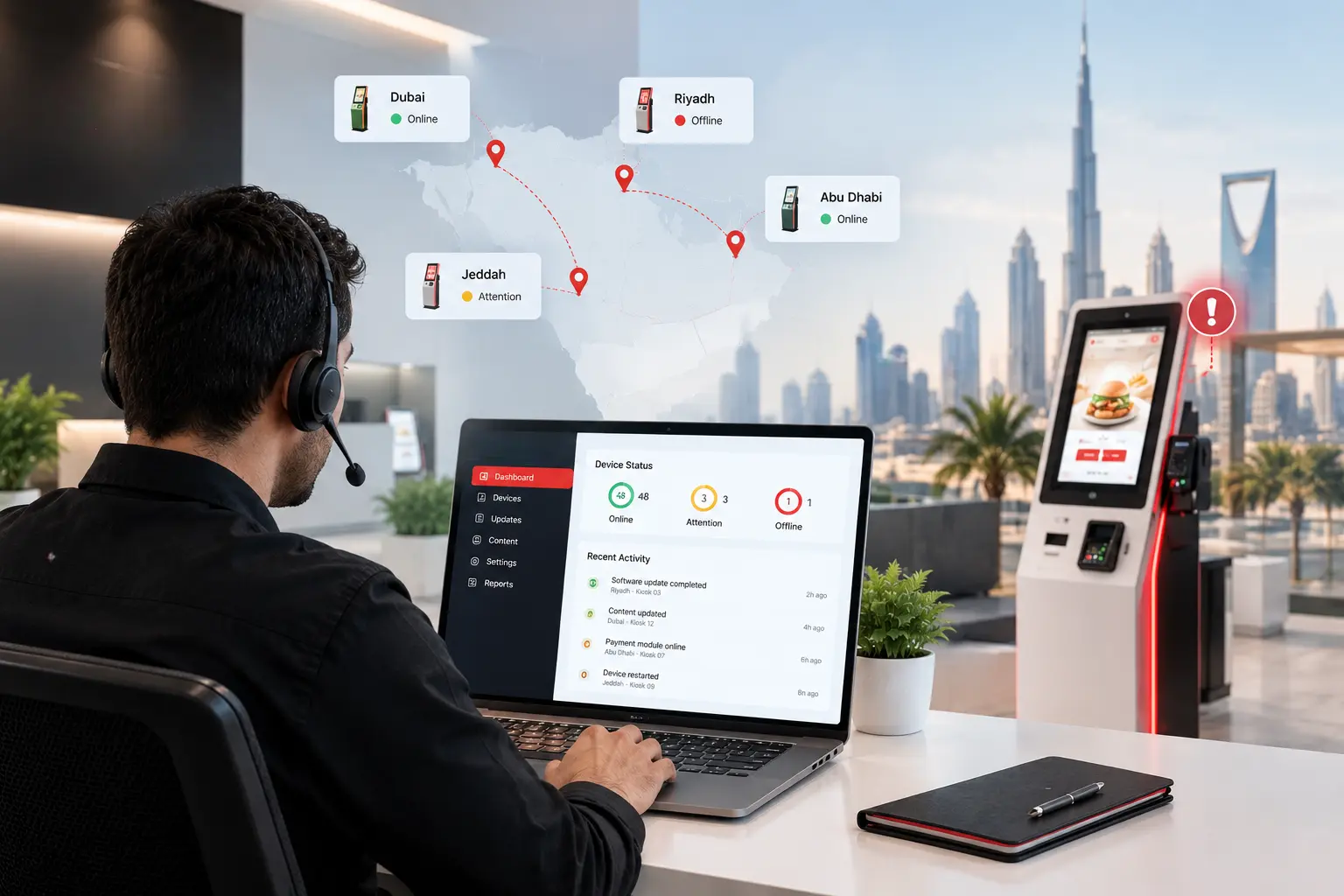
Remote kiosk management is the ability to control, update and secure self-service kiosks from one central dashboard.
It allows businesses fix issues, push software updates, change content and pricing, and manage security across every location. All these takes place without sending a technician on site.
With the help of remote management, the service providers may closely monitor the performance of the kiosk machines irrespective of their location or network size.
What are the key aspects of kiosk remote management?
Kiosk remote management covers six core areas:
- Remote control and troubleshooting - rebooting, diagnosing and fixing kiosks from a central dashboard, with no site visit needed.
- Software deployment - pushing app updates, OS patches and security fixes across the whole fleet at once.
- Configuration management - changing settings, payment options and workflows centrally for consistency across locations.
- Content and pricing updates - refreshing promotions, menus, prices and multilingual interfaces instantly.
- Security control - locking down devices, restricting access, managing user permissions, and remotely wiping compromised kiosks.
- Scheduling and automation - automating restarts, updates during off-peak hours to keep disruption to a minimum.
Remote Management benefits
Remote management has multiple benefits and they are listed below.
- Prevents on-site maintenance – As an eminent self-service kiosk provider in the Middle East, we are well-aware of this scenario. On-site visiting and maintenance is a tedious task, particularly, when the technician has to cover vast distances in secluded areas.
- Reduces expenses involved – Of course, if one can avoid the travel to the place of the client for the purpose of maintenance, it reflects in reducing the travel-related expenses. The time required to travel long distances is always a concern for technicians which can be averted through remote management.
- Improves Kiosk uptime – Your IT team can proactively monitor the performance of the kiosk machine nullifying the chances of error or future chances of service disruption. This improves the uptime of the kiosk machine and hence the customers may access the services without any delay or break. And remember, better the kiosk uptime, better the revenue and better the customer satisfaction.
- Say YES to preventive maintenance – If your team is in a position to conduct relentless monitoring, then it becomes easy to track the performance of various hardware peripherals. Based on the collected data, the team can successfully foresee hardware breakdowns and do the most-needed preventive measures.
You may schedule the maintenance and perform hardware replacement during the prescribed time preventing unforeseen system failures. Preventive maintenance also helps to enhance the lifespan of the kiosk machine, thereby increasing the ROI. The well-known quote, “prevention is better than cure”, is perfectly applicable here!
- Provide timely updates – the technical team may perform important software updates in a timely manner via remote management. This, in turn, improves the performance of the system and protects the kiosk software from cyber-threats and unauthorised access.
- Improved CX – Your customers appreciate your services when they get it in a consistent and uninterrupted manner without service delays. Therefore, improved kiosk uptime enhances customer experience. There is every chance that a satisfied customer will make a repeat purchase and probably become your loyal customer.
- Gain valuable data insights – Your self-service kiosk is a gold mine of valuable customer data. Through remote monitoring, you may tap into these data and gain useful information pertaining to customer preferences and behaviour. Based on the collected data, you may restructure your campaigns or optimize your services for the good.
- Reduced carbon footprint – This may not be a direct benefit to the service provider. But, an important benefit in the sustainability point-of-view. The blue planet would thank you for sure!
When it comes to on-site maintenance, a technician needs to visit the site of the service provider. And this may involve extensive travel, especially if the deployment site is located in a remote area. For travel and commute purposes, the person should rely on vehicles that result in carbon emission. Remote monitoring prevents this scenario and helps to reduce carbon footprint.
Self-service kiosk market size – UAE and Saudi Arabia
As per Grand View Horizon research, by 2030, the UAE self-service kiosk market is expected to generate US$ 1,224.5 million in revenue. The market is projected to grow at a CAGR of 10.7% during the period 2025-2030.
When it comes to Saudi Arabia, the research conducted by imarc claims that Saudi market is expected to reach USD 647.7 million by 2034. The increase is expected to achieve at a CAGR of 7.14% during the period 2026-3034.
Why GCC kiosk operators can't afford to skip remote kiosk management?
Without proper, professional remote management, a kiosk network across the Middle East exposes operators to several risks. And, the risks are sharper here than in many other regions because of the climate, geography, regulations, and what customers expect.
Let’s have a closer look.
Operational and downtime risks
- Kiosk component failure – Printers might run out of paper, card readers jam and screens freeze. Nobody notices until a customer complaints or revenue drops. Without real-time alerts, a kiosk in a mall in Dubai or Riyadh can sit dead for hours or even days.
- On-site fix can be a costly affair – Many fleets are spread over long distances. You know Saudi Arabia is a vast country. To add on, kiosk machines can be deployed across remote regions. If every fault needs a technician on site, service costs rise sharply. A simple reboot or config fix can turn into a half-day trip.
- Peak season exposure – Ramadan evenings, Eid, Hajj and Umrah traffic, DSF, and major events bring huge spikes in footfall. An unmonitored kiosk that fails during these windows loses the most revenue at the wrong time.
Environmental and hardware risks
- Heat and dust – Outdoor and semi-outdoor units such as the kiosks terminals deployed in transportation hubs or citizen service kiosks face summer temperatures above (45-50) °C. Sandstorms and high coastal humidity are common across the region. Without remote monitoring of internal temperature and component status, overheating and dust clogging stay invisible until they show up as permanent hardware failure. Thus, outdoor units require more attention and maintenance compared to the indoor units. To understand the differences between outdoor and indoor kiosks, please visit our comparative study blog.
- Shorter components life – Thermal printers, touchscreens and power supply units wear out faster in this climate. Without usage and health data, maintenance stays reactive instead of predictive.
Cybersecurity risks
The GCC is a frequent target for cyberattacks on banking, government and critical infrastructure. Kiosks that need manual OS and app updates often lag behind on security patches. Unpatched systems are prone to cyber attacks.
Customer experience and brand risks
- High customer expectations – The UAE and Saudi Arabia in particular have digitally demanding consumers. An “Out of Order” screen hurts the brand quickly.
- Inconsistent content and language – Without remote content management, pricing, promotions and Arabic/English interfaces may go out of sync between locations. These issues can affect service consistency.
As per Kiosk Industry, around two in three users (67%) have run into self-checkout failures. Common issues include scanning errors, failed payments and system glitches.
Financial and strategic risks
- Hidden total cost of ownership – More site visits, longer downtime, early hardware replacement and lost transactions increase TCO over the kiosk’s lifetime.
- Limited or no data for decision-making – Without usage analytics, operators can’t tell which locations perform, when to add capacity, etc.
Conclusion
Hope you’ve understood the role of remote monitoring in self-service kiosk management.
Panashi offers top-notch maintenance and support services via remote management to our clients.
When it comes to kiosk installation, we offer on-site assistance to all our clients, irrespective of the location. If found necessary, our team is fully-equipped to perform on-site hardware replacement.
We have a resourceful and experienced team of professionals to manage kiosk deployment and maintenance in the entire middle-east and Africa.
Get in touch with our team and let us know your business requirements. We’ll come up with a highly rewarding and efficient solution for your business, satisfying all your business aspirations.
Frequently
Asked Questions
Yes, indeed. We offer remote kiosk management and assistance for all our esteemed clients around the globe based on Service Level Agreement.
Yes. Panashi provides on-site kiosk repair and maintenance based on a service level agreement. For more, please get in touch with our Panashi technical team.
Yes, in most cases. Frozen screens, software glitches and configuration errors can be fixed remotely. A quick reboot from the dashboard often does the trick. You need a technician’s help only when the kiosk hardware requires repair or replacement.
Kiosk operators irrespective of the industry make use of remote kiosk management. Think banking, retail, quick-service restaurants, healthcare, hospitality, transport and government services. Wherever kiosks are spread across multiple locations, remote management makes life much easier.
You can track uptime, transaction volumes, peak usage hours and error trends. These reports show which locations perform best and which need attention. These vital reports also help you make better decisions about operations and scaling.