

What Is an IK Rating? How Vandal-Resistant Touchscreens Protect Unattended Outdoor Kiosks
What happens when an angry customer punches your kiosk screen at midnight? Or when a stray football slams into it outside a metro station? Unattended kiosks face these risks every single day. And there is no staff member around to step in. That is exactly why IK ratings matter. In simple words, an IK rating tells you how much impact a touchscreen can take before it breaks. I have seen many buyers focus only on-screen size and price. But impact protection decides how long your kiosk actually survives. Kindly read on.
What is an IK rating?
An IK rating is an international classification for impact resistance. The rating shows how well an enclosure protects its contents from mechanical impacts.
The scale runs from IK00 to IK10. IK00 means no impact protection at all. IK10 is the toughest level on the scale.
Is this rating only for touchscreens? Not really. The same scale applies to light fittings, CCTV housings and electrical cabinets. But for self-service kiosks, the screen is usually the most exposed part. It’s big, made of glass and it faces the public all day. So, the touchscreen’s IK rating deserves a close look
How does the IK rating work?
An IK test comprises a fixed mass being dropped or swung onto a surface. The drop height is fixed for each level. The higher the rating, heavier the mass and stronger the impact. Impact energy is measured in joules, which is the unit of Energy.
The manner IK rating works can be easily understood with the help of the table provided below.
IK rating | Impact energy | Test mass and drop height |
IK05 | 0.7 Joules | 0.25 kg from 280 mm |
IK06 | 1 Joule | 0.25 kg from 400 mm |
IK07 | 2 Joules | 0.5 kg from 400 mm |
IK08 | 5 Joules | 1.7 kg from 300 mm |
IK09 | 10 Joules | 5 kg from 200 mm |
IK10 | 20 Joules | 5 kg from 400 mm |
It simply means that a rating of IK05 means that the product or enclosure is protected against 0.7 Joules of Impact energy.
And, when it comes to IK10, the product is protected against 20 Joules of impact energy. Therefore, IK10 offers the maximum protection from the impact.
Notice the jump between IK08 and IK10? For IK10, the impact energy becomes 4 times of that of IK08. Imagine a 5 kg weight falling onto your screen from 40 centimetres. An IK10-rated screen is built to survive that hit.
Why do unattended kiosks need vandal-resistant touchscreens?
As you know, an unattended kiosk has no guard standing next to it. It runs through the night, on weekends and in quiet corners of public spaces. That freedom is what makes outdoor kiosks so useful. But it also makes them an easy target.
There are several real-life scenarios out there. I’ve listed a few.
- Deliberate vandalism. Kicks, punches, keys and even stones thrown at the screen.
- Accidental impacts. Luggage trolleys, shopping carts, backpacks and cleaning equipment.
- Frustrated users. A slow transaction might lead to an angry slap on the glass.
- Crowded locations. Stadiums, festivals and transport hubs see heavy, careless foot traffic.
A single cracked screen can take the whole kiosk offline. For an outdoor kiosk in a remote town, a technician may take days to arrive. That means lost transactions, unhappy users and repair bills. And a broken, unrepaired screen affects the reputation of your brand too.
What are the key factors that govern vandal resistance capability of a touchscreen?
A high IK rating doesn’t come from one feature. It comes from several design choices working together. I have listed the major ones below.
Toughened cover glass – When compared to standard glass, impact-absorption is greater for a chemically strengthened or thermally tempered glass.
Projected capacitive (PCAP) touch – The touch sensor sits behind the cover glass, not on the surface. So, surface scratches rarely affect touch response.
Optical bonding – The glass is bonded directly to the display with a clear adhesive. This removes the air gap and helps spread the force of an impact. To add on, it also improves readability in bright sunlight.
Anti-shatter film – If the glass does break, the film holds the fragments together. That protects users from sharp shards.
Protected edges. Glass is weakest at its edges. A steel bezel or flush-mounted frame shields them from direct hits.
Protective coatings. Anti-scratch and anti-graffiti coatings keep the screen clean and readable for longer.
Which IK rating does your kiosk need?
It depends on where the kiosk stands, basically outdoor or indoor, and who is around it. Here is a practical guide.
- Indoor, supervised areas – This comprises the hotel lobbies, offices and clinics with staff nearby. IK06 or IK07 is often enough.
- Busy indoor public spaces - Malls, hospitals, airports and government offices. Even though it’s an indoor environment, the foot traffic is more. The kiosk is more vulnerable to accidental impacts. Hence, IK08 is a sensible minimum.
- Outdoor and unattended sites – In busy outdoor environments, kiosk machines remain exposed to all those external factors. Bus stops, parking areas, drive-thru lanes, fuel stations and rural towns. Go for IK10.
When in doubt, choose the higher rating. The extra cost at purchase is often smaller than the cost of replacing a broken screen. You wouldn’t regret later!
For more on IK rating and the science behind, please visit the Stratasys blog here.
What are the benefits of a high IK rating?
More the IK rating, better the impact-absorption capability of your kiosk.
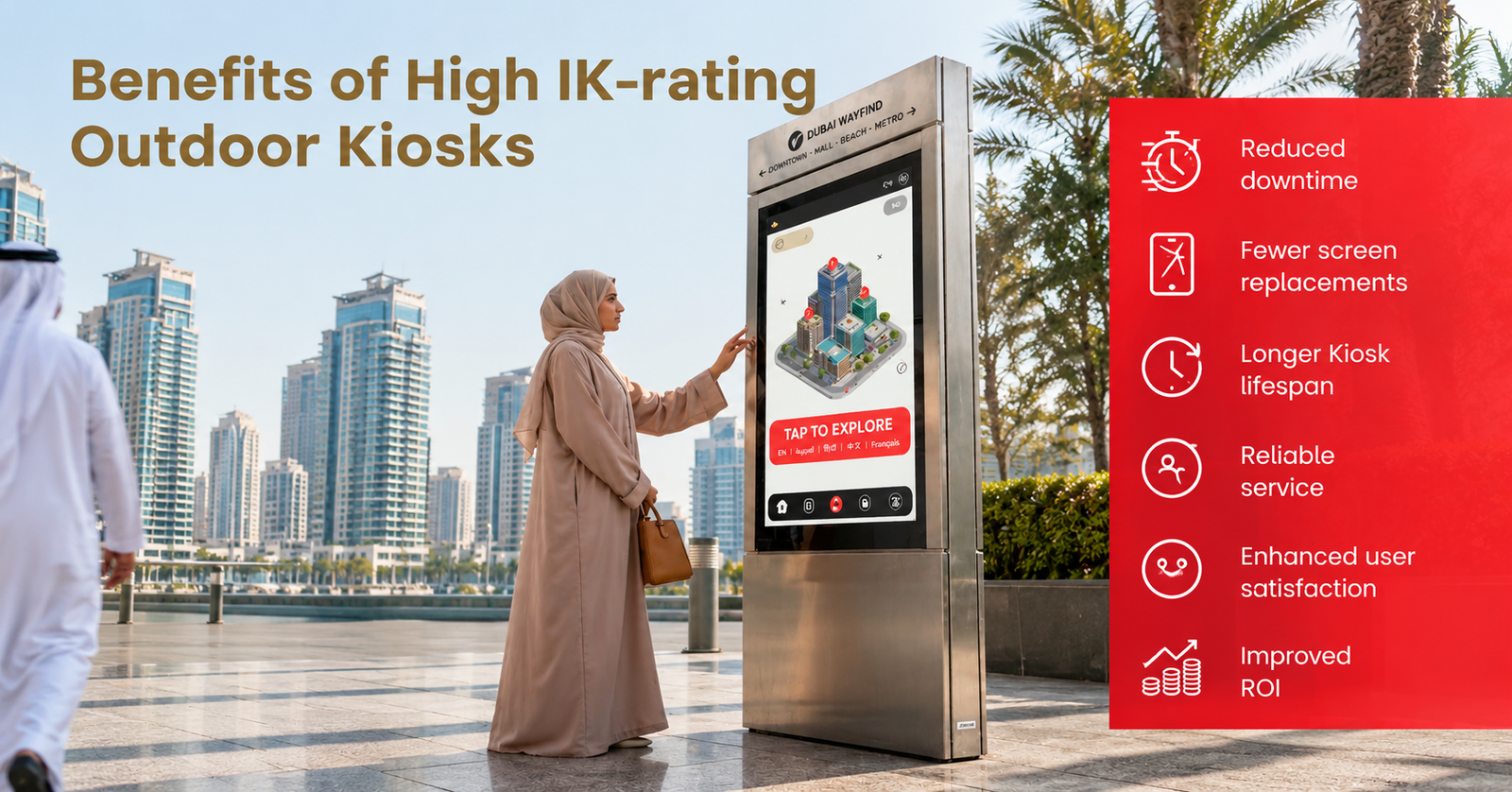
Here are those benefits.
- Reduced downtime – the kiosk keeps serving customers instead of waiting for the repair and maintenance team.
- Lower maintenance costs – Fewer screen replacements and fewer emergency technician visits mean a lot of money saved.
- Longer kiosk lifespan - A tougher screen protects the display and electronics behind it. Hence, more life to the machine.
- Improved ROI – More working hours means more the number of transactions over the kiosk’s life.
- Reliable service – the kiosk services are always available for the users/customers. Hence, service consistency is improved.
- Enhanced customer/guest/user satisfaction – Reliable services, top-notch performance, and a solid, well-kept kiosk make people comfortable. Hence, they trust the service provider or operator.
Does Panashi offer vandal-resistant kiosk machines for Outdoor requirements?
Yes. Indeed. Panashi offers outdoor kiosk terminals built to the IK rating your site requires.
We offer weatherproof, vandal-resistant kiosk machines for a wide range of outdoor use-case scenarios.
To name a few:
- Ticketing terminals for transportation hubs
- Payment kiosks for parking facilities
- Ticket issuance terminals for events and festivals
- Smart city kiosk
- Information and wayfinding kiosks for parks, streets, etc
Here are some of the key features of Panashi outdoor kiosk machines.
- Weatherproof steel enclosure – Durable IP65/IP67-rated steel enclosures keep Panashi outdoor kiosks running 24/7, day in and day out, in harsh weather.
- IP65 dust and splash protection – Complete protection from dust and water splashes, backed by a multi-layer filtering system that keeps dust out.
- IP67 water immersion protection – Complete dust protection plus water immersion protection up to 1 metre for 30 minutes.
- Sunlight-readable display – High-resolution, sunlight-readable screens stay clear and easy to read for users, even under intense, direct sunlight.
- Anti-corrosive coating – Specially treated enclosures with anti-corrosive coating and industrial-grade paint resist rain, dust, sunlight, temperature extremes and wear and tear.
- Intelligent temperature control – Built-in systems manage temperature variations inside the kiosk to maintain optimum performance in changing outdoor conditions.
- Temperature alerts – Dedicated temperature sensors send timely alerts to kiosk operators whenever the temperature rises above a preset value.
- Wide operating temperature range – Panashi outdoor kiosks operate from -30°C to 60°C, suiting businesses and service providers across varied climates.
To understand the difference between outdoor and indoor kiosk machines, please visit our blog here.
Panashi outdoor kiosk for ticketing – Case study
Panashi’s weatherproof outdoor ticketing terminals handle the ticketing operations of the renowned Sheikh Zayed Festival, the annual cultural and entertainment event held in Abu Dhabi, UAE.
The ticketing terminals are deployed at the entry gates and they perform 24/7, automated ticketing.
The ticketing kiosk deployment helps the authorities to reduce congestion at entry points, and also improves the visitor flow.
To gather more information on the Sheikh Zayed outdoor ticketing kiosk deployment, please visit our official Project page.
To conclude
An IK rating is a simple number. But it tells you a lot about how your kiosk will survive in the real world. For supervised indoor spaces, a moderate rating works fine. For outdoor and unattended kiosks, IK10 is the safe choice.
Undoubtedly, self-service kiosks are moving into streets, parks, fuel stations, rural towns, and underserved regions. As they spread, impact protection will matter even more. Choose the right rating today, and your kiosk will keep serving users for years.
Stay tuned for more on kiosk touchscreens.
Frequently
Asked Questions
Yes, of course. We manufacture vandal-resistant, weatherproof kiosks for government institutions, law enforcement agencies, municipalities, etc.
Yes. We install drive-thru outdoor kiosks for several industries like governments, QSRs, retail, banking, telecom, hospitality, automotive industry, etc. Let us know your specific industry and associated use-case scenarios.
For high ambient lighting scenarios, kiosk touchscreens should offer a brightness of 4000 nits for clear visibility. Exposure to direct sunlight is a crucial factor here.
Yes. Panashi is an end-to-end kiosk supplier in Saudi Arabia. We provide high-brightness touchscreen kiosks for various outdoor requirements and use case scenarios in KSA.
An IK10 rating is the highest level of impact protection. A standard outdoor kiosk starts at around USD 4,000 to 7,500. A fully custom unit with payments, biometrics and cooling can cross USD 10,000. Share your use case, site conditions and quantity with our team. We will send you a detailed proposal at the earliest.