
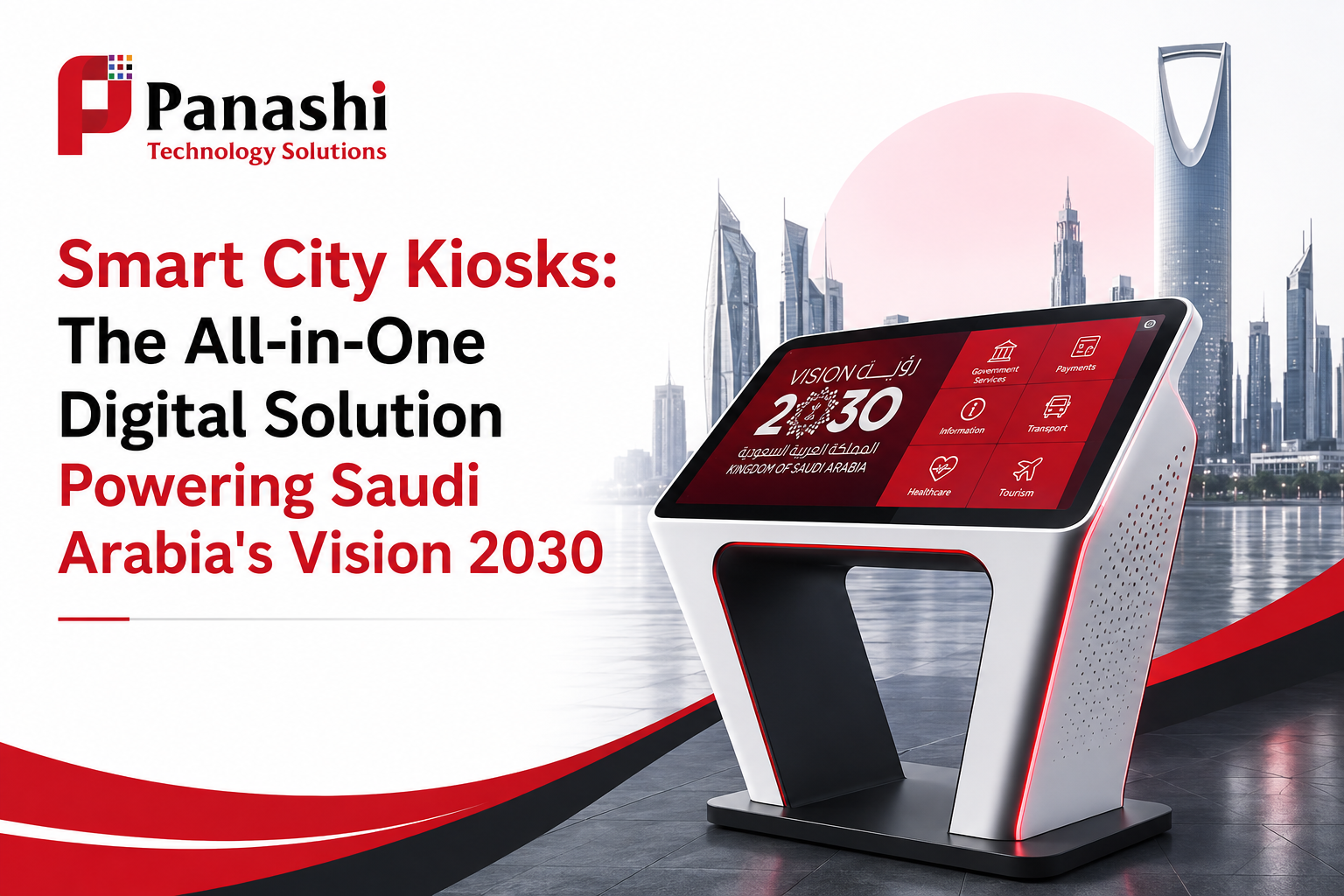
Smart City Kiosks: The All-in-One Digital Solution Powering Saudi Arabia's Vision 2030
The Kingdom of Saudi Arabia is truly on a transformational path propelled by the Vision 2030 initiative. As part of the Vision 2030 goals, Saudi Arabia focuses on multiple developmental programs that encompass multiple sectors. Financial sector development, health sector transformation, pilgrim experience program, national industrial development and logistics program, quality of life program, housing program, just to name a few. Yes, it’s a comprehensive, multifaceted project aimed to revamp and revitalize Saudi Arabia – a 360-degree transformational approach.
Smart city kiosks can be equipped to offer a plethora of services in connection with this transformation, particularly in smart city and urban development initiatives.
This blog will help you understand the relevance of Smart kiosk terminals and highlight how these interactive machines play a transformative role in realizing the Vision 2030 goals.
Vision 2030 Saudi Arabia: the 3 phases
Vision 2030 is a strategic initiative by Saudi Arabia to diversify its economy and bring down the country’s excessive dependence on oil. The Vision was launched under the direction and guidance of Crown Prince Mohammed bin Salman in 2016. Almost a decade after the launch, the Kingdom has been able to make significant advancements in the sectors like logistics, renewable energy, tourism, manufacturing, entertainment etc.
“An Ambitious vision for an ambitious nation” – is what is published on the official Vision 2030 website. And I totally agree with this small but powerful statement.
The Saudi government has demarcated the Vision 2030 project into 3 parts or phases in terms of duration.
- 2016 – 2020 phase – aimed at the development of smart cities and economic zones to portray Saudi Arabia as a business/investor-friendly landscape.
- 2021 – 2024 phase – aimed at digital transformation of the government and business sectors through strategic technology adoption.
- 2025 – 2030 phase – bring the transformation to the next level by improving investment opportunities, and project Saudi Arabia as a prominent leader in all economic aspects.
Vision 2030 – the 3 pillars
Vision 2030 is built on 3 pillars and they are, a vibrant society, a thriving economy, and an ambitious nation.
Let’s have a deeper dive into the pillars of Vision 2030 for a better understanding.
Vibrant society – Saudi Arabia hopes to build a vibrant society that offers a gratifying life to its people, values its cultural traditions, and upholds the principles of Islam. The pillar prioritizes on improving education, social initiatives, and healthcare.
The major goals of this pillar are:
- Enhancing the quality of life through tourism, entertainment and healthcare.
- Indulging in smart urban planning, development of giga infrastructure projects like NEOM and Red sea project.
- Prioritizing health and well-being of the residents through sports and other recreational activities.
- Preserving Saudi cultural and Islamic legacy.
Thriving economy – The pillar is focused on reviving and revitalizing Saudi’s economy through economic diversification and creation of job opportunities.
The major goals of this pillar are:
- Reducing the dependency on oil by focusing on non-oil sectors like tourism, healthcare, technology and manufacturing.
- Giving priority to the non-oil sectors and improve their offering towards the national GDP.
- Strengthening private sector through Foreign Direct investment (FDI).
- Cultivating the spirit of entrepreneurship among the residents by supporting the growth of SMEs.
- Building a skilled workforce through education, training and upskilling programs.
- Enhance women’s role in the workforce to 30% and reduce rate of unemployment to 7%.
- In terms of economic position, Saudi Arabia is the 19th largest country in the world. Under the Thriving Economy pillar, the country aims to improve its position to the list of first 15.
Ambitious nation
The pillar stands for building an effective, accountable and transparent government and fostering a society of well-informed and responsible citizens. It urges all parties involved (government, private, non-profit organizations and citizens to actively participate and play their respective roles in nation-building.
The major goals are:
- Improve government operations and efficiency through digital transformation
- Build accountability and trust by implementing anti-corruption policies.
- Facilitate civic engagement among the residents.
- Increase revenue from government sector (non-oil sectors) to 265 billion USD, by 2030.
- Raise Saudi Arabia’s E-government Survey Index to the top 5 and Government Index ranking to 20th position.
What is a Smart City Kiosk?
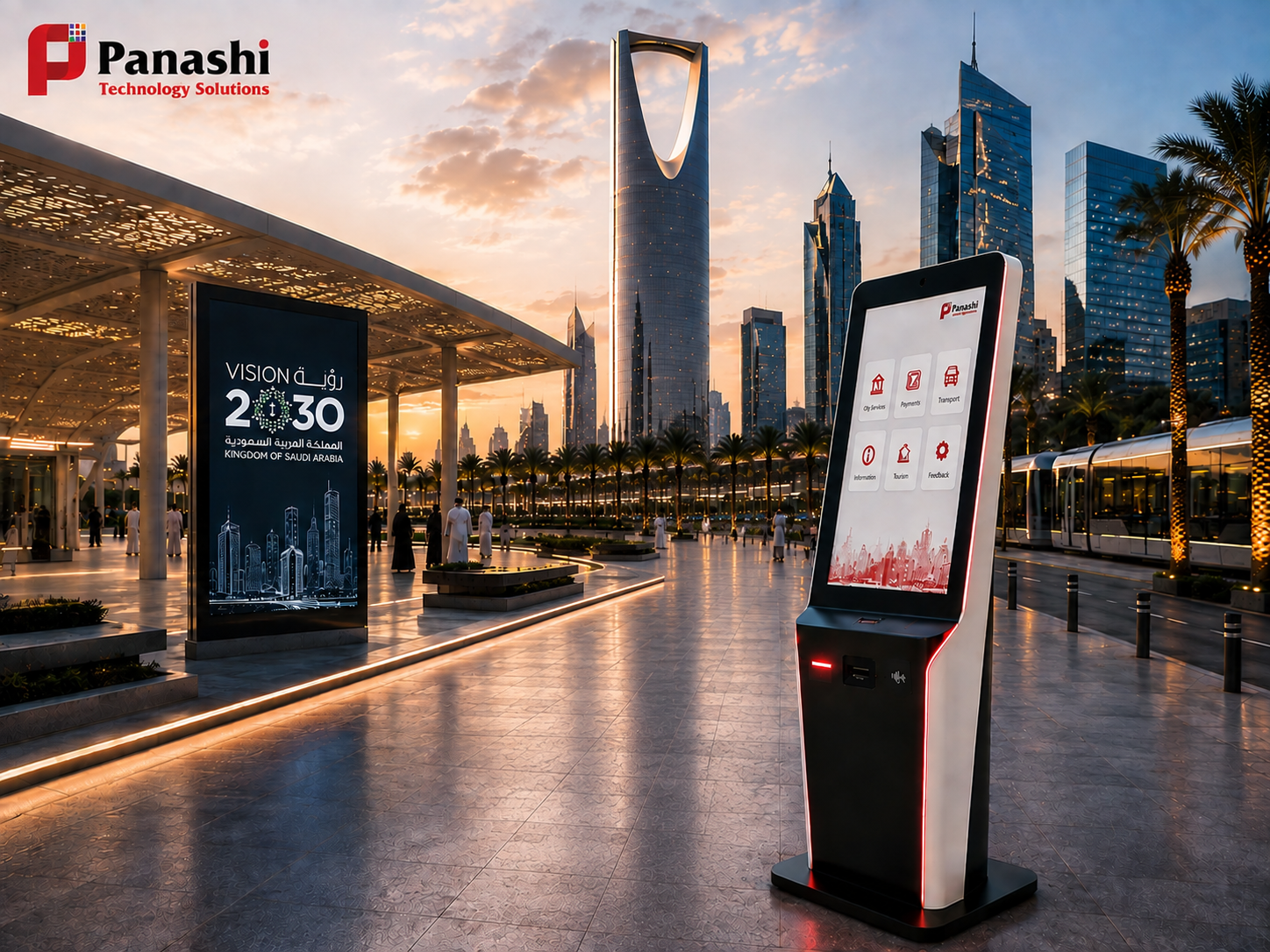
A smart city kiosk is an interactive kiosk terminal that provides a plethora of services to the citizens and tourists, like wayfinding, public services, bill payment, information dissemination, emergency assistance etc. These kiosk machines are integrated with various hardware, software and technology integrations like an interactive touchscreen, internet connectivity, sensors etc. to offer seamless interactions.
When deployed at strategic, high-footfall locations, these smart self-service kiosk terminals help both citizens and tourists access a wide range of information and services, on a 24/7 basis. With self-service technology, the users may perform their desired tasks without external human intervention or support, which facilitates a high degree of user convenience. To make things easier, visitors and tourists can interact with the kiosk machine in their preferred language. This makes the smart city kiosk terminal a priceless investment for the travel and tourism industry.
Smart city kiosks are ideal for smart city planning and development initiatives. These kiosk terminals play a crucial role in propelling the smart governance initiatives of the government, helps the travel and tourism sector, and improves urban mobility to a great extent.
To read more on smart city kiosk for urban planning and development, please visit: https://test.panashi.ae/smart-solution-for-urban-planning-and-development/
Features of a Smart city Kiosk
A smart city kiosk is equipped with a range of exciting features. Let’s have a look.
- Intuitive touchscreen – the large, intuitive kiosk touchscreen facilitates kiosk navigation.
- Multilanguage facility – the user can choose the preferred language from a list of languages and use the same for kiosk navigation.
- Wayfinding feature – Visitors and citizens can make use of the wayfinding feature to spot a specific locale or attraction with the help of detailed, interactive maps.
- Utility bill payments – Users can easily perform utility bill payments via smart city kiosk terminals without visiting physical counters.
- Driving License issuance – Driving license issuance becomes an effortless task with smart city kiosks.
- Wi-fi hotspot – The smart city kiosk terminals offers Wi-fi hotspot connectivity so that the users can easily connect their devices to access high-speed internet.
- SOS feature – In times of emergency, the users can press the SOS button to connect with the law enforcement officials.
- CCTV camera – offers 24/7 high-resolution surveillance.
- Cashless payments in smart cities– the users can make use of the payment facility to pay transportation or utility bills; the kiosk terminals offer multiple payment modes like cash, card, or mobile app payments, and cashless payment, making payment process highly convenient.
- News and weather update – the kiosk terminal offers the most updated information regarding local weather, temperature, humidity, air quality via the kiosk screen.
- Ticketing facility – The kiosk terminal is equipped to issue travel and transportation tickets, so that tourist need not visit transportation centers, or other physical ticket-issuing outlets.
- Integrated charging facility – flawless charging facility for seamless charging of devices.
Benefits of Smart city Kiosks in Vision 2030 perspective
Now, let’s delve into the benefits of Smart City kiosk in a Vision 2030 perspective, like how you could leverage the smart self-service kiosk terminal to realize the Vision 2030 goals.
1) Enable automated citizen services
Government institutions can integrate several citizen services into the smart kiosk terminal, so that citizens can avail them via the kiosk machine without having to visit physical service outlets.
The e-government portal of Saudi Government (Saudi.gov.sa) can be integrated into our kiosk platform which will serve as a single touch point to access various government services. Citizens can walk up to the kiosk and access a plethora of services including business registrations, municipal, health, education, and social services etc. By 2030, the number of services is expected to grow.
Of course, the kiosk terminal can serve as a public service kiosk machine. For example: Utility services, renewal of certificates, licenses and other important documents, tracking traffic-related fines and paying the dues via the kiosk machine, filing complaints or submitting requests to local government authorities, etc.
Citizens visit local authorities for a plethora of reasons. And, most often, they are forced to wait in the long lines for several minutes, or perhaps, even for hours.
There are several benefits associated with integrating government services into smart city kiosks.
- Reduced waiting time – The automated smart kiosk eliminates waiting time at government service counters, thereby, saving time of the citizens.
- Bring down operational cost – Government institutions may cut down cost on office rentals, hiring of new staff, and maintenance.
- Reduce paper usage – The kiosk issues transaction receipts in both the print and digital formats. A sustainable, forward-thinking society always go in favor of reducing carbon footprint and they prefer digital receipts over the conventional paper receipts.
2)Take tourism and pilgrimage experience to the next level
In 2024, Saudi Arabia witnessed a record rise in the number of foreign tourists, from 27.5 million (2023) to 30 million. The country is investing in billions in its tourism sector as part of the Vision 2030 initiatives. And hence, the numbers are not that surprising.
As per the statement of Saudi Arabia Tourism Minister, Ahmed Al-Khateeb, the tourism industry alone contributed towards 5% of the overall GDP of Saudi Arabia.
Smart city kiosk has a humungous role in realizing the travel and tourism dreams of Saudi Arabia.
Visitors (both inbound and outbound) can make use of the services of an interactive Smart city machine in various ways. The kiosk terminal serves as a 24/7, interactive touchpoint that informs tourists on various aspects like the ones listed below. The icing on the cake is that the users can access the information in their own language.
- Information about tourist accommodation and amenities - The kiosk terminal offers accurate and updated information about entertainment facilities, local attractions, hotel and restaurant facilities etc.
- Navigation features - The large interactive touch screen of the kiosk machine offers detailed, accurate digital maps of local attractions. This becomes useful for citizens, visitors and tourists alike.
- Ticketing facility – Visitors can book and even purchase tickets via the smart city kiosk which offers a high degree of convenience for the tourists.
- Hajj and Umrah pilgrimage assistance - One of the key goals of Vision 2030 initiative is to enhance the visitor capacity of the Islamic pilgrimage event in Mecca, also known popularly as Umrah, from 8 million to 30 million. The smart kiosk can be deployed in all strategic locations where pilgrims come in large numbers, and serve as a 24/7 self-service information portal.
3)Streamline transportation services
By 2028, the public transportation sector of Saudi Arabia is expected to make a revenue of 1 billion USD – claims Statista. And the same studies predict an annual growth rate of 3.1%, during the time period 2025 to 2029.
Right now, the transportation sector is experiencing significant modernization and expansion, particularly in the mass transportation sector, comprising Metro and bus services. The major cities like Riyadh, Dammam and Jeddah, are right now going through this significant transformation.
A Smart City Kiosk plays an integral role here, as it can serve as an efficient Ticketing kiosk machine.
The kiosk terminal features the ticketing facility, so that travelers and citizens can book and purchase travel tickets via the kiosk machine.
If installed at important transportation hubs, terminals and airports, the kiosk machine can issue and print tickets with utmost efficiency. And the benefits are evident.
- 24/7, smart ticketing system – The kiosk machine takes care of the ticketing responsibility. The travelers need not have to stand in the long lines at busy transportation hubs for the sole purpose of purchasing tickets.
- Recharge transit cards – metro travelers can easily recharge their transit card through the kiosk terminal which prevents congestion at ticket counters.
- Access timings and schedules - Passengers can easily access accurate, real-time schedules of metro or bus services via the kiosk machine.
- Integrated transportation ticketing services – The integrated transportation ticketing facility allows tourists to book multiple modes of travel through a single kiosk platform like bus bookings, metro train reservations, open-top city tour bookings, ferry bookings etc. The one-stop booking facility improves the overall travel experience by leaps and bounds.
- Integration with mobility applications – You may integrate a smart city kiosk with other travel-related mobility applications or facilities like ride-hailing apps, charging stations, smart parking solutions etc. and contribute towards improving urban mobility.
4)Sustainability Vision 2030
Sustainability is another integral aspect of Saudi’s Vision 2030 initiative. Don’t be surprised – the country is striving towards net zero emissions, and there is every chance of achieving the same, probably within next 4 decades. The Kingdom has already launched the Saudi Green Initiative (SGI) in 2021 and it revolves around battling climate change, enhancing quality of living, and environment conservation. The 3 main objectives of SGI are as follows:
- Reduce carbon emissions by substantial levels by 2030.
- Large-scale planting of trees over an extensive area.
- Protection of land and sea
Smart city kiosks perfectly align with sustainable urban development in various aspects. Let’s have a look into it.
-
Enabling paperless transactions – A sustainability-conscious citizen would definitely opt for a digital receipt instead of a paper receipt after a particular transaction. Even though the self-service kiosks are equipped with a printing device, it is not necessary to always take paper print-outs or accept printed receipts. Instead of a printed copy, a forward-thinking user sends the document to his personal email ID or other apps.
The E-documents, e-bills, or e-receipts reduce the usage of paper to a great extent and work towards a more sustainable and greener environment. - Renewable source of power - Smart City kiosks installed in outdoor conditions can be equipped with solar power panels which helps to reduce power consumption.
- Use of energy-efficient components - the use of kiosk components that consume less power work in favor of sustainability. For example: kiosks manufacturers may design smart city terminals with motion sensors that could regulate power consumption based on sensing user-activity.
- Helps in reducing vehicle-induced emissions – Now, you may wonder what a kiosk machine has to do with controlling vehicle emissions.
As, I have already mentioned above, smart city kiosks can streamline mass transportation services. When users are able to figure out Metro or bus timings accurately, in real-time, and plan their travel schedules accordingly, it’s an encouragement – the encouragement to rely on mass transportation services, instead of calling a taxi or using a private-owned vehicle. Relying on mass transportation facilities significantly reduces vehicle-induced carbon emissions.
Similarly, by integrating mobility solutions with smart city kiosk, like the information regarding the nearest charging station, smart parking facilities etc. help users easily locate these facilities and reach those locations in minimum time. This reduces the congestion on roads which further reduces the harmful emissions.
- Spread Sustainability cause – At idle time, the kiosk machine can be programmed to display messages and suggestions that convey the importance of sustainability to the public. You may display the content by means of short audio or video clips, text message, or via animated videos. Yes, there are a lot of engaging options!
5)Helping retail growth
The “tremors” of Vision 2030 initiative can be felt in the retail sector too, in the form of investments in the retail sector and amendments in retail regulatory norms. And they have certainly helped to promote retail competition.
It is predicted that, by 2028, the retail sales value is expected to reach around 161.4 billion US dollars, claims Statista. In 2024, the value was estimated at 133 billion US dollars.
The capital city of Saudi Arabia – Riyadh has emerged as a luxury retail hub. When it comes to luxury, lifestyle and entertainment, Riyadh, has become one of the most preferred destinations, housing some of the finest retail centers like Via Riyadh, Bujairi Terrace, Century Corner etc.
A new addition to the list is Diriyah Square, that features restaurants, souks, hotels, resorts, and more than 400 luxury brands.
- Omnichannel touchpoint – A smart city kiosk can serve as an omnichannel touchpoint for retail establishments. Retail players can list their business and even market their products via the kiosk machine in the form of advertisements or promotional messages. And not just that, the users can browse through the product listings and even purchase their desired product by simply placing orders through the kiosk machine. To add on, apart from the offline shopping experience, the local retailers get the added opportunity to reach their customers digitally, via a self-service order & purchase platform.
- Kiosk advertising through smart city kiosks – by installing the smart kiosk at strategic, high-footfall locations, the kiosk terminal can serve as a highly effective advertising platform that catches the attention of the people around.
6)Teleconsultation services for Saudi Arabia smart cities
As part of the Vision 2030 initiative, the Saudi government has devised a Health sector transformational program. The program takes a comprehensive approach towards revolutionizing healthcare facilities and ensuring the participation of private players in the healthcare sector.
Due to the comprehensive approach, the program deals with most of the vital aspects of healthcare like innovation, economic sustainability, and prevention of ailments. It also delves into the possibilities of improving patient care through the implementation of e-health services and developing digital applications.
In 2020, Saudi Arabia’s healthcare expenditure was estimated to be $49 billion, with the graph climbing upwards towards $77 billion, by 2027. To improve the access to healthcare services is one of the chief objectives of Vision 2030.
A Smart city kiosk can play an instrumental role in improving the access to healthcare. Here is how.
- Teleconsultation/Remote consultation booth – With video conferencing technology in place, the Smart City kiosk serves as a telehealth kiosk that offers remote consultation. The users can either schedule an appointment with a registered medical practitioner or engage in a live, virtual consultation, whichever convenient. This remote consultation facility can be used by citizens and visitors as well, 24/7.
- Traveler’s medical assistance – The teleconsultation booth can serve foreign tourists and visitors, as they need not go to a hospital, perform patient registration and stand in the long lines to seek medical consultation.
- Ideal for remote areas – The remote consultation facility is ideal for remote locations where medical infrastructure and facilities are limited.
- Promote public awareness campaigns through animations and videos like CPR demonstration, health-awareness videos, combating drug addiction campaigns, etc.
7)Supports digital inclusion initiatives
Citizens are entitled to have equal access to internet and e-government services, so that they can become part of the decision-making initiatives of the government. As part of Saudi government’s digital inclusion initiative, the government has rolled out various programs that revolve around the core concepts of connectivity, affordability, accessibility to e-government services, and digital skill acquisition.
- Reducing the digital divide – Deploying smart city kiosks could be a perfect move towards digital empowerment.
Not all people would have access to smartphones, or high-speed internet services. At times, infrastructure-related limitations can cause accessibility issues for citizens. Here comes the role of a Smart City Kiosk terminal.
A Smart Kiosk terminal installed at high-footfall locations serves as a digital touchpoint for the public, enabling people of all ages, financial background, access the services offered by the government.
The kiosk terminal serves as a reliable public service delivery platform that allows citizens to perform most of the tasks related to the General Department of Traffic, utility bills, complaint registration, request submission, and a lot more.
- Successful transactions done in minimum time without errors and inconsistencies, attract more and more users to the Smart city Kiosk, which paves the way for improved digital adoption.
8)AI and IoT in smart cities
The latest cutting-edge technologies like AI and IoT can be integrated into the smart city kiosk terminal to improve the operational efficiency and overall user experience.
Role of AI
- AI voice-over technology - integrating AI voice-over technology can improve voice-enabled interactions. The technology integration becomes useful, particularly for people with some kind of disability that restricts their movements. For example, a user can access the kiosk and enquire about the current temperature or metro timings to a particular destination.
- AI-enabled biometric authentication – AI-enabled biometric authentication improves security at the time of user authentication, and thus prevents frauds, impersonation etc.
- AI-based analytics – AI-based analytics helps authorities take data-driven decisions related to a wide range of domains like transportation, peak-time footfall, environmental conditions etc.
IoT integration benefits
- IoT sensors for information dissemination – Integrating IoT sensors enables effortless interactions with smart urban infrastructure, helping with gathering dynamic updates about local weather, air quality, transportation schedules, traffic-related updates etc.
- Law enforcement authorities – users can instantly connect with the authorities at the time of emergencies.
- Smart transportation facilities – IoT enabled sensors helps users gather the most updated information about parking availability and traffic scenario.
- Assisting retail sector – IoT sensors can pick up certain interesting data like the footfall in the surroundings, and help with displaying retail ads.
Self-service kiosks in Saudi Arabia - General Benefits
The Smart city kiosks serve as the perfect automated information and service platform that attend to the needs of both the visitors and citizens. Moreover, they serve the government authorities in a lot many ways. And, here are some of their common benefits, which I feel, you should definitely know.
- Real-time monitoring facility – A smart kiosk terminal can be monitored from a remote location by a designated admin, without having to visit the actual site of the kiosk. The same admin may deploy software patches and necessary updates, when required. This, in fact, helps to save a lot of travel expenses.
- Scalability – The kiosk terminals are scalable, which means that you may augment the number of kiosk machines to form a kiosk network. The scalability benefit immensely helps in future expansion plans.
- Customizability – These kiosk terminals are highly customizable, let it be the kiosk design, branding aspects, the hardware or software customization or even the customization of its functionality. Yes, you’ve got a lot to explore or innovate, depending on your creativity and requirements.
- Ease of deployment – The smart kiosk terminals can be deployed in both outdoor and indoor environments. They also come in semi-outdoor modes, which means, these interactive machines are highly flexible, and easy to deploy in different environments.
- Easy relocation – the kiosk terminals can be easily relocated to a different location, as and when needed.
Smart City Kiosks - the final wrap up
The feature-rich smart city kiosks have immense potential and they certainly have a huge role to play in the digital transformation of Saudi Arabia. The technology-integrating benefits, easy customization and scalability make these interactive terminals perfectly align with the diverse goals of Saudi Arabia’s Vision 2030 initiative.
At Panashi, we are inspired by this bold ambition. We are committed to contributing to Saudi Arabia’s journey toward becoming a global hub for smart cities and digital innovation.
As Saudi continues to build modern, tech-driven cities, a smart interactive kiosk will serve as an essential tool or platform in driving innovation. The helps the Saudi Economy to achieve the most-needed diversification.
And I can assure – by embracing the smart kiosk technology, the Kingdom will move closer to its vision of a digitally empowered, globally connected economy.
Frequently
Asked Questions
Yes. Absolutely. We supply smart city kiosks for smart city projects in Saudi Arabia to support its economic diversification and Vision 2030 initiatives. Our modular kiosk design and full-on customisation benefits help governments to deploy the apt machine with all the necessary features.
Smart city Kiosk price in KSA varies with several factors like kiosk type - outdoor or semi-outdoor or indoor, technology integration, customisation requirements, deployment units, etc. Let us know your specific requirements, our team will come up with the best pricing for Saudi Arabia.
Panashi’s outdoor kiosk terminals are tried-and-tested to handle Saudi Arabia’s harsh environmental conditions. The kiosk enclosures are IP65/IP67-rated and protect the components from extreme summer heat, sand and dust storms, coastal humidity swings, and cold winter nights.
Timelines vary depending on the scale of the project – a single kiosk Vs a city-wide rollout – are two different undertakings. We request your team to have a quick conversation with Panashi team.
Yes. Absolutely. Panashi kiosk interface can be set up in the Arabic-first, right-to-left layout to suit Saudi customers or citizens. We perfectly understand the importance of this layout in Saudi Arabia.
Yes. Panashi smart city kiosks support Mada and STC Pay for all payment-related transactions. Mada is practically the default card network across the Kingdom, and STC Pay has become one of the most widely used digital wallets among Saudi consumers.