

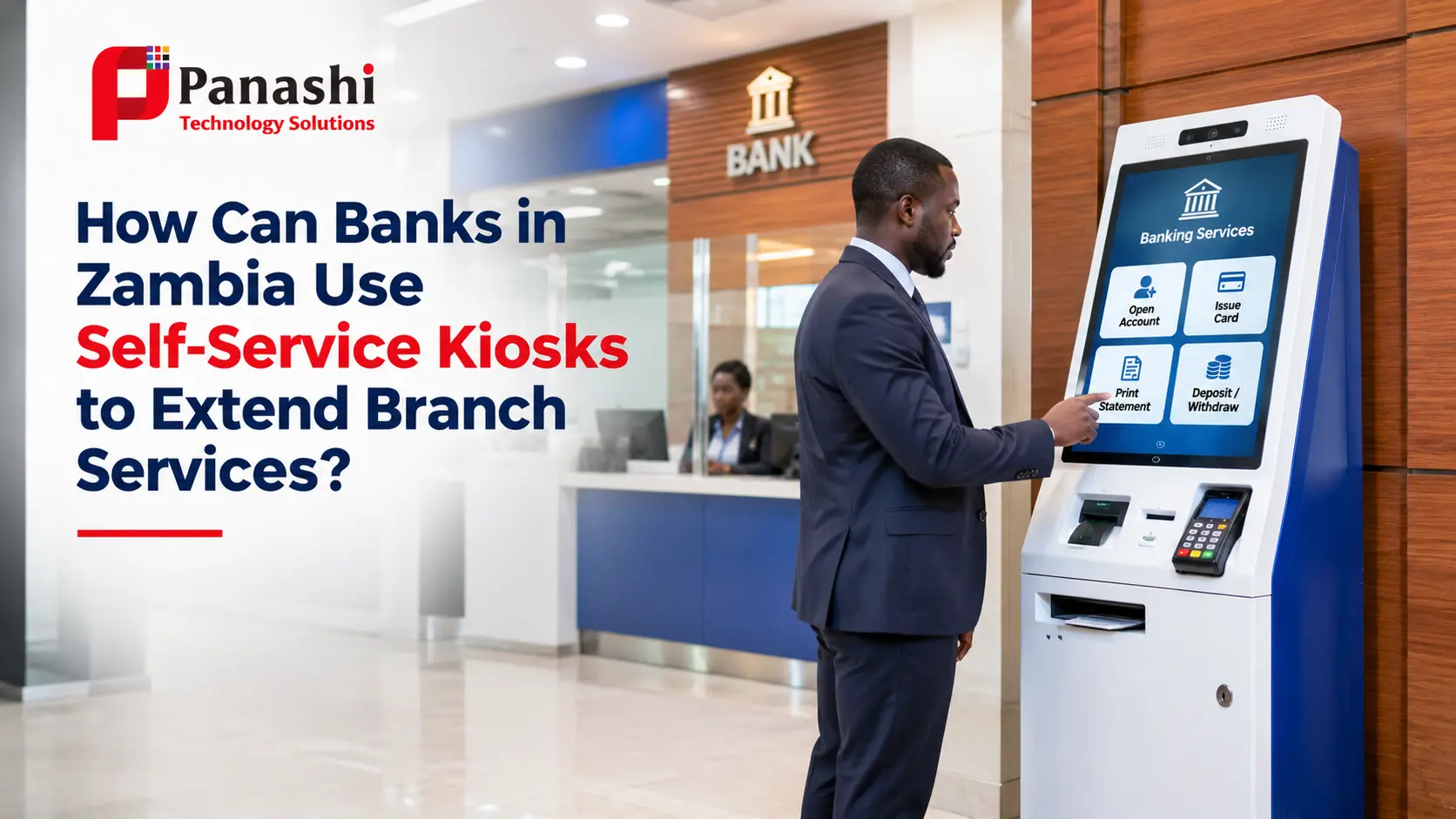
How can Banks in Zambia use Self-service Kiosks to Extend Branch Services?
Can a bank branch reach customers who live far from its doors? In Zambia, that question matters more than ever. Mobile money has brought millions of people into formal finance. But many customers still need a bank for cards, statements, and account updates.
And opening a new branch takes time and money. So, what is the practical answer?
Self-service kiosks for banks in Zambia can bring selected branch services closer to your customers. In simple words, you automate routine work and keep the personal touch for complex needs. Kindly read on to see how.
What is a banking self-service kiosk?
A banking self-service kiosk is a secure terminal that allows banking customers perform most banking tasks on their own without staff assistance. It’s usually loaded with several hardware components that include:
- Interactive touchscreen
- ID scanner
- Printer
- Card module
- Cash module
- Biometric reader
The banking kiosk does not replace a full-fledged bank branch. It handles the common service requests that are repetitive in nature. You can even think it as a smaller, always-ready extension of your branch counter. Refer for more https://panashi.ae/banking-kiosk-solutions/
What are the banking services offered by a banking kiosk?
I have listed some of the most useful services below.
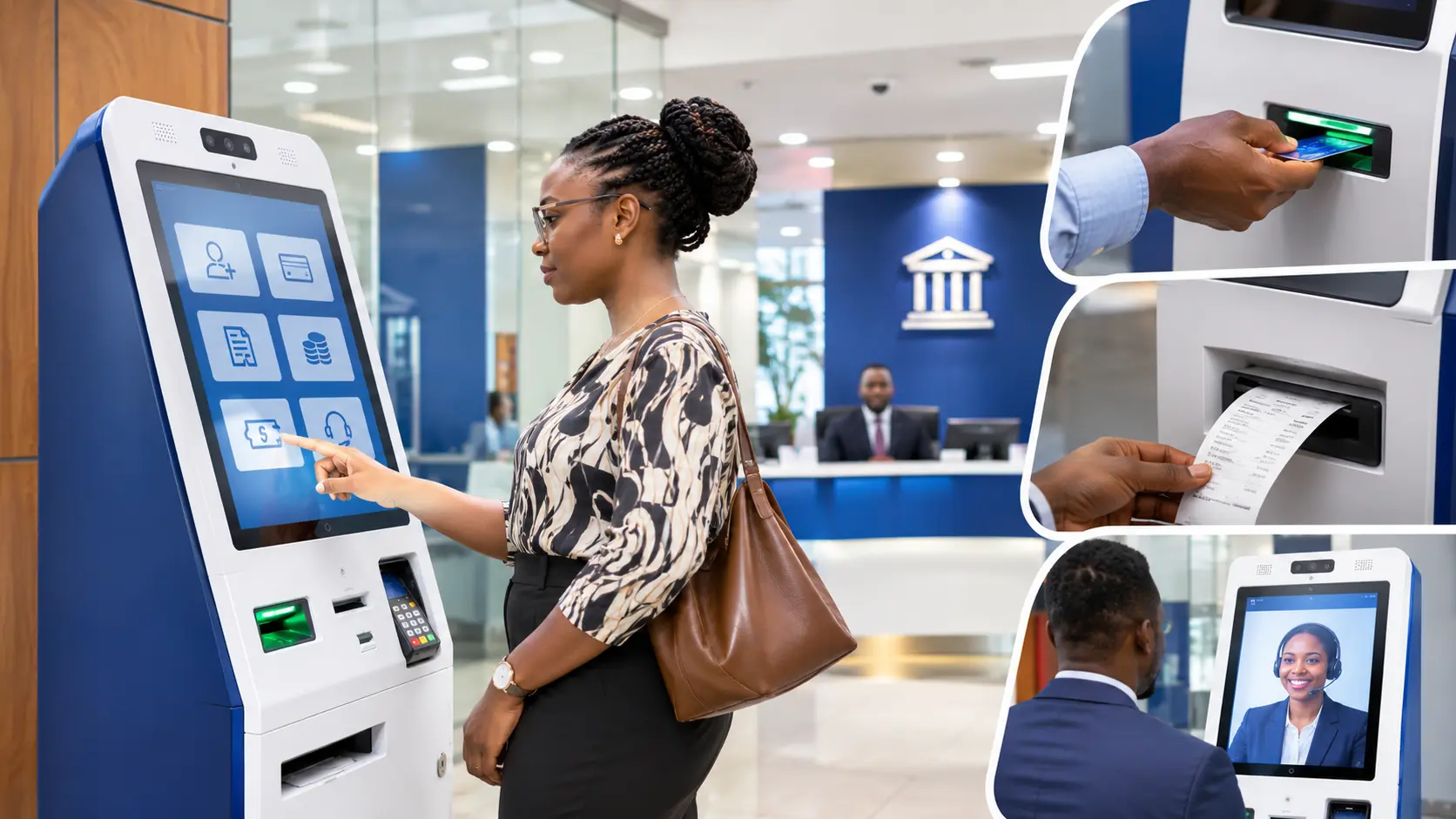
- Account opening - Customers can enter their details, scan their ID, and perform eKYC.
- Instant card issuance – Receive a new or replacement card on the spot. No second trip is needed.
- Customer data updates – Update customer phone number, address, or other details without joining a queue.
- Bank statements and letters – The kiosk can print statements and account confirmation letters within minutes.
- Deposits and withdrawals – Kiosks integrated with cash modules can accept deposits and dispense withdrawals.
- Cash-in and cash-out – mobile money cash-in and cash-out on integrated wallets.
- Video banking – The video chat facility allows the customers to interact with a remote banking agent. This is extremely useful in places without a full branch team.
Where should banks install banking kiosks?
Now let’s see where a kiosk can make the biggest difference. The right location depends on footfall, security, and the services your customers need the most.
- Busy branches – Routine tasks can move to kiosks, which frees your counter staff for complex customer requests.
- Shopping centres and markets – deploying banking kiosks at major commercial centres, shopping destinations, and markets help customers complete their banking tasks at their convenient time.
- Universities and large employers - Students and staff can get cards, statements, and account-related support close to home or work.
- Mining areas – Self-service banking kiosk offers blue-collar workers on mining areas a safe, local banking touchpoint.
Why do banks in Zambia need to extend branch services?
Zambia’s financial inclusion story is impressive.
As per the findings of Zambia Finscope 2025 survey, financial inclusion rose to 80.1 percent from 69.4 percent (2020).
Mobile money became the leading force behind financial inclusion. (76.2 percent as of 2025)
Zambia almost doubled its financial literacy, from 23.6 percent (2020) to 46.1 percent (2025).
Active mobile money wallets nearly doubled in 2025, rising 98% to 17 million.
But it happens to be a different story when it comes to physical bank access in Zambia.
According to the data published by the World Bank Group, as of 2020, commercial bank branches in Zambia per 100,000 adults was approximately 3. But, as of 2024, the number got reduced to 2.5 branches per 100,000 adults.
See the gap? Customers are moving to digital channels, yet some tasks still bring them to a branch.
The payment scene is changing quickly as well.
As per Bank of Zambia, Zambia ended the use of cheques as a payment instrument on 26 June 2026.
Leading Zambian commercial banks such as Zanaco and Stanbic now accept mobile money payments on their POS machines.
Banks are clearly going where their customers are. Self-service kiosks can take that thinking one step further.
What are the benefits of implementing banking kiosks in Zambia?
Both the banks and their customers benefit from implementing self-service banking kiosks.
Here are those benefits.
Benefits in bank’s perspective
- Wider reach – you can add secure, service points without having to build a brick-and-mortar branch.
- Better use of employees – Banking employees can spend more time on productive tasks like customer advice, proactive outreach, etc.
- Reduced paperwork – Digital forms reduce manual data entry and storage.
- Gather vital data - Kiosk reports show which services customers use, and where demand is growing.
- Reduced expenses – Banks can save on rental and utility expenses.
Customer benefits
- Reduces wait time – commonly requested services need not go through the counter queue, which eliminates wait time.
- Language and accessibility support - Multilingual menus, guided on-screen steps, and accessibility support can make transactions easier for more people.
- Less travel – Customers can accomplish their routine banking tasks closer to where they work or travel, which reduces travel time.
- Instant results – Several requests such as card issuance or statement printing, can be completed on the spot without return visits or waiting for delivery.
- Improves access to banking services – A self-service banking kiosk is open to 24/7 banking, and can be installed at high foot-traffic locations.
- Improved privacy and control – Customers can review their details on the screen at their own pace without communicating at the counter.
Panashi’s branch-in-box banking solution for Zambia
A branch-in-box is a small-footprint, integrated banking solution that offers most of the services offered by the conventional bank branches.
Banks can open branch-in-box banking solutions in rural towns, markets, industrial zones, and mining communities in minimum time, with lower setup costs and fewer staff.
And, customers can open accounts, deposit or withdraw cash, pay bills and print cards without visiting the conventional brick-and-mortar banks.
Even microfinance institutions can use the same model to serve customers who have never visited a bank branch.
Implementing our branch-in-box solution is a highly feasible strategy to connect with the underserved regions of Zambia.
Which are the major banks in Zambia?
The leading commercial banks functioning in Zambia are listed below.
- Zambia National Commercial Bank Plc – The Zambia National Commercial Bank or Zanaco is a commercial bank headquartered in Lusaka. It offers various banking products and services like Personal Banking, Private Banking, Business banking, Corporate and Investment banking, etc.
- Absa Bank Zambia Plc – headquartered in Lusaka, previously known as Barclays Bank of Zambia, caters to the needs of retail, SMEs, and also offers corporate banking solutions.
- Stanbic Bank Zambia Limited – Stanbic Bank Zambia Limited is a wholly owned subsidiary of the JSE-listed Standard Bank Group and a leading Zambia-focused financial services provider, headquartered in Lusaka.
- Standard Chartered Bank Zambia Plc – Lusaka-based, LuSE-listed bank established in 1906 and part of the UK’s Standard Chartered group. The bank focuses on corporate and investment banking.
- First National Bank Zambia Limited – Lusaka-based commercial bank and wholly owned subsidiary of South Africa’s FirstRand Group. The bank serves corporate, commercial and individual clients across Zambia.
- AB Bank Zambia Limited – Lusaka-based commercial bank, part of the Berlin-headquartered Access Microfinance Holding network. The bank basically associates with micro, MSMEs and low- to middle-wage communities.
- Zambia Industrial Commercial Bank Limited – The Lusaka-headquartered bank is a wholly Zambian-owned commercial bank. It serves commercial establishments and industries across Zambia.
How can banks get started?
Start small, learn quickly, and then scale. Here is a simple five-step plan.
- Understand branch requests - Study your branch data and choose the routine tasks that consume staff time or cause operational delays.
- Choose your pilot sites – Begin with two or three locations.
- Staff training – Train your staff, and assign someone to provide floor assistance beside the kiosk for the first few weeks.
- Measure the results - Track uptime, completed transactions, failed attempts, and customer feedback.
- Scale - Add services and locations once the pilot shows real customer demand.
To conclude
Zambia has already advanced rapidly in digital finance. Mobile money is widely used, and payment systems are becoming more connected. Yet many customers still need the services traditionally offered by a branch counter.
Self-service kiosks can certainly fill that gap. They can bring cards, account services, statements, and assisted support closer to your customers. And they can give your branch teams more time for the conversations that truly need a human.
Undoubtedly, the branch of the future may not always look like a branch. Sometimes, it may simply be a secure screen in the right place.
Frequently
Asked Questions
The banking kiosk price in Zambia is not fixed. It depends on several factors like the technology and hardware integrations, customisation, number of units required, etc. However, the typical prices start from 20,500 ZMW, and go upwards, depending on the configuration.
Yes, we can. Most banking kiosk solutions are deployed indoors, such as in bank branches, shopping malls and office lobbies. An outdoor kiosk needs a weatherproof enclosure, a sunlight-readable display, temperature control, surge protection and secure anchoring. It also needs vandal-resistant hardware to protect the components, cash and customer data.
Yes. Panashi offers service and maintenance for banking kiosk solutions based on a service level agreement. It includes both remote and on-site assistance.
Yes. Our banking kiosk can connect with mobile money platforms through secure software integration.
Yes, Panashi supplies Interactive Teller Machines (ITMs) for banks and financial institutions in Zambia. Customers can speak with a remote teller through a live video call. They can deposit or withdraw cash, transfer funds, pay bills and get account support without visiting a teller counter.