

Reverse Vending Machines in the GCC: A Complete Guide
Have you ever wondered where your empty bottle goes after you throw it away? Too often, it ends up in a landfill or the sea. Yes, you read that right!
Gone are the days when recycling depended only on goodwill. Today, Reverse Vending Machines (RMV) make it simple, rewarding and measurable.
You feed in a used bottle or can, and the machine gives you points, vouchers or coupons. RVMs are gaining importance in several countries across the globe for its ease of use and sustainability benefits.
So, what exactly do these smart machines deliver? Kindly read on.
What is a reverse vending machine?
In simple words, reverse vending machines are self-service terminals that accept used containers like glass or plastic bottles, metal cans, etc. and in return offer vouchers, coupons, and cash-back offers.
Instead of dispensing consumables and products, as in the case of normal vending machines, RVMs accept stuff for the purpose of recycling. Hence, the name reverse vending machine.
In many countries, RVMs are part of a deposit return system (DRS). You pay a small deposit when you buy a drink. When you return the empty container to an RVM, the machine scans it and refunds your deposit. In the GCC, most schemes reward you with points or vouchers instead, with no upfront deposit.
How big is the global RVM market?
According to the research conducted by Global Information, the global reverse vending machine market is valued at USD 496.8 million in 2025. It is projected to reach USD 752.5 million by 2032, attaining a CAGR of 6.1%.
Some of the chief drivers of RVM market growth are listed below.
- Mandatory deposit return schemes – the countries that belong to the European Union are required to separately collect at least 90% of single-use plastic bottles and metal drink cans, by 2029.
- Plastic waste and sustainability targets – landfill diversion and recycling goals of governments. For example: Saudi Arabia plans to keep 90% of its waste out of landfills by 2040.
- AI and IoT technology – Image recognition helps machines identify containers accurately and reject fraud, cloud monitoring lets operators track fill levels and faults remotely, and app-based rewards make recycling easier for users.
- Retail footfall and loyalty – Retailers makes use of RVM-based loyalty programs to attract customers to their stores.
- Corporate sustainability goals – RVMs serve as automated waste collection platforms for MNCs, corporates, etc. RVMs do an exceptional job in promoting the sustainability goals.
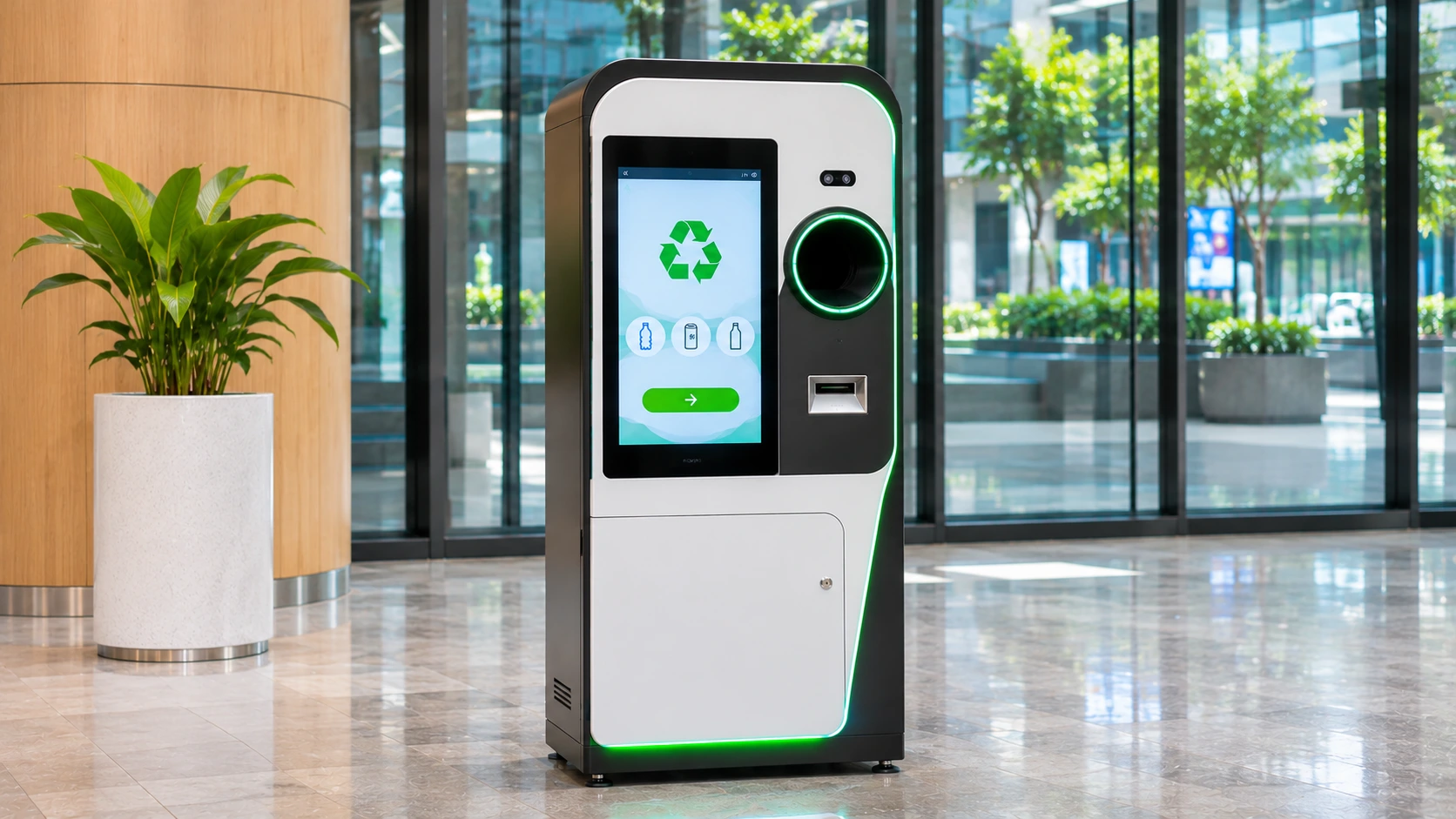
What is the working principle of a reverse vending machine?
You deposit the item, and collect the incentive – is the basic crux of how a reverse vending machine works.
- Deposit the used item – the user places the recyclable material in the designated area of the RVM.
- Item detection and sorting – The RVM system combines several identification technologies like barcode scanning, optical recognition to recognize and validate containers.
- Volume reduction – When the item is qualified for recycling, the machine crushes or compresses the container to reduce its volume. Or the item is moved to a storage section for collection.
- Incentive issuance – Based on the detected item, the RVM system issues the incentive to the user, in the form of loyalty points, coupons, discount offers, etc.
- Material recovery – Upon reaching the maximum storage capacity, the recyclable waste is collected.
What are the benefits of implementing a Reverse Vending Machine?
We can look at those benefits in different perspectives.
For retailers and host sites
- More foot traffic - People who come to return containers often shop while they’re there.
- Customer loyalty - Rewards such as vouchers, coupons, or loyalty points bring customers back.
- Less manual handling - Staff don’t have to count, sort, or store bottles by hand.
- Space savings – Volume reduction reduces the storage needed for collected containers.
- Sustainability credentials - A visible way to show environmental commitment.
For operators and recyclers
- Clean, pre-sorted material - Containers are separated by type (PET, aluminium, glass) at the point of collection, which makes the material more valuable.
- Lower logistics costs – Volume reduction means fewer collection trips.
- Accurate data - Every return is counted and recorded, which supports reporting and audits.
- Fraud prevention - Recognition technology rejects unqualified materials or tampered containers.
For governments and municipalities
- Higher recycling rates - RVMs are central to deposit return schemes that reach high return rates.
- Less litter and landfill waste - Fewer containers end up in streets, beaches, and dumps.
- Policy support - RVMs help meet Extended Producer Responsibility (EPR) and circular-economy targets.
- Measurable results - Real-time data on collection volumes.
For consumers
- Rewards for recycling - Cash refunds, vouchers, or digital points.
- Convenience - Quick, self-service returns at familiar locations.
- Sustainability- conscious citizen - An easy way to act sustainably.
Where to install Reverse Vending Machines?
You may install reverse vending machines in a wide range of settings.
- Major transportation hubs – Airports, metro and bus stations see heavy bottled drink use, making them ideal high-volume collection points.
- Tourist destinations – Theme parks, beaches and heritage sites can cut litter and keep the area clean.
- Pilgrim centres – Millions of pilgrims consume bottled water daily.
- Shopping malls and supermarkets – Shoppers recycle while they shop and redeem rewards instantly. This increses footfall and customer loyalty.
- Educational institutions – Schools and universities build lifelong recycling habits among students.
- Government institutions – Ministries and public service centres can lead by example and support national sustainability targets.
- List Item Corporate establishments and MNCs - Offices and business parks turn everyday recycling into a visible part of their ESG commitments.
- Industrial establishments – Factories and labour camps with large workforces generate steady volumes of bottles and cans for collection.
- Restaurants and Hospitality – Hotels, resorts and food courts can recover drink containers and strengthen their green credentials with guests.
- Smart cities – Connected RVMs feed real-time data into city waste systems. This supports smarter collection and planning. Aizawl Smart City Ltd teamed up with an India-based RVM manufacturer, Endlos Innovations to deploy RVMs in city areas to tackle waste management.
- Outdoor deployments - Parks, beaches, fuel stations and public squares need rugged, weatherproof RVMs built for heat and dust.
Who are the major RVM manufacturers in the GCC?
- TOMRA – Norway-based TOMRA is a pioneer in reverse vending machine manufacturing. It has a global presence in 60+ markets with around 95,000 installations. TOMRA is in the process of establishing its presence in the UAE and KSA, so that it can work closely with potential investors and other stakeholders.
The TOMRA B5, free-standing design model comes with a 21.5 inches screen and is suitable for convenience stores. The B5 model can handle up to 40 containers per minute. The model is equipped with a combi crusher designed for plastic bottles and cans.
- Sparklo – Sparklo is a notable cleantech company that offers recycling solutions in the MENA region. Headquartered in Dubai, they have installed several AI-powered RVMs, branded Sparklomats in MENA. Sparklo has recently installed 46 RVMs in Kazakhstan in collaboration with local partners. Sparklo is also expanding its reach to Southeast Asian countries like Vietnam and Philippines.
Any limitations for RVMs?
The main limitations are listed below.
- High upfront cost– The cost of installing and maintaining the RVMs may deter small retailers and municipalities.
- Uncertain ROI - Payback depends on how many containers people return. Without a deposit law, volumes can stay low.
- Limited material acceptance - Most RVMs only take PET bottles, aluminium cans and glass. Paper, cartons and other plastics usually need separate collection.
- Jams and downtime - Users sometimes insert crushed, dirty or ineligible items, or containers with liquid inside. These can block the machine and increase machine downtime.
- Outdoor RVMs cost more - In the GCC, outdoor machines must handle extreme heat, dust and direct sunlight. This calls for rugged, more expensive designs.
Conclusion
In the coming years, many countries are likely to rethink their waste management priorities for the better.
A reverse vending machine does the hard work of collecting and sorting the recyclables, reducing scenarios like overflowing bins and manual sorting.
The machine recognizes each container, compacts it and rewards your customer within seconds.
With sustainability rules getting stricter every year, the question is no longer whether you need one.
So, is your business ready to be part of this change? The sooner you start, the bigger the value you will see.
Frequently
Asked Questions
Reverse vending machine prices in India range from INR 1,00,000 to INR 5,00,000, depending on the technology used, machine capacity, outdoor or indoor type, etc.
Reverse vending machine prices in Saudi Arabia are not fixed. It depends on several factors like the machine type indoor or outdoor, technology integration, hardware and software components, etc. Please contact any reputed RVM manufacturer in Saudi Arabia for pricing-related aspects.
Rewards depend on the operator. Common rewards include cash refunds, store vouchers and discount coupons. Some machines add credit to mobile wallets or loyalty accounts. Others let users donate their refund to a charity.
Many machines send remote alerts when they are full or need service. Usually a machine operator is in charge of emptying storage bins, cleaning and basic upkeep.
Modern RVMs use several checks. They read the barcode to confirm the container is part of the scheme. Shape and material sensors detect fake or ineligible items. Many machines crush containers right after acceptance. So, the same bottle cannot be returned twice.