

AI and Biometric Kiosks: The Next Generation of Self-Service Kiosks in Kuwait
Have you ever queued for hours at a government service centre in Kuwait? Gone are the days when a simple Civil ID renewal meant hours of waiting.
Now imagine walking up to a kiosk, scanning your fingerprint and finishing the job in minutes. And the kiosk is getting smarter every year.
Artificial intelligence and biometrics are turning a simple touchscreen into a trusted digital counter.
For ministries and public authorities, this shift is no longer optional. Kindly read on to see why AI and biometric kiosks will shape Kuwait’s next phase of self-service.
What is a self-service kiosk for biometric verification?
A biometric verification kiosk is a self-service terminal that confirms a person’s identity by scanning faces, fingerprints or irises and matches them against stored records. Once verified, users can access services, collect documents or complete transactions without any staff assistance.
What is the role of AI in biometric kiosk solutions?
AI is the brain behind advanced biometric kiosks. This intelligence transforms the kiosk from a mere hardware terminal into a smooth, fast, and secure biometric touchpoint.
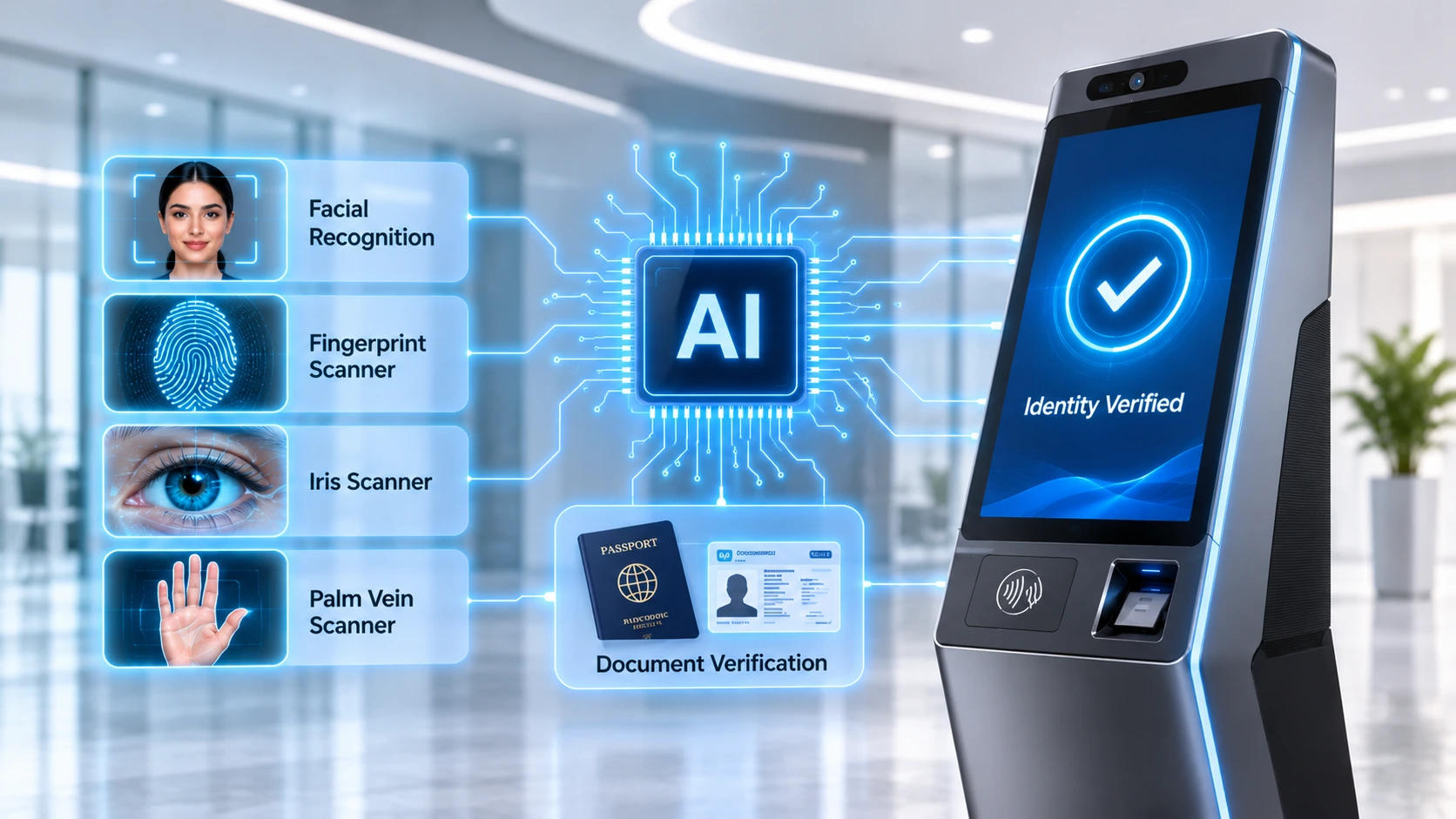
A typical biometric kiosk is loaded with one or more biometric hardware peripherals like:
- Facial recognition camera – captures facial images for face matching and identity verification.
- Fingerprint scanner - captures patterns in the fingerprint for identity verification and authentication.
- Iris scanner - captures the unique patterns of a person’s iris for identification.
- Palm vein scanner – captures vein patterns in the palm.
Other essential hardware peripherals are listed below.
- Interactive touchscreen – Allows users to interact with the kiosk machine.
- ID card reader – Reads information from relevant ID cards.
- Passport reader – Extracts identity information from machine-readable passports.
- QR code/barcode scanner – scans QR codes or barcodes for authentication.
- Document scanner – scans identity documents and other relevant documents.
- Printing device – Prints authentication slips or receipt or reports.
- Webcam – captures live image/video for verification.
Biometric hardware peripherals like finger print scanners and cameras capture raw physical data. AI algorithms process, analyse, and verify the captured data, almost instantly.
AI powers several key functions in biometric kiosks.
Computer vision and biometric matching
After detecting the face and checking image quality, convolutional neural networks (CNNs) convert the captured image into a unique numerical template. The system compares this template against a stored record, either to confirm a person’s claimed identity (1:1 verification) or to identify them from a database (1:N identification). The same approach applies to fingerprint and iris data.
Presentation Attack Detection (PAD) and Anti-spoofing
Liveness detection models distinguish a real person from printed photos, video replays and 3D masks, significantly reducing the risk of spoofing and identity fraud.
Automated document verification
AI-driven OCR extracts data from passports and national IDs, while additional checks confirm the document’s authenticity. For e-passports, the kiosk reads the embedded chip and matches the person’s live face against the chip photo.
Multimodal biometric fusion
By combining inputs such as face and fingerprint, AI reduces both false matches and false rejections, and keeps the system working when one biometric is unavailable. The result is stronger security, higher reliability and a smoother UX.
What can these kiosks do for government agencies?
Let’s see how they work across a typical citizen journey.
- Identity verification in seconds - A fingerprint or face scan matches the user against the national database.
- Document scanning and checking - AI reads passports, Civil IDs and certificates. It flags expired or mismatched documents before the request moves further.
A Civil ID is the Public Authority for Civil Information-issued (PACI) National Identification Number meant for all Kuwaiti citizens including expats.
- Multilingual conversation - An AI assistant answers queries in Arabic, English, Hindi or any other language. It explains fees, required documents and next steps in natural, conversational language.
- Card and document issuance - Print and dispense Civil IDs, residency cards, certificates and permits on the spot, after biometric identity verification.
- Payments and receipts - Users pay fees by card or KNET and receive a digital receipt instantly.
- Smart queue management - AI studies footfall patterns, predicts busy hours and routes users to the right service.
How do citizens and ministries benefit?
I have listed the benefits in both the citizen and government perspectives.
Citizen and resident perspective
- Reduced waiting – Routine tasks move from the counter to the kiosk, which reduces queues and waiting time.
- Longer service access – Kiosk installed in malls and other high foot-traffic areas can serve people well after the office hours.
- Fewer repeat visits - AI checks documents upfront, so applications are complete on the first attempt.
- Select preferred language – Citizens can select their preferred language like English or Arabic to navigate the kiosk.
- Contactless and hygienic - Face and iris scans need no physical contact with the kiosk.
- Higher citizen satisfaction - Faster, simpler and more reliable services leave citizens with a better experience of government.
Ministry or government perspective
- Stronger fraud prevention – Biometric traits are far harder to steal or share than cards and passwords. Liveness detection adds another layer against spoofing.
- Smarter use of staff – Employees move from repetitive transactions to complex cases that need human judgement or involvement.
- Gather useful data – Get peak hours, popular services and common application errors. The data helps government organisations optimise their existing services and policies.
- Clear activity logs - Every transaction links to a verified person. This supports KYC and AML compliance in banking, telecom and government services.
- 24/7 service – the kiosk works 24/7 without any stops or breaks.
- Easy scalability - If situation demands, government agencies or departments can expand to new locations.
Where should Kuwait install biometric kiosks?
The best locations are places where people already spend time. I have listed the major use-case scenarios below.
- Ministry service centres across all six governorates - Civil ID renewals, residency services and fine payments with face verification, cutting queues at government counters.
- Large shopping malls and cooperative societies - Perform bill payments, civil ID services and SIM registration where residents shop every day.
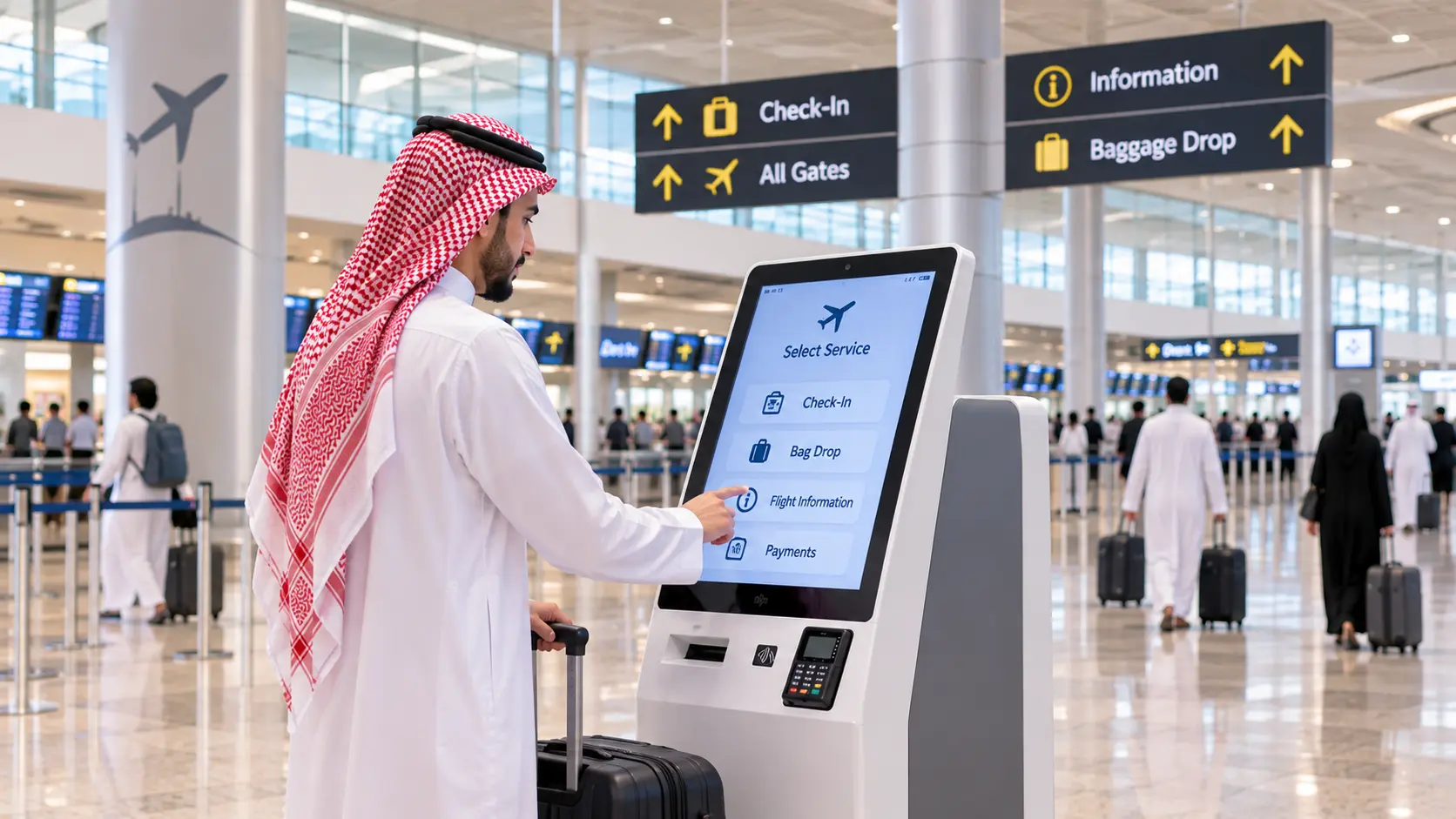
- Kuwait International Airport - Biometric check-in, bag drop and e-gate border clearance for faster passenger journeys.
- Hospitals - Patients check-in through civil ID and face match.
- Universities - Student identity verification for registration, exam hall entry, library access and campus services.
- Large employers and MNCs - Biometric attendance, visitor management and HR self-service for large, multinational workforces.
Are mobile apps making kiosks unnecessary?
It’s a fair question. But mobile apps and self-service kiosks are not rivals. Not every citizen is comfortable with smartphones. Many services still need a physical output, such as a printed card or certificate. Visitors and new residents may not have the app set up yet. And some transactions need an identity check at a secure, supervised point.
The smart approach is one connected ecosystem. Citizens may start on the mobile app and finish at the kiosk, or even the other way round.
Panashi’s kiosk deployment projects in Kuwait
HR kiosk for Kuwait National Guard – The Kuwait National Guard implemented Panashi’s HR kiosks to automate its employee services.
The HR kiosk automates the vital HR tasks, offering a 24/7 HR access portal for the KNG employees. To read more on the problems faced by the client, visit our KNG HR kiosk project page here.
HR kiosk for Kuwait Airways – Panashi’s HR kiosk terminal handles the HR operations of Kuwait Airways. The HR kiosk automation helped significantly to reduce the workload of the HR department. 24/7 HR operations, faster service delivery, secure handling of employee data and improved employee satisfaction are some of the results achieved. Employees access their personal records securely, with minimal risk of data breaches.
What does the future look like?
Kuwait has the users, the biometric data and the political will for smart government services. AI and biometric kiosks are the natural next step. They bring the convenience of Sahel into the physical world. They make every transaction faster, safer and easier to audit. And they free your staff to focus on the cases that truly need a human touch.
The next few years will decide which ministries lead this change and which ones follow.
If your ministry is planning its next service upgrade, we would love to help you build it. Talk to Panashi team today.
Frequently
Asked Questions
Panashi kiosk solutions are equipped with facial recognition and fingerprint scanning capabilities. Each kiosk is configured around the client’s identity verification needs. Our biometric-enabled kiosk solutions support a wide range of sectors like governments, event & entertainment industry, transportation sector, banking, etc.
Yes. We supply biometric-enabled kiosks in Dubai and other Emirates in the UAE. Panashi is a Dubai-based kiosk manufacturer serving clients across multiple industries. Local presence means faster deployment and on-ground after-sales support.
Yes. Panashi supplies kiosk solutions across the GCC, including Saudi Arabia. Our biometric kiosks suit citizen services, residency transactions, document issuance and identity verification. The kiosk solution can be easily integrated with existing government systems.
The price depends on the kiosk’s configuration. Key factors include the biometric modules, screen size, printers, card dispensers, software integration and order volume. Indoor and outdoor enclosures also differ in cost. Since every project is custom-built, we provide quotes based on your exact requirements. Please let us know your detailed requirements via Panashi email or WhatsApp.
Yes. Panashi kiosk solutions can integrate with government platforms, HR and payroll systems, hospital records and ticketing software. Integration typically happens through APIs which allows the kiosk to verify identities against your own databases in real time.