

Why Truck Driver Check-in Kiosks are a MUST for Middle East Warehouses
You might have seen long lines of trucks in busy warehouse entrances waiting for their turn to check-in.
Yes, the truck driver has to spent several minutes, in fact hours, to perform the check-in formality. It has been the normal for decades until technology-assisted automated check-in came in.
A truck driver check-in kiosk could offer the most feasible solution for the inefficiencies and delays involved in the manual driver check-in process.
The automated kiosk machines are highly versatile and can be deployed in connection with various logistics-related requirements.
This blog sheds lights on the benefits of deploying a check-in kiosk in logistics and transportation industry.
What is a Truck driver check-in kiosk?
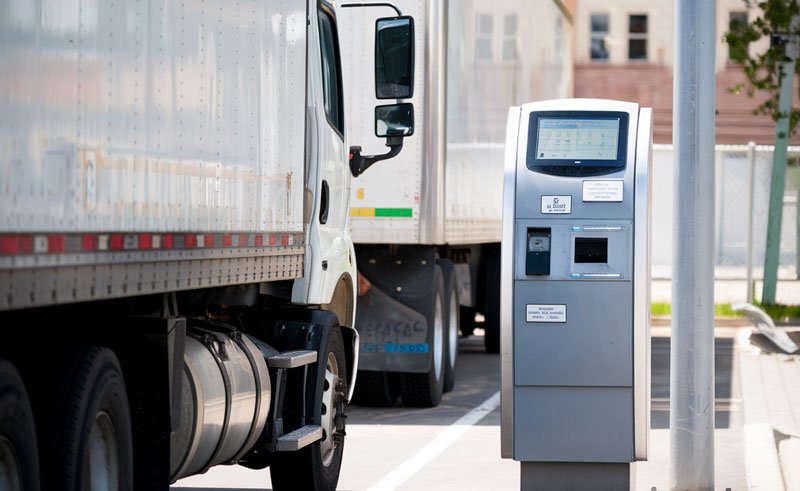
A truck river check-in kiosk is a self-service kiosk machine installed at warehouse gates, designed to match truck seat height.
Drivers can scan their ID, license and cargo documents, get verified, receive a dock assignment and print a gate pass, all without leaving the cab.
Features of a truck driver check-in kiosk
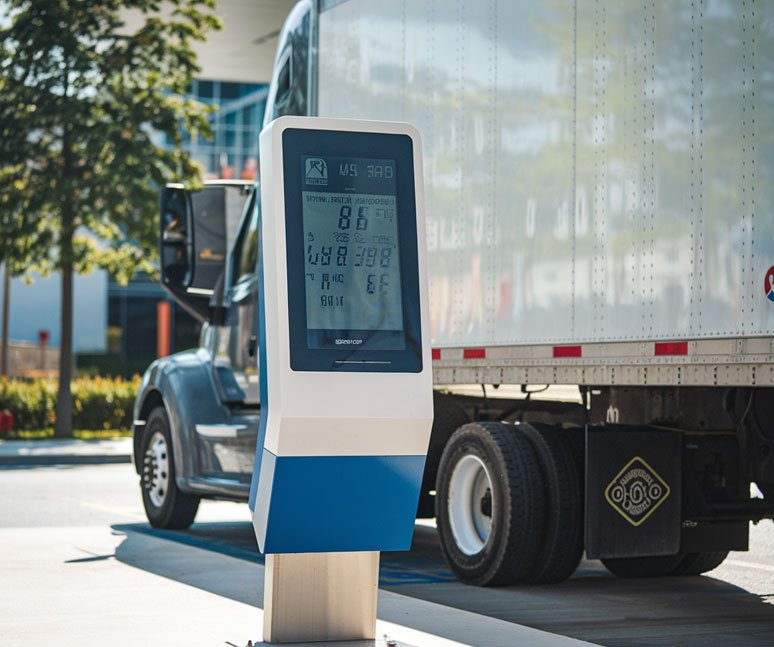
Panashi’s truck driver check-in kiosk is equipped with top-notch features to streamline the check-in formalities.
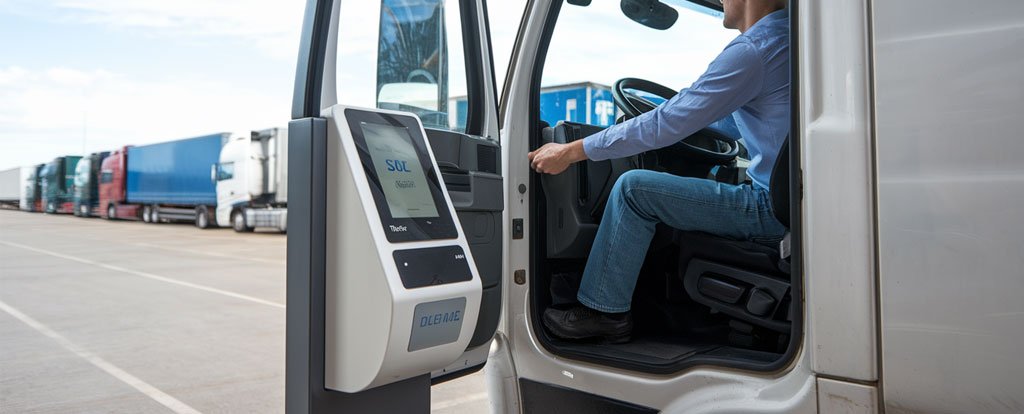
The kiosk is perfectly aligned with the truck’s standard seat height, allowing the driver to easily perform the check-in process without leaving the vehicle.
The features of the check-in kiosk are listed below.
- Scan driver documents- the driver can easily scan relevant documents like license, vehicle details etc. via kiosk machine’s document scanner.
- Scan cargo-related information- Perform scanning of cargo-related documents via the kiosk machine.
- Automated driver check-in and authentication- The truck driver check-in kiosk performs automated driver check-in and authentication eliminating human interventions and delays.
- Issue check-in receipts- the receipt printer device prints confirmation ticket or receipt once the driver authentication is done.
- Microphone and speaker or Intercom- for additional communication with warehouse manager.
- Outdoor Kiosk- Panashi Outdoor kiosks are made of weather-resistant, durable enclosures with IP65 standards. Our outdoor kiosks can withstand harsh weather and other environmental parameters like intense heat and sunlight, rainfall, humidity etc.
Components of a truck driver check-in kiosk
Hardware components
Panashi makes use of high-end and reliable hardware components of renowned manufacturers for maximum efficiency and optimum performance.
- Touchscreen interface- the driver can easily access the robust, interactive touchscreen through the truck window and input pick up/ delivery-related information.
- Barcode scanner- the barcode scanner handles scanning of relevant documents related to driver ID or logistics-related documents.
- Audio support terminal- if needed, the driver can make use of the Intercom to initiate communication with the warehouse manager.
- Camera- a high resolution, inbuilt camera for driver identification or biometric authentication.
- Sensors- Special sensors can be integrated into the kiosk machine to detect various environmental parameters like temperature, humidity etc. Detecting these parameters at regular intervals is crucial for the optimal functioning of the kiosk machine.
- Climate control system- The truck driver kiosk is equipped with an intelligent, state-of-the-art climate control system inside the enclosure.
Software components
Panashi truck driver check-in kiosk is equipped with all the necessary software applications to streamline the check-in process and improve the operational efficiency of the warehouse. The relevant ones are listed below.
- User-interface application- efficiently handles the truck-driver check-in process.
- Authentication software- performs driver authentication through document or biometric scanning.
- Data management application- handles the input data and sends it to the backend systems.
- Software for warehouse integration- verifies the input data against the Warehouse management system (WMS).
- Remote monitoring application- the admins can monitor the performance of the kiosk machine, perform troubleshoots, and issue updates whenever necessary.
- Payment modules- if required facilitates truck driver payments via the kiosk machine for specific services, if necessary.
- Audio and video conferencing module- The truck driver can initiate live audio and video interactions with the warehouse manager, if necessary.
KSA and UAE to become global destinations for integrated logistics. – MAERSK
Gate integration workflow of a Truck driver check-in kiosk
- Pre-arrival booking - The carrier or transporter books a delivery or pickup slot in the Warehouse Management System (WMS). The system issues a booking reference or QR code, sent to the driver by SMS or WhatsApp.
- Lane approach and vehicle identification - As the truck enters the check-in lane, an RFID reader picks up the tag on the truck or the driver’s badge. If the warehouse uses ANPR cameras, the number plate is read at the same time. The kiosk wakes up and pre-loads the matching booking.
- Driver perform in-cab check-in at the kiosk - The kiosk sits at truck seat height, so the driver can stay in the cab.
- Driver selects a preferred language.
- Driver scans the booking QR or enters the PO/shipment number on the touchscreen.
- Driver scans the licence, ID and vehicle documents with the document/barcode scanner.
- Driver scans cargo documents (delivery note, bill of lading).
- The built-in camera captures the driver’s face for biometric matching.
- Real-time validation for approval or exception – The inputted information is validated real-time.
- Exception handling – In the case of any discrepancy (no booking, mismatch, wrong time slot, etc.)
- The driver connects to the warehouse manager or security desk through the intercom.
- Staff can approve remotely, reschedule, or direct the truck to a holding area.
- Security gets a real-time alert for any suspected unauthorised access attempt.
- Dock or yard assignment - The WMS assigns a dock door or parking slot. If the truck arrived late or early, the manager can adjust the dock schedule in real time.
- Gate release
- The receipt printer issues a gate pass with a QR code, dock number and timestamp.
- The kiosk sends an open signal, which lifts the barrier.
- Entry time is logged.
Truck driver check-in kiosk – Benefits
If you are into logistics and warehouse management, you perfectly know the practical difficulties associated with the conventional manual entry system. Managing truck flow during peak hours is a daunting task which requires proactive warehouse management.
A check-in kiosk for truck drivers eliminates these inefficiencies with ease.
-
Ideal for in-lane installation The height of the kiosk machine is perfectly aligned with the standard truck height, allowing the driver to perform the check-in without getting out of the vehicle. Truck drivers would surely appreciate this facility.
-
Efficient driver check-in process the automated check-in process takes place smoothly with minimum or no human interaction. Self-service kiosk automation eliminates delays associated with manual check-in.
-
Reduces administrative burden The truck driver check-in kiosk significantly reduces the administrative burden on warehouse staff, thereby reducing staffing expenses.
-
Improved yard space optimization By integrating a Yard Management Software (YMS), the yard movements becomes more efficient. Efficient movement of trucks in and around the yard, time-bound pick-up and delivery etc. results in better utilization of the yard space.
-
Reduces driver waiting times The traditional manual check-in and document verification process is time-consuming. The driver has to wait for several minutes at the entrance gates for clearance. The check-in kiosk barcode scanner facilitates the scanning of both driver info and shipment documents in a matter of few seconds. And hence the waiting time can be drastically reduced.
-
RFID check-in - Warehouses can even integrate RFID technology into the kiosk machine and expedite the check-in process and hence the movement of consignments.
RFID tags attached to trucks or driver badges can make the identification process much faster and efficient. This means the driver can perform instant check-ins without having to scan various credentials at the kiosk machine.
Check-in kiosks equipped with RFID readers can be deployed at high-security areas where restricting or controlling the access is mandatory. Continuous and accurate monitoring is another advantage of RFID-enabled kiosks.
To understand RFID technology and their benefits associated with healthcare industry, click here.
- Driver safety – Warehouses can ensure the safety of drivers as drivers need not leave the vehicle, unless required.
- Prevent unauthorized access – By integrating Driver ID scanning and biometric authentication facility, warehouses can restrict unauthorised access to the yard. The facility ensures the overall security of the warehouse premises.
- Real-time data gathering – The check-in kiosk offers a plethora of rewarding benefits in the form of real-time data to both the drivers and warehouse managers. And here are they:
- Instant driver notifications – Truck-drivers get instant, real-time status updates regarding check-in, dock assignments etc. The operations run smoothly when drivers get real-time, accurate information.
- The warehouse managers get timely notifications regarding truck arrival and departure timings, the number of trucks queuing up, docks that are engaged etc. This real-time data gives them an accurate picture of what’s happening 24/7.
- Real-time authentication – The driver and vehicle credentials have to be confirmed against the warehouse database for the purpose of authentication. This real-time confirmation is possible with self-service check-in kiosks.
- Real-time monitoring – the security staff can make use of the real-time data to remain vigilant, 24/7, of any fraudulent activity or unauthorised access attempts.
- Real-time dock adjustments – In case of any arrival delays, the warehouse manager can instantly adjust the dock schedule to avoid further delays.
- Preventive maintenance – the real-time data can also help find potential issues that could cause future operation delays or service interruptions, and fix them as early as possible.
- Preventive maintenance – the real-time data can also help find potential issues that could cause future operation delays or service interruptions, and fix them as early as possible.
-
Multi-language facility - The UAE is a multi-lingual society. Warehouses and logistics firms employ drivers from various nationalities, and most of them are from Asian countries. Panashi truck driver check-in kiosk offers multilanguage facility for drivers. The drivers can select from a list of languages and select their preferred one with ease.
-
24/7 operations- the check-in kiosk operates 24/7 with utmost efficiency which helps to manage employee-shifts-related constraints. The drivers can check-in at any time, which reduces the burden on both the warehouses managers and the drivers.
-
Improved driver experience- Drivers appreciate self-service check-in facility after long hours of driving. They can easily perform the check-in formalities, comfortably, at their own pace avoiding time-consuming interactions with warehouse staff.
-
Low carbon footprint- Automated check-ins significantly reduces the usage of paper in conventional check-in transactions, which is a sustainability-friendly feature.
- Scalability- The check-in kiosk is ideal for any number of in-lane deployments. Panashi kiosks are perfectly suitable for any future expansion plans.
Freight and Logistics industry statistics – UAE and Saudi Arabia
In 2026, the market value of the UAE’s Freight and Logistics industry is USD 23.05 billion. By 2030, the value is projected to USD 31.63 billion, which marks a growth rate of CAGR 6.55%. – Mordor Intelligence
As per the research conducted by imarc, KSA’s logistics market size is estimated at USD 58.88 billion, in 2026. By 2034, the market size is estimated to reach USD 83.41 Billion, achieving a CAGR of 4.67% during the forecast period 2026-2034.
Challenges experienced during manual driver check-in
There are several challenges involved in the manual driver-initiated check-in process. Some of the major challenges are furnished below.
-
Prolonged waiting The conventional manual check-in is a time-consuming process which involves prolonged waiting. Prolonged waiting periods may lead to inefficiencies in loading and unloading activities, which in turn can cause interruptions in supply chain management.
-
Security matters a lot Warehouses are strategic locations that demand top-notch, flawless security. Manual check-in process may have loopholes when it comes to driver authentication. Chances of unauthorised access and fraud attempts are more likely to happen in the case of manual check-in.
-
Inadequate real-time information Apart from security-related issues, manual check-in is deeply devoid of real-time information regarding shipment arrivals and departures. This may impact warehouse operations, planning and allocation strategies.
-
Obvious time delays You may simply picturize or imagine the scenario in your mind. The driver parks the vehicle and gets down the truck to perform the check-in. The next step involves filling forms or documents and conveying the shipment-related data verbally to the warehouse employee. In a practical scenario, especially during peak hours, this could be a time-consuming formality.
-
Human errors “Human error” is the part and parcel of manual check-in process irrespective of the type of industry. Just imagine the situation in which the driver wrongly enters the shipment information! A minor input error can lead to shipment-related confusions, delays and all sorts of inventory management issues.
-
Handling of paperwork Paperwork handling and storage has become a thing of the past due to the inherent practical difficulties. Data retrieval can be a tough task when you have heaps of documents and paper receipts.
-
Communication gaps Language problems, accent-related issues and even a reluctant employee can cause miscommunications. The driver-warehouse employee interactions may not take place smoothly as intended which results in delays, confusions, and escalations.
-
Data-handling inefficiencies Manual check-in can cause data-handling and sharing issues. Getting the right data at the right time can become a tedious task which can further cause delays. As a result, data analysis and reporting tasks do no work as intended.
- Unhappy driver Drivers do not appreciate prolonged check-in times, miscommunications, unprofessional interactions, human errors etc. which causes driver discontent. These scenarios can even erode the relationship between shipment partners and associates.
Conclusion
To conclude, the truck driver check-in kiosk is not just a check-in terminal that handles the movement of trucks in and out. The kiosk machine serves as an effective and rewarding platform that gathers a treasure trove of crucial data related to the overall warehouse operations.
Panashi kiosks are highly flexible and versatile and can be deployed for a wide range of logistic applications like handling automated check-in in logistics industry, ports and maritime facilities, and retail distribution centers.
Our kiosks are highly customizable too to suit your unique requirements and branding needs.
Get in touch with our technical team, and tell us about your logistic needs and requirements. We’re happy to help you.
Frequently
Asked Questions
Yes. Panashi designs, manufactures and supplies truck driver check-in kiosks across the UAE, with full support for installation, WMS/YMS integration and after-sales maintenance.
Yes. Panashi delivers warehouse check-in kiosks to clients in Saudi Arabia and across the GCC. Our check-in kiosks for warehouses are customised for local languages, climate and operational needs.
There is no fixed price. The price depends on the hardware, software integrations, outdoor enclosure and number of units. Kindly contact Panashi’s team for a customised quote.
Yes, indeed. The kiosk runs round the clock, so drivers can check in at any hour without waiting for staff.
Yes. Panashi’s warehouse check-in kiosks come with IP65/IP67-rated, weather-resistant enclosures and a built-in climate control system to handle intense heat, sunlight, humidity and rain.