

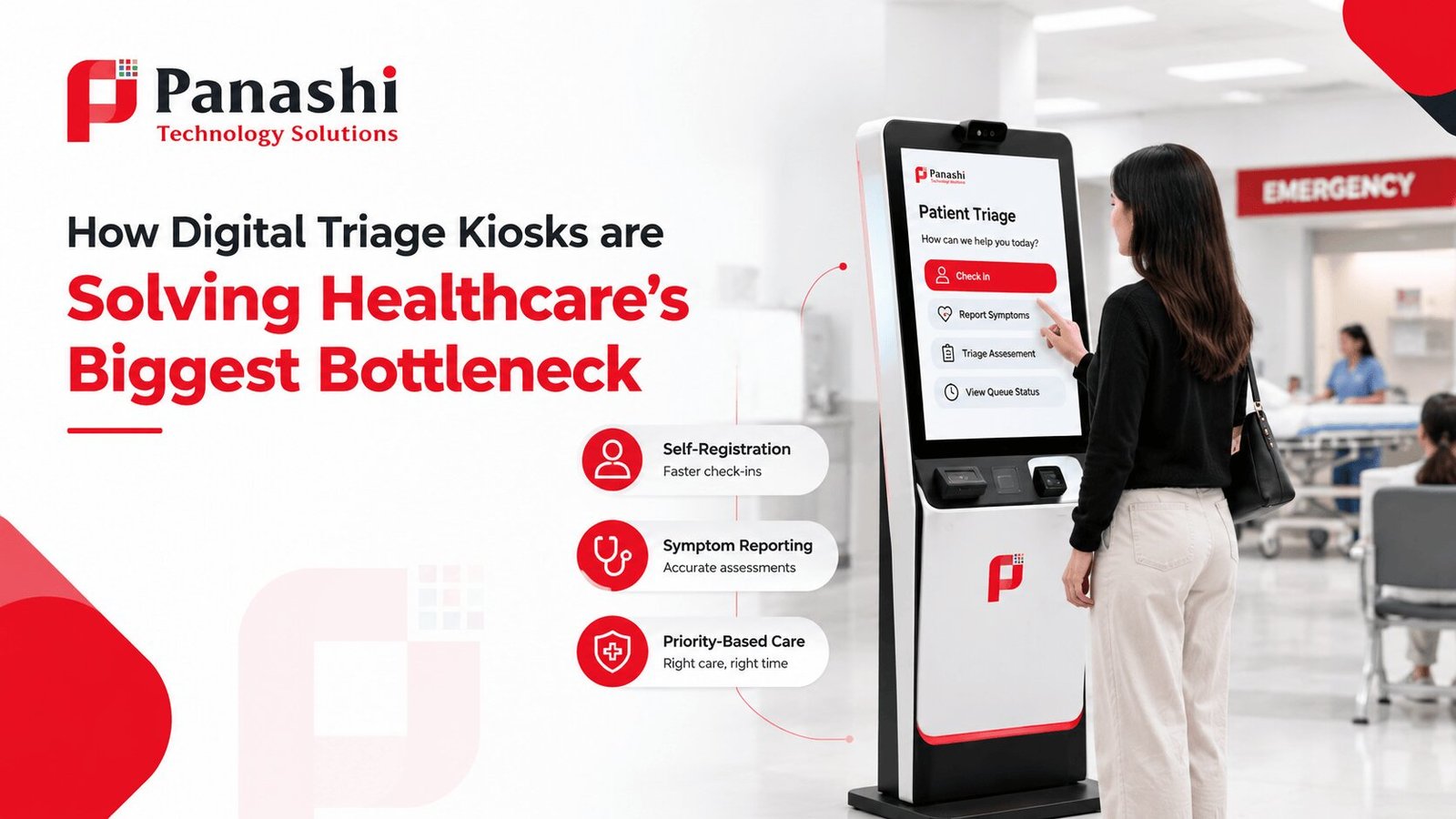
How Digital Triage Kiosks are Solving Healthcare's Biggest Bottleneck
Have you ever visited the emergency departments of hospitals in major cities?
Most of them are overcrowded with patients, especially during rush hours, causing real stress on the hospital resources.
In busy emergency rooms, manual check-ins and paper-based triage often mean loss of precious minutes.
The critical time that could worsen the condition of the patient.
In an emergency situation, every second counts.
Digital triage kiosks change this equation entirely. These automated machines let patients self-register, report symptoms, thereby, facilitating priority-based care.
This blog lets you know more about these interactive triage terminals in detail, covering their features and benefits.
Reasons for the rise in visitors to Emergency Departments (ED) in the UAE
The key reasons are listed below.
- UAE the traveller’s paradise – Tourism contributes a major share of Dubai’s GDP. Dubai or UAE receives visitors from all over the globe, especially from Europe, GCC and South Asia. People visit Dubai for multiple reasons ranging from visiting the tallest building Burj Khalifa, experiencing the shopping malls, skiing in the desert, experience Dubai’s rich and diverse cuisines, food festivals, and a lot more.
According to the tourism performance report published by the Dubai Economy and Tourism, it is reported that Dubai had recorded 19.59 million visitors in the time span of Jan-Dec 2025. This huge visitor number marks a 5% increase compared to the previous year.
- Traffic-related emergencies – According to the data published by the UAE Stat, the Ministry of Interior reported 4898 traffic accidents, in the year 2024. In the same year, the country reported 6618 traffic injuries.
Based on the studies conducted by the Ministry of Interior, multiple factors contribute to the traffic accidents in the UAE, including negligent or reckless driving, swerving tendencies, lack of line discipline, driving under influence etc.
- Weather or climate – Even the hot arid climate of the region can cause health-related issues in visitors. The sudden transition from hot outdoor conditions to air-conditioned interiors can cause health conditions like flu. The symptoms may aggravate when the person’s immunity is low. Outdoor temperatures above 40℃ can cause dehydration among travellers, which is quite common. Dust and sandstorms can cause allergic reactions in some tourists, as they are not accustomed to the region’s outdoor environment.
- Travel-related discomfort – Jet lag, lack of adequate sleep, long hours of travel, changes in food habits, food allergies, may force travellers to visit the ED.
- No or limited knowledge about primary healthcare centers – Most visitors are least informed about the primary health centers. These primary care centers serve as the first point of contact for preventive, chronic, and urgent care in the UAE.
What is a digital triage kiosk?
A digital triage kiosk is a self-service kiosk terminal installed in hospital emergency departments to streamline patient intake.
The patient can easily access these kiosk machines and input their symptoms on the kiosk touchscreen, so that the medical professionals can prioritise patients based on their condition or severity of symptoms.
These hospital ED kiosks can be deployed in various healthcare settings like primary health care centers, clinics, urgent care centers, etc.
What are the features of a digital triage kiosk?
A digital triage kiosk is equipped with all the necessary features (both hardware and software components) to enhance the triage flow in hospital emergency departments.
Interactive touchscreen
Allows patients to easily navigate the hospital triage kiosk.
Patient authentication
Card reader/ passport scanner scans ID card (National ID/ Emirates ID), health cards, or passport for the purpose of patient authentication.
System Assessment and Triage Logic
- Guided, touch-based symptom questionnaires.
- Rule-based or AI-driven triage algorithms to flag urgency levels.
- Vital signs capture via integrated devices like pulse oximeter, thermometer, etc.
Queue Ticket generation/ Real-time routing
- Automatic queue ticket generation based on priority.
- Integration with digital display boards showing queue status and wait times.
- Real-time patient routing to appropriate department.
Multi-language support
The patients can select their desired language to navigate the kiosk machine.
Video conferencing module
Offers virtual consultations for patients who require immediate medical advice.
Integration with hospital systems
The kiosk terminal can be easily integrated with the Electronic Medical Record/ Hospital Information System (EMR/HIS).
Payment processing
The triage kiosk processes co-pay or consultation fee via cash, card, cashless, or mobile wallets.
Receipt printing
The integrated printing device prints transaction receipts, test reports etc.
Remote monitoring
An admin can remotely monitor the performance of the kiosk machine from a centralised location.
How does the digital triage kiosk work?
How does the digital triage kiosk work?
Patient authentication
The patient approaches the kiosk machine and performs check-in via ID scan, insurance card, QR code or by manually entering patient credentials.
Patient record lookup
The kiosk checks the hospital system to know whether the patient is a first-time visitor or a returning patient. In case of a new patient, the system prompts the person to register. For returning patients, the kiosk system automatically pulls up the patient history.
Reason-for-visit capture
The patient responds to a guided series of questions via touchscreen selection. Answering these questions helps patents describe their symptoms or condition.
Vital signs collection (if integrated)
Several advanced kiosk machines are integrated with body vitals capture capability with the help of integrated devices. These devices comprise pulse oximeters, blood pressure cuff, thermometer, weighing scale etc. to check the crucial body vitals.
Urgency classification
Based on the rule-based or AI-driven algorithm, the kiosk system analyses the inputs collected and instantly assigns an urgency score to the patient.
Patient routing and queuing
Based on the patient urgency score, the patient is either directed to an appropriate department or assigned a queue number. In case of an emergency, the kiosk system immediately alerts nurses or concerned staff, bypassing the normal queueing.
All capture data, including patient symptoms, body vitals and urgency score is sent to the hospital system (EMR/HIS). Therefore, the medical staff gets immediate access to the patient intake data as soon as the patient reaches the concerned department.
What are the benefits of a digital triage kiosk?
Here are the benefits of deploying a hospital triage kiosk in both the patient and hospital perspectives.
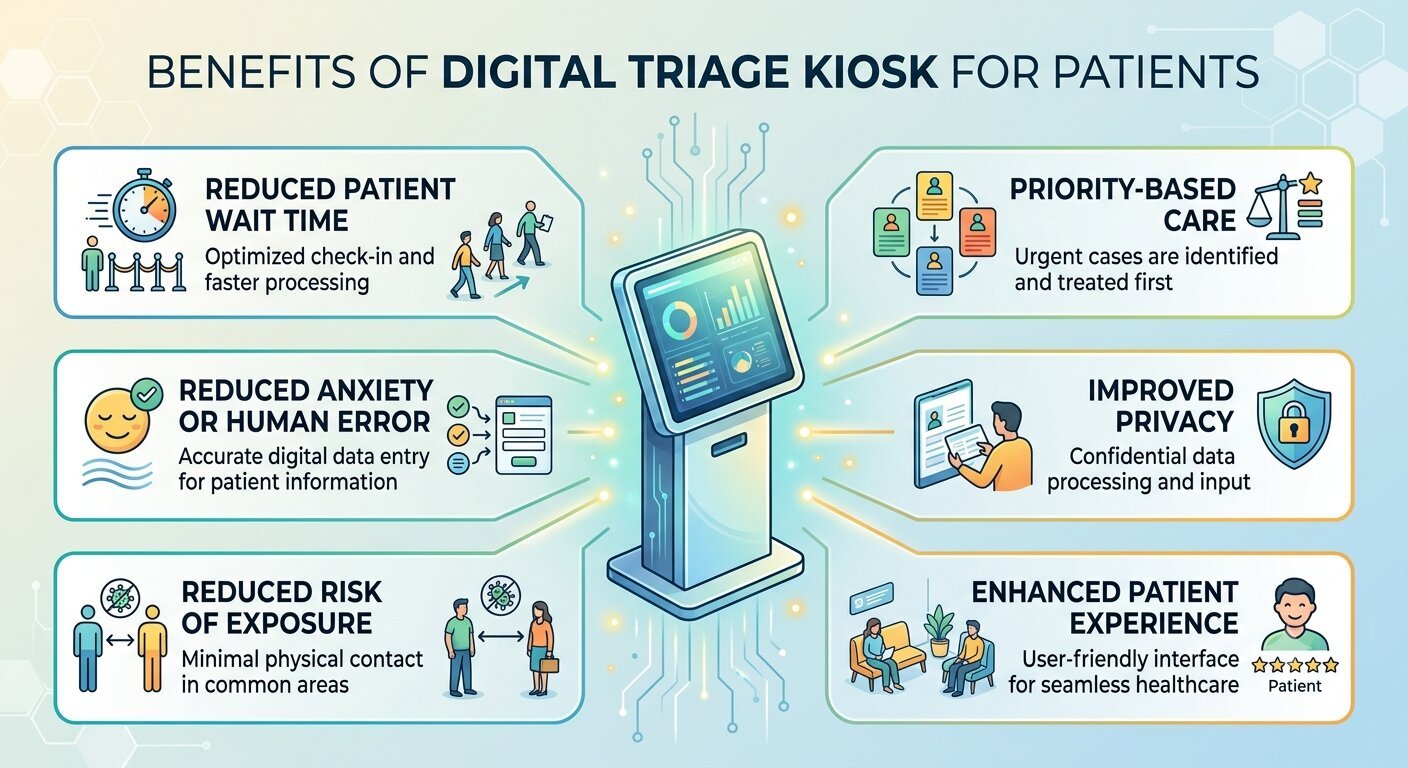
Patient benefits
- Reduced patient wait time – patients perform self-check-in and get triaged in few minutes instead of waiting for a nurse to assess them.
- Priority-based care – they get priority-based care on the basis of urgency or seriousness of their condition or symptoms.
For example: patients with chest pain or high fever are immediately routed to the appropriate department, so that critical cases don’t sit behind routine ones.
- Reduced anxiety or human error – Attending a busy staff member may cause anxiety among triage patients. In certain scenarios, they might forget to mention a critical symptom due to the same anxiety. The guided, structured questions displayed on the kiosk screen helps patients take their own time, and clearly state their condition.
- Improved privacy – Entering the symptoms or reason for visit on the kiosk screen offers them much privacy when compared to openly saying it loud in a crowded emergency room.
- Reduced risk of exposure – the patients need not have to wait in the waiting room as part of the intake. The reduced face-to-face contact helps patients mitigate their worries about catching or spreading illness in a waiting room.
- Enhanced patient experience – All of the above patient benefits contribute towards enhanced patient experience in EDs.
Healthcare benefits
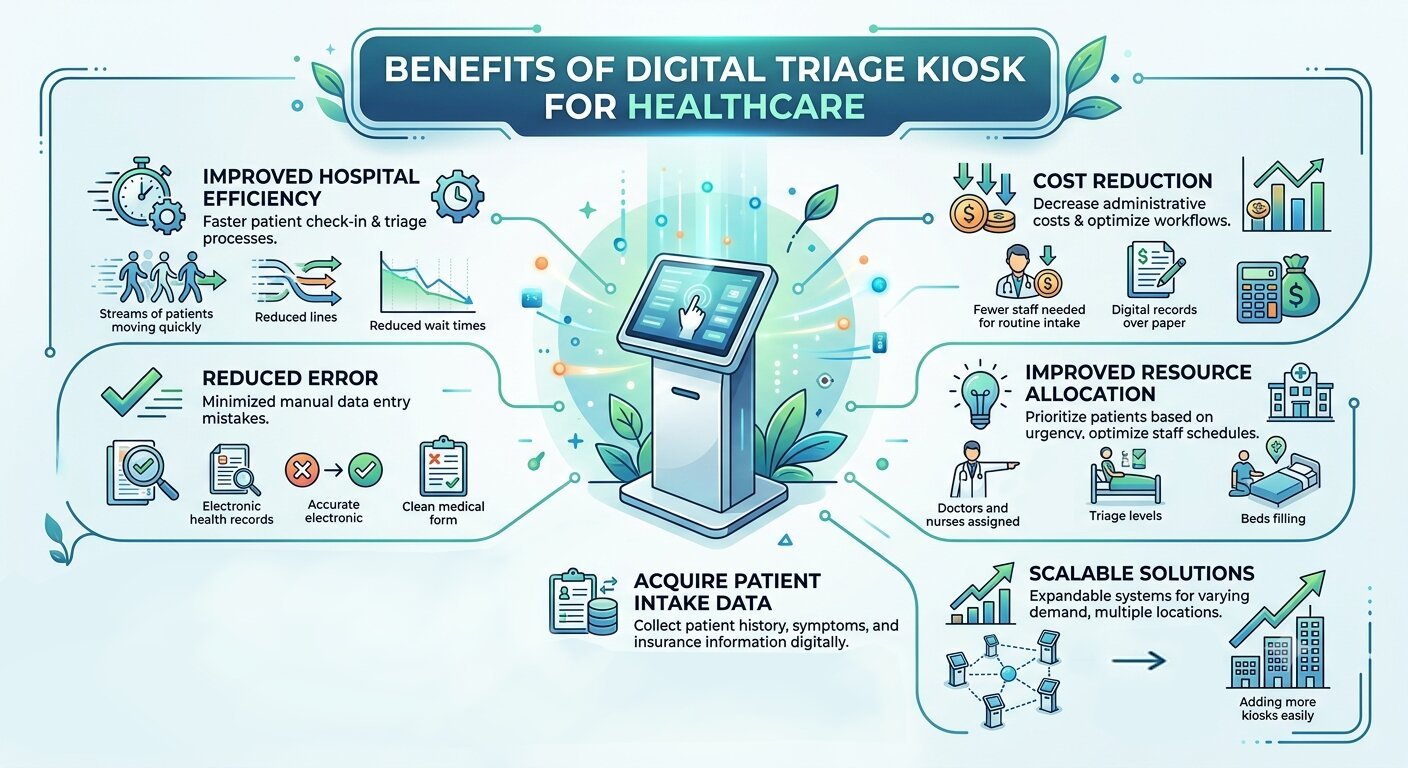
- Improved hospital efficiency
- Triage prioritisation – The hospitals can reduce patient wait times in emergency departments through intelligent triage prioritisation.
- Handles emergency demands – human triage staff are stretched, particularly during mass casualty events or during flu season. The digital triage kiosk reduces bottlenecks during these rush hours and other emergencies.
- Reduces manual data entry – the triage nurses can fully focus on patient care rather than paperwork.
- Improved patient flow and throughput – Automated patient intake improves patient flow through the ER/OPD.
- Cost reduction – the hospitals can reduce the number of intake staff, thereby reducing manual intake and data entry tasks. This reduces staffing expenses for high-volume clinics and public healthcare centers.
- Reduced error - Patients enter their own details directly. This prevents transcription mistakes from verbal intake. The hospitals receive accurate, consistent, and complete intake records every time, without any missing fields or incomplete data.
- Improved resource allocation – the hospitals get real-time visibility into patient intake and flow, which helps the administrators allocate beds, staff, and equipment more efficiently.
- Acquire patient intake data – The digital triage kiosk offers a wealth of information for the hospital administrators. This Includes peak hour demands, patient demographics, patient flow data, etc. The data provides immense administration and operational insights for the hospitals.
- Scalable solutions – the automated kiosk triage solution can be easily scaled to meet the future hospital intake requirements.
The Queen Elizabeth University Hospital based in Glasgow, Scotland has recently adopted the patient check-in & triage kiosk in the hospital’s Accident and Emergency department.
To Conclude
ED triage kiosks offer priority-based triage for hospital emergency departments, reducing the burden on hospital staff and improving patient satisfaction.
Kiosk-assisted triage in emergency departments is comparatively a new development in the healthcare sector. However, its early results suggest it will soon become a standard feature of modern hospital infrastructure.
With more inflow of visitors, the patient volumes are expected to rise across the region.
The technology adoption helps hospitals to position themselves as a quality and consistent emergency care provider.
If you want to deploy a digital triage kiosk at your emergency department, please get in touch with our team ASAP.
Frequently
Asked Questions
Yes. Panashi is a reputed self-service kiosk provider in Dubai, UAE. We provide self-service kiosk solutions, which includes patient check-in kiosks and digital triage kiosks for healthcare providers in the middle-east.
Yes, certainly. Our solutions and services are available in the UK and Europe. Let us know your unique healthcare requirements and customisation plans, if any. We’ll come up with the best plan to implement the ED triage kiosk.
The digital triage kiosk price varies with several factors like technology integration, customisation, and other factors. Let us know your specific requirements, kiosk deployment numbers, and customisation plans, we’ll come up with the best solution for your healthcare organisation.
Yes. Digital triage kiosks are equipped with video calling hardware to conduct live video consultation with a remote physician. Hence, virtual consultations or appointments are possible.
Yes. We provide consultation services in connection with patient check-in kiosks, emergency triage kiosks, telemedicine kiosks, etc.