

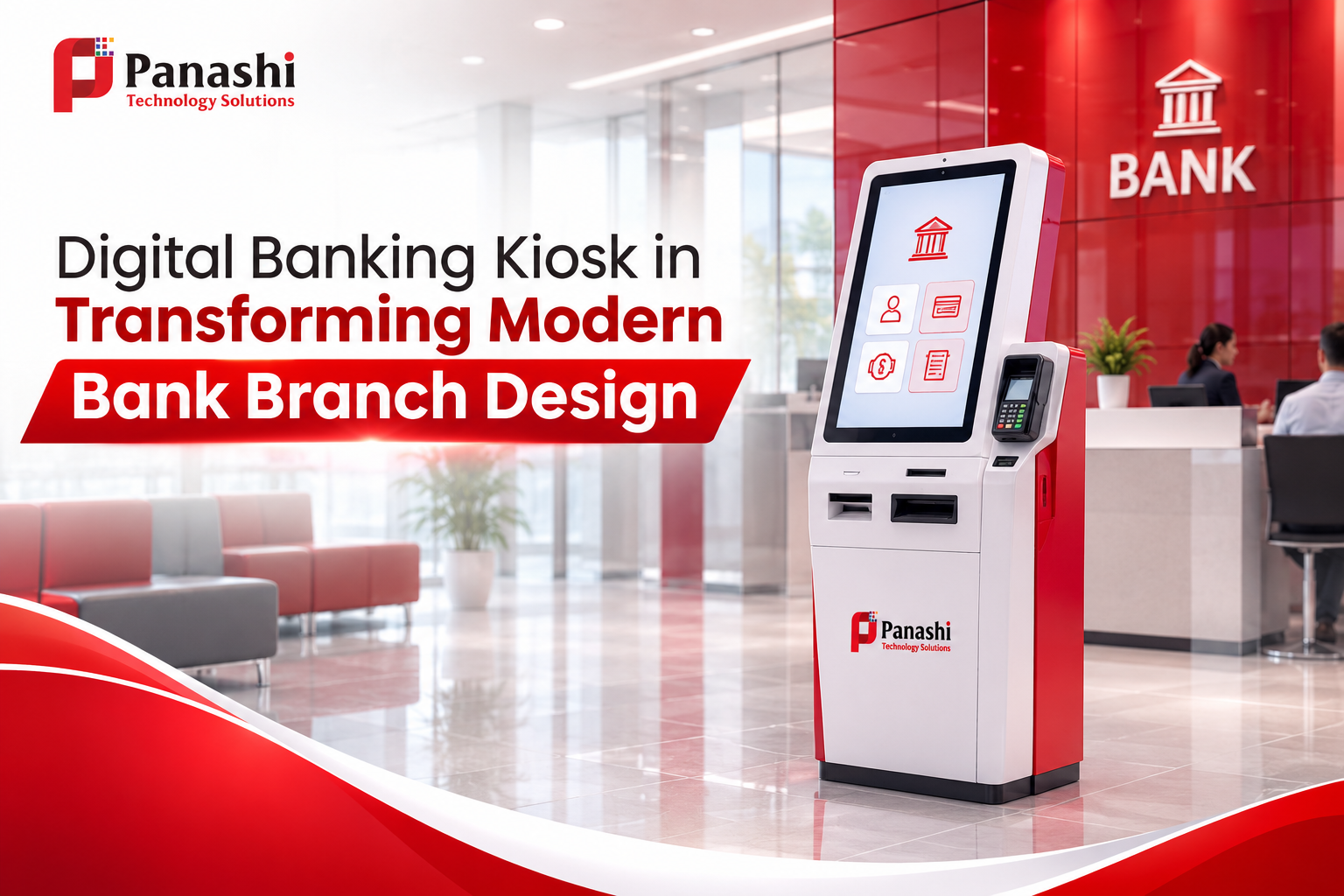
Digital Banking Kiosk in Transforming Modern Bank Branch Design
Digital banking is nothing but automated delivery of new and traditional banking products and services directly to customers through electronic and interactive communication channels.
Gone are those days of standing in line just to deposit a cheque or update a passbook. Today’s bank branch looks and feels completely different. A digital banking kiosk is usually the reason why.
Kindly read on to understand how this digital banking platform is quietly reshaping branch operations?
What is driving this shift?
According to the research data published by Mordor Intelligence, the global bank kiosk market was worth USD 24.56 billion in 2026. The value is estimated to rise to USD 50.54 billion, by 2031, at a CAGR of 15.53%. That’s not a small trend. That’s an industry-wide rebuild.
The same research has documented the rise of multifunction kiosks in banking environments. Banks are replacing the legacy ATMs with multifunction kiosks, as these units can handle 90% of the routine transactions on their own.
What is a digital banking kiosk?
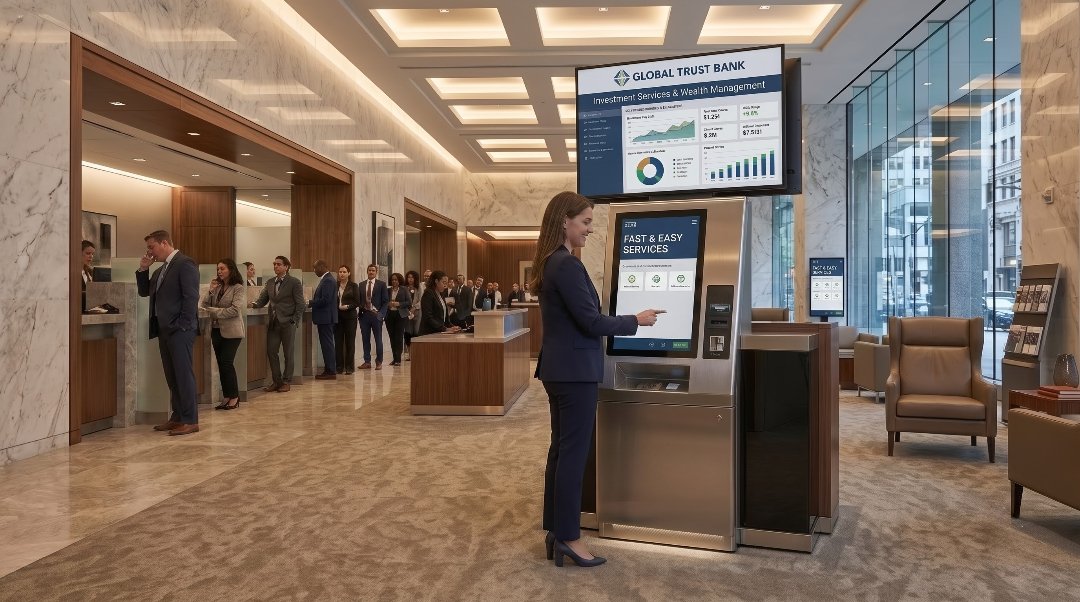
In simple words, a digital banking kiosk is a self-service terminal that lets customers complete most banking tasks on their own. These tasks include cash deposits, withdrawals, account opening, loan enquiries, card issuance, and several more. All without waiting for a teller to be free.
What are the features of a digital banking kiosk?
The main features of a digital banking kiosks are listed below.
- Instant bank account opening - A customer can go to a digital banking kiosk and open a bank account, then and there.
- KYC authentication – via biometric scanning/PIN/ OTP or card.
- Card printing – Get personalised credit or debit card printed with ease.
- Cheque book issuance - Get a personalized cheque book with 25 or 50 cheque leaves.
- Account-related services - The customers can easily access their account-related services like balance enquiry, transaction history, statement printing, etc.
- Cash deposit and withdrawal – customers can easily withdraw and deposit cash without standing in queues.
- Biometric authentication – allows customers verify their identity in seconds using a fingerprint or facial scan.
- Remote monitoring – centralised software updates and monitoring.
- Video conferencing – For additional real-time support and guidance, the customer can interact with customer service executives through a video chat.
- Real-time integration – the banking kiosk terminal or network of terminals can be integrated with bank’s core banking system.
- Data Analytics – Banks can collect crucial data on usage patterns, which helps in decision-making.
Which are the hardware devices integrated into the digital banking terminal?
A typical self-service digital banking kiosk usually comes with the following hardware devices.
- a touch-enabled screen
- card printer
- card reader
- pin pad
- cheque scanner
- cheque printer
- cash acceptor
- cash dispenser
Now, the best part is that banks can choose the hardware peripherals based on their functional, service and payment-related requirements. Banking kiosk manufacturers like Panashi allows banks to fully-customise their banking kiosk terminals.
A bespoke, custom-built kiosk solution offers banks and other financial institutions the freedom to match every kiosk to their exact branch layout, customer base, and compliance requirements.
What are the benefits of deploying a digital banking kiosk?
The Banks perspective
From the bank’s side, kiosks aren’t just a convenience feature. They’re a serious cost and efficiency play.
- Improved staffing - Every transaction handled by a kiosk is one less transaction eating into a trained teller's time. That frees staff to focus on advisory work, cross-selling and genuine relationship banking.
- Reduced congestion – long lines, waiting, a slow teller, busy banking hours – all these factors lead to congestion in branches. Through 24/7, faster, efficient, and consistent services, a digital banking terminal reduces congestion.
- Enhanced service reach – the digital banking kiosk serves as a box branch offering banking services outside regular banking hours. These kiosk terminals can be conveniently deployed across a wide range of environments, ranging from underserved regions to economic zones, in the premises of factories, healthcare institutions, etc.
- Reduced overheads - Smaller branch footprints also mean lower real estate and staffing costs. Banks can still serve the same customer base, or even a larger one.
- Kiosk interaction data – Through data analytics, banks can amass a wealth of behavioral insights via every customer transaction. The data helps to fine-tune staffing, product offers, and even branch location decisions.
Customer perspective
- Multi-language support – the customers can select their preferred language for navigating the kiosk, hence no language barriers. The feature becomes highly useful in multicultural societies like the UAE and India.
- Improved control and convenience – Imagine a customer walking in during lunch hour. They don't have to fight a queue behind ten other people. They walk up to a kiosk, finish a deposit or a card request in minutes, and walk out.
- Faster service – Deposits, withdrawals, card issuance, etc. happens on the spot.
- 24/7 banking experience – the customers get extended or 24/7 banking access.
How Digital banking kiosks help to reduce expenses?
- Reduce on-boarding and printing expenses - Digital banking kiosks not only can work as a bank branch, but it also helps the bank to reduce the overall cost of customer onboarding, card printing, cheque book printing etc. If the card printing is happening in a central location, then that card needs to be couriered and it takes a week or more to reach the customer. Similarly, the cheque book also takes almost similar time frame to get it delivered to the customer. Cost involved for issuing one card or cheque to the customer can be reduced by 20-30%, if it’s done through a digital banking kiosk.
- Reduced operational expenses – As we have discussed earlier in the “bank perspective” benefits, deploying automated banking terminals can bring down operational expenses. The digital banking kiosk serves as a 24/7 box branch offering most of the services offered by the traditional bank branch.
- Extended service hours without extra payroll – A kiosk machine runs around the clock without overtime pay, unlike human staff.
- Centralised software updates – Banks can push updates across every branch at once, avoiding the cost of updating each terminal manually.
- Lower paper and printing costs – Digital forms and instant statements cut down on physical paperwork across the branch.
How do banking kiosks create an omnichannel banking experience?
Digital banking kiosks can do wonders for the banks specially in the areas where mobile banking and online banking have limitations. There are some banking services in which the use of hardware is unavoidable. Some examples are card printing, cheque book printing, statement printing etc.
Since ATMs primarily focus on cash transactions and their security, it is a challenge for banks to incorporate the above services into ATMs. That is where the importance of kiosks comes in, facilitating these banking services for customers.
A digital banking kiosk isn’t a standalone machine anymore.
The moment a customer deposits cash, that particular action syncs instantly. It shows up on the mobile app and online banking right away. Hence, no mismatched balances. With a simple QR code scanning, the customer can restart their previous sessions, without any delays.
For example: consider the loan journey of a typical customer.
A customer starts the application on their phone, then walks into the branch to finish document verification at the kiosk. The journey doesn’t reset. It simply continues, because the kiosk and the app read from the same system.
Successful omnichannel strategies lead to improved customer retention, and enhanced product sales in the form of fixed deposits, insurance, loans, etc.
Customers nowadays demand for a unified, consistent banking experience across multiple banking touchpoints, whether it’s mobile, online portal, kiosk or in-branch communications.
In simple words, the kiosk stops being “the machine in the lobby.” It becomes one touchpoint in one customer journey. Kiosk, app, web and branch stop behaving like four separate banks. They start behaving like one bank with four doors.
AI-powered Kiosks for banking and financial institutions
AI-powered banking kiosks are advanced digital banking terminals that leverage AI. These terminals make use of machine learning, computer vision, and NLP, to read customer behaviour, and they adapt in real-time to make decisions or suggestions on their own.
Key features of AI-powered banking kiosks
- Recognize behavioral patterns – Learns from a customer's transaction history to anticipate what they might need next.
- Biometric integration – Instant customer authentication using facial and fingerprint recognition.
- Real-time product recommendations – Suggests relevant products, like a fixed deposit or a loan offer, based on transaction history.
- Natural language processing – Understands spoken queries, allowing conversational interactions instead of rigid menu navigations.
- Predictive maintenance - Uses AI to flag hardware issues before they cause downtime, reducing repair costs and service disruption.
IDFC FIRST Bank in Mumbai, India makes use of an AI-powered holographic digital avatar of the veteran Indian actor Amitabh Bachchan. The digital avatar offers the immersive banking service experience for customers which improves engagement by leaps and bounds. By engaging with the digital avatar, the customers can easily access information related to bank’s diverse products and services.
From Transaction Counter to Advisory Hub
Here’s where branch design itself has had to catch up. For decades, a bank branch was built around one job. Processing transactions as quickly as possible.
With the help of digital banking kiosks, the conventional bank branches have undergone a visible transformation. Now, we call it the “phygital” branch. It’s a space that blends physical presence with digital convenience. Branch networks are becoming smaller and smarter. They’re also getting placed more strategically, while kiosks handle the routine work that used to eat up floor space.
In simple words, the branch is shifting purpose. It’s no longer a place you visit out of necessity. It’s becoming a place you visit for advice and trust. A conversation a mobile app can’t simply replace.
Undoubtedly, the branches that win the next decade won’t have the biggest lobbies. They’ll be the ones that got the balance right. Smart self-service kiosks paired with genuine human expertise, in a layout built around both.
Conclusion
With the help of digital banking kiosks, banks not only extend their reach and service offerings digitally but also improve the overall CX. Customer expectation of accessing banking products anytime, anywhere, and securely are being met through these digital banking kiosks.
A customer who gets fast, secure, always-available service loses the reason to compare or switch to another bank. Retention goes up simply because friction goes down. A happy and satisfied customer becomes open to more products and services offered by the bank.
Top-notch, consistent services turn your customers into brand advocates.
Eventually, the relationship shits from transactional to habitual.
It is time for banks to seriously consider digital banking kiosks for faster growth with minimal investment.
Frequently
Asked Questions
No. Automated banking terminals do not reduce the need for staff entirely. They shift staff toward advisory and consultation work instead of routine processing.
Yes, they are. Modern digital kiosk terminals use biometric authentication, encrypted sessions and real-time fraud monitoring. Security has become a selling point rather than a concern for most deployments now.
Yes. Panashi manufactures AI-powered banking kiosk solutions that offer improved personalisation, voice conversation, enhanced security features, and several other benefits. Our next gen banking solutions can significantly improve the overall banking experience for customers, especially in high-footfall bank branches.
Digital banking kiosk price varies with several factors like technology integration, number of units deployed, customisation requirements, outdoor or indoor deployment, etc. Let us know your requirements in detail via email or WhatsApp. Our team will get back with the pricing structure at the very earliest.
Yes, absolutely. Panashi offers plenty of customisation options to our banking clients Every bank has a different branch layout, brand identity, and customer base, so a one-size-fits-all kiosk rarely works well. We offer customisation across hardware, software, design and accessibility for banks in the middle-east, Africa, Europe and Asia.