

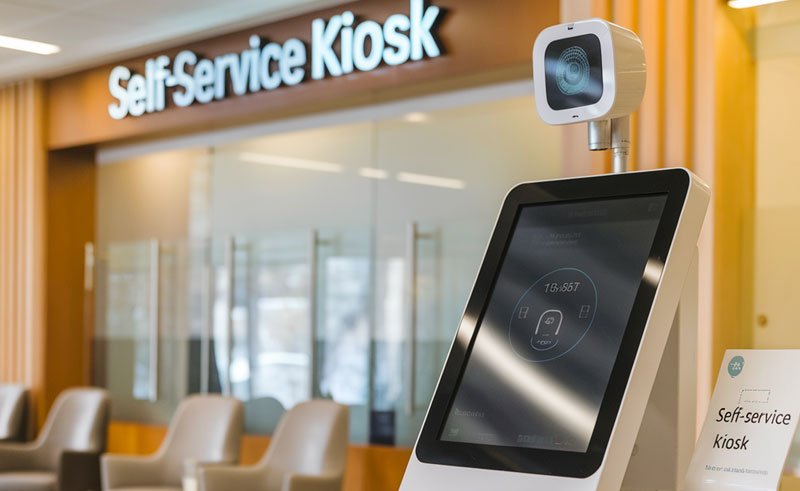
Video Conferencing Kiosk: The Intelligent Answer to Document Verification Challenges
Verifying customer identity can be a time-consuming task due to several reasons. The complexity involved in document verification, the practical difficulty involved in document collection, the unavailability of touchpoints, the sheer number of applications to process – all these aspects make customer identity verification a herculean task.
Of course, there are digital channels like mobile apps. But when it comes to the document verification UX, these digital channels lag behind. This means that the UX of digital channels has to be uplifted for an improved customer experience.
A video conferencing kiosk can serve as a feasible solution to tackle this age-old challenge.
Read on to understand the role played by a video conferencing kiosk machine in customer identity verification, its deployment benefits, and various use case scenarios.
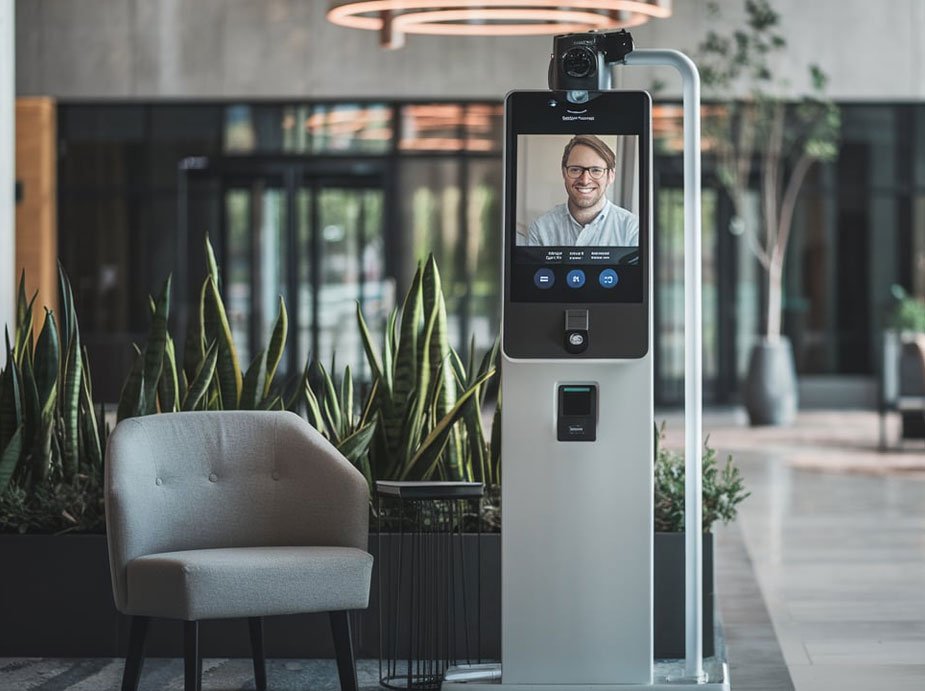
What are the components of a video conferencing kiosk?
A self-service kiosk for customer verification is loaded with several key components to streamline vital tasks.
Hardware components
- Interactive display – The responsive and interactive touchscreen facilitates seamless remote interaction with the verification agent via video chat. It also helps the user easily follow the instructions and perform the submission of documents.
- High-resolution camera – Of course, a high-resolution camera is a crucial component of the video conferencing kiosk. A high-resolution camera with a decent specification is needed for customer identification and real-time video call.
- Document scanner – performs high-resolution scanning of physical user documents, so that agent may instantly verify the information once it is uploaded by the user.
- Printer – Once the verification of documents is completed, the document printer prints the confirmation receipt for the reference of the user. The user may collect the receipt for future use. If needed, the document printer can also print the copies of the verified documents.
- KYC devices – The video conferencing terminal is loaded with KYC devices passport scanner, fingerprint scanner, Civil ID reader, facial recognition feature etc.
- Digital signature pad- The document verification kiosk is equipped with a digital signature pad, so that the customers can offer their digital signature easily via the kiosk terminal.
- Card reader – Verifies user ID cards or banking cards, once they are submitted by the user.
- Passport scanner – Scans the passport of the user instantly after submission.
- Barcode scanner – gathers customer information on ID cards reducing human errors.
- Payment devices – the machine is equipped with cash acceptor, cash dispenser coin devices to accept customer payments.
- A4 printer – to print relevant documents for customer reference, if necessary.
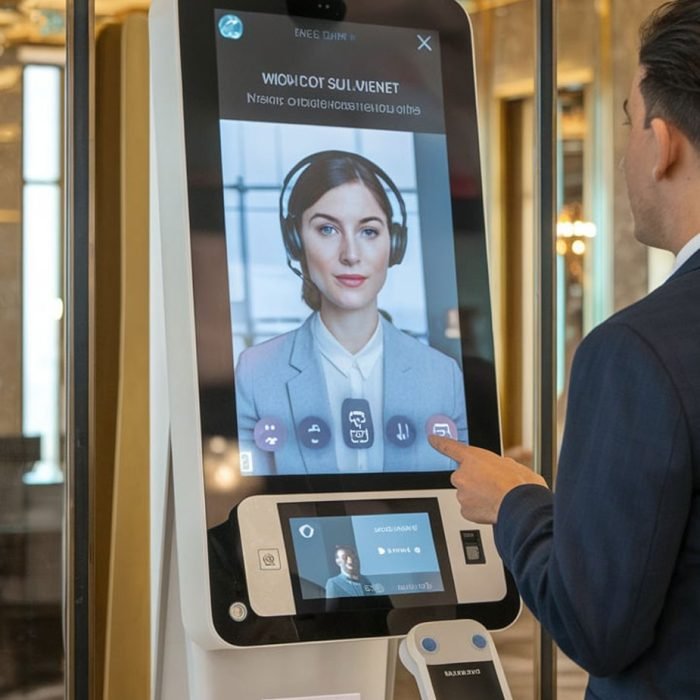
When it comes to software side:
- Kiosk client – the application running through kiosk terminals.
- Agent application – the agent verifies the documents through the agent application portal.
- Agent service – A Windows service that facilitates kiosk-agent communication.
- Terminal Management System (TMS) – the central admin panel that control and monitors all the activities of the kiosk system.
- Kiosk client listener – A Windows service that perform administration and maintenance tasks.
- Kiosk server – responds to the kiosk client’s requests and messages.
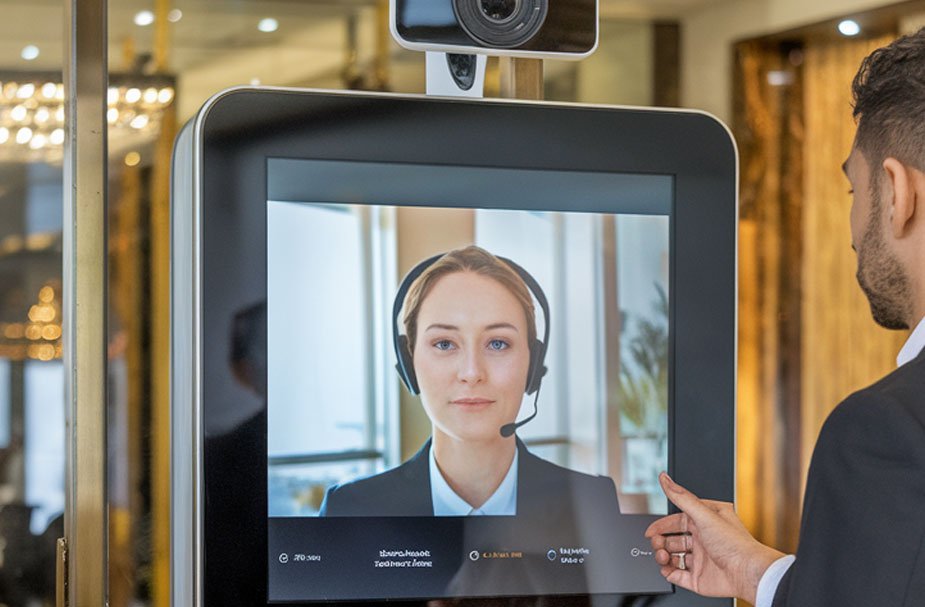
Video conferencing kiosks for document verification – Benefits
The customer carrying a heap of documents to the physical office of the service provider is an inefficient and time-consuming process. The kiosk terminal eliminates these scenarios and make the process highly efficient and streamlined. Here are the benefits.
Citizen/customer benefits
- User convenience – the customer is able to perform a face-to-face, virtual interaction with the verification agent in real-time through video chat. The agent can guide the user through the entire process of verification. And hence, no worries! The user can submit the documents one after the other via the video conferencing machine without any confusions or practical difficulties.
- Improved CX – The highly streamlined and efficient verification process instills confidence in the users. Every time the user upload/submits a document, the same is verified by a backend agent. Multiple document verifications can be handled by a team of back-end agents which speed up the entire process. The users need not wait for several hours and can even avoid repeated visits to physical branches.
- Reduced errors – The user submits the necessary documents based on real-time video interaction with the verification agent. Once the user submits any document, the agent verifies the same instantly, thereby reducing the chances of errors.
- 24/7 service – the kiosk terminal offers 24/7, uninterrupted service.
- Reduces long lines and congestions - The customers/citizens may arrive for verification at their time of convenience. This reduces congestions and long lines in Tadbeer centers.
- Multiple payment modes – The user may make the service charge payment via multiple payment modes like card payments, cash payments, cashless or mobile app payments. The facility adds to user convenience.
- Multi-language capability – The user may select any one of the desired languages from a list of languages offered by the kiosk machine. Hence, the kiosk terminal becomes highly useful for a multi-cultural and multi-linguistic society.
Service provider benefits
- Ideal for agent-assisted verification process – Domestic workers may not be tech-savvy or may not have sufficient expertise in performing the document submission process, all by themselves. The agent-assisted verification process guides them accomplish tasks one by one, avoiding confusions and errors.
- Centralized remote control – the video conferencing kiosk can be remotely controlled from a central location by an admin. The same admin can deploy necessary updates and even perform troubleshoots without visiting the actual site of installation. To add on, avoiding site visits as part of troubleshoots, helps the service provider save considerable amount of money. The centralized management system also ensures accuracy and consistency in operations.
- Perfect alternative for physical branches – the service providers need not set up physical branches for the sole purpose of customer identity verification. Instead, they can deploy a network of video conferencing machines to handle the verification tasks. You all know how much it would cost to run a full-fledged office space in Dubai’s prime locations!
- Location flexibility – You may deploy the video conferencing kiosk machine at any convenient, high footfall location/s. Therefore, users can easily access your services. Be it shopping malls, transportation hubs, airport premises, job expo sites etc.
- Deployment flexibility – the service providers can deploy video conferencing kiosks for a variety of purposes or environments. These kiosk machines can work like a charm in indoor, semi-outdoor or even outdoor conditions.
- Ideal for remote locations – Self-service kiosks for document verification is ideal for remote locations where infrastructure is not well-developed or have insufficient transportation facilities.
- Prevents identity fraud – Since the customer verification takes place via live video chat, the service providers can keep away fraudsters and prevent malpractices like identity fraud. This adds security to the entire verification process.
- Better service reach – The video conferencing facility breaks geographical barriers, as the service providers can reach a wider audience by deploying the kiosk facility at multiple locations.
Video conferencing terminals are better than mobile apps. Here’s why?
When it comes to document verification UX, the video conferencing terminal offers an improved UX compared to mobile apps.
While in app-based verification, the user has to perform all the verification processes through a single device, following the instructions and scanning the documents – all at the same time.
In reality, the user has to hold the smartphone in one hand, do the scanning of documents, capture user’s live photo and read through the instructions simultaneously, which is inconvenient. Moreover, the mobile app UX can vary with the type of device, OS, app design, internet connectivity etc. Hence, there is no uniformity in UX.
Kiosk-based document verification offers live video chat support to the customers throughout the verification process. The feature avoids errors and input-related delays. Live video chat support is highly beneficial for services that involve extensive verification procedures.
The kiosk machine is equipped with dedicated, use-specific devices that manage each and every task involved in customer verification process. For example, document scanning. Document scanning is carried out by a document scanner. When the user is ready to scan, the scanner device with LED lighting assistance turns on and captures the scanned image of the document with ease. The document scanners are highly helpful to capture wrinkle-free, high-resolution images. And you know the clarity of the documents speeds up the verification process.
The kiosk terminal offers top-notch internet connectivity, and therefore, offers uninterrupted and smooth document verification. Whereas, a smartphone may experience internet connectivity issues for several reasons, which would hinder the verification process. In short, the verification process becomes highly dependent on the device and network connectivity.
Kiosk machines offer enhanced security features like data encryption and they operate in a controlled environment. This avoids unauthorised access. Smartphones are highly prone to malware and phishing attacks. Even an unsecured network connection can result in data breaches and identity theft.
Video conferencing kiosk are extremely helpful for the unbanked and non-tech-savvy customers who have limited access or exposure to technology.
When we consider all the aspects shared above, it becomes evident that a video kiosk terminal is a far better option for document verification compared to mobile apps.
Video conferencing kiosks for Document verification – Use case scenarios
You may leverage the benefits of a video conferencing kiosk in a wide range of use case scenarios, where customer identity verification is necessary. And they are:
- Government institutions and agencies – Government agencies like Road and Transport Authority (RTA Dubai), Tadbeer centers, passport issuing authority and any other government agency can make use of the video conferencing terminal to conduct user and document verification.
- Banking and finance sector – Even banks and insurance companies require customer identity verification. And these kiosks are widely used in this sector for their convenience and efficiency. The banking staff can conduct video conferencing sessions from the main branch or head-office without having their physical presence across all branches. To add on, acquiring KYC details, and on-boarding procedures can be performed via video conferencing.
- Healthcare – Hospitals can make use of video conferencing terminals for processing patient insurance claims, streamlining administrative processes, patient verification etc. Doctors may conduct remote monitoring of patients, access patient information and prescribe medicines, if necessary, via video conferencing. And this becomes possible without conducting personal visits.
- Telecom sector – Identity verification, documents submissions are normal in the telecom sector as part of new sim card issuance. And yes, the telecom transactions demand a high degree of security as sim cards can be misused. Deploying video conferencing self-service kiosks can effectively handle real-time customer verification with utmost security, adhering to the telecom regulatory policies.
- Travel and Tourism sector – Tour coordinators, travel agents need to verify their customer credentials and documents. Deploying a video conferencing kiosk at high footfall regions like airports, transportation hubs, busy junctions can streamline document verification process. The customer need not have to visit the physical location of the travel agent and may obtain instant approvals too.
- Educational institutes/ Universities – Video conferencing kiosk facilities are available in many of the major colleges and universities across the world. Through video conferencing, students can easily connect with various department-heads and staffs and sort out their queries. Students can even raise complaints to the college authorities via video conferencing.
- Airport/Aviation – Video conferencing kiosks installed at airports allow passengers and tourists to make a video call to the concerned executive, whenever they needed assistance. The executive attends the queries of the passengers and offers them necessary guidance. The information related to the availability of flights, flight status, timings and many other vital information can be easily conveyed through video conferencing.
Video Conferencing Kiosks for Life Plus Domestic Workers Center, UAE
Life Plus is a supplier of domestic workers including housemaids, nannies, lady drivers and cooks in the UAE. The service is known by the name of Tadbeer in the UAE. Tadbeer centers are government-licensed institutions that offer recruitment, visa processing, training and orientation of domestic workers.
As of now, there are 19 jobs that come under the category of domestic workers in the UAE, like housemaid/servant, guard, cook, nanny, worker, personal assistant, gardener etc.
What Panashi offered the client
Panashi video conferencing kiosks are designed to streamline and automate the visa processing operations of Life Plus. The video conferencing solution is a full-fledged, feature packed solution that offers live video chat facility and self-service document verification.
Once Life Plus kiosks are activated, an agent will cross check the visa application process through the deployed self-service kiosk solution and subsequently authenticate, direct and endorse the possible services to a customer, promptly and effectively.
These kiosks will be deployed in multiple, high footfall locations like shopping malls and can be controlled and managed remotely, by an authorized admin.
Panashi’s video conferencing solution eliminates the time-consuming, human-assisted verification process conducted via physical branches, and thus saves precious time and resources of both the service providers and customers. Moreover, the video conferencing kiosk solution offers a unique and highly convenient user experience. The users can find a document verification kiosk near to their locality and easily apply for Visa. And hence, they can avoid travel to the Visa processing agencies.
With agent support and guidance via live video chat, customers can easily submit their documents via the device-integrated kiosk terminal.
Conclusion
There are several domestic workers service centers in the UAE that are approved by the Ministry of Human Resources and Emiratization.
A large number of domestic workers visiting these service centers on a daily basis makes the verification process highly time-consuming. It can also result in service-related delays.
Panashi’s video conferencing kiosks for Tadbeer centers facilitate a highly efficient and streamlined customer identity verification platform. It’s scalable and customisable too.
For any information regarding the implementation of video conferencing machines for document verification, please get in touch with Panashi technical consultants.