

Sustainable Dining Experience: Trends Shaping the Middle East in 2026
Sustainable dining is more of a health-conscious dining, and the “health” quoted here is not just the human-centric health, but in a larger sense, the health of the planet.
Sustainability in the hospitality domain is a globally trending topic, and its ripples are now being felt in the middle-east too. The young, sustainability-conscious population of the middle-east plays a vital role in spreading the benefits of ethical eating in restaurants.
Even the food industry-insiders and chefs are taking up the green-restaurant initiative. Right from food manufacturing process to packaging, food preparation and waste management, eco-friendly dining practices are quickly gaining traction.
In this blog, we will discuss the restaurant sustainability in detail. The blog covers the key aspects like reducing food wastage, technology integration in restaurants, addition of regional flavors, and plant-based alternatives. Let’s dive in…
Food service market in GCC
The foodservice market share in GCC countries was estimated at USD 65.55 billion in 2025, and by 2030, the market size is projected to reach 109.91 billion, achieving a growth rate of 12.29%.
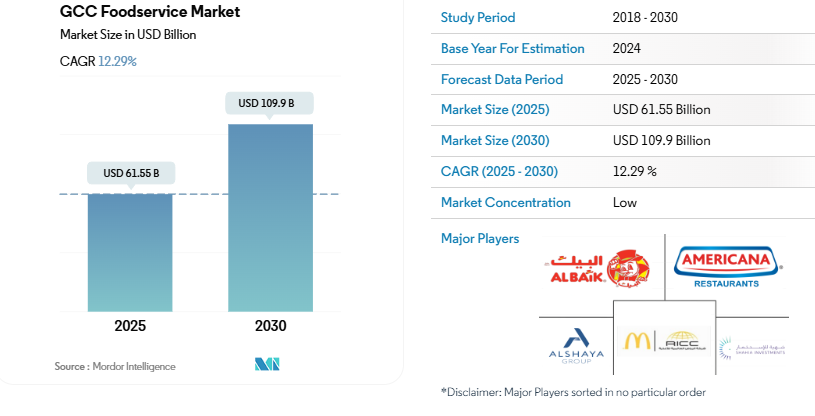
Right now, the GCC food service market is experiencing an interesting shift in terms of customer preferences. A rising preference for organic and sustainable dining, fueled by customer demand and government intervention is evident in the market. This has resulted in the adoption of plant-based and environment-friendly products combined with an emphasis on improved waste management solutions. Customers value the “convenience” factor in dining and they are increasingly becoming mindful of what they eat.
Restaurant food waste – causes and consequences
In a global perspective, the food service industry experiences a whooping 2.6 trillion dollars financial loss due to food wastage.
It is estimated that around 12% of the total food waste is contributed by the hospitality sector. Of course, it is a matter of deep concern.
Causes of food waste
Do you cook food at home? If yes, you know what it’s all about!
In a typical restaurant setting, the food waste occurs at a much larger scale. And hence, it’s impact on the environment is much more.
Food waste in restaurants or in the hospitality industry is caused due to the following reasons.
- Large portion sizes – One of the common reasons of food waste, when customers cannot finish the ordered food and it becomes leftover food.
- Preparation waste – When the vegetable peels and trimmings are not repurposed in some manner, they are discarded as food waste.
- Overproduction – In order to prevent unpleasant scenarios, like non-availability or food scarcity, restaurants tend to produce more food than it is actually needed. When the overproduced food is not consumed, it’s food waste! As simple as that…
- Inefficient Inventory management – Lack of proper storage or overordering of ingredients may result in spoilage, as these ingredients remain unused for a long period of time.
- Menu adjustments for sustainable dining – When the existing menu is changed to a new one to attract new customers, some ingredients of the previous menu might go unused, provided the new menu is much different from the previous one. This results in spoilage.
Consequences of food waste in restaurants
A miniature form of food waste happens at our homes. Many of us source food stuffs, cook and have food at our homes. We do have food waste at our homes. However, the quantity of the food wasted is negligible when compared to the restaurants that serve 100s of customers on a daily basis. And, the consequences of the same are listed below.
- Production of greenhouse gases – When food waste is allowed to rot, it produces the greenhouse gas named methane. As per the United Environmental Protection agency (EPA), methane gas is 28 times more formidable than carbon dioxide, at holding heat in the atmosphere. Yes, too much heat means rise in temperature which leads to global warming.
- Sheer wastage of resources – When eatable leftovers are discarded, and thrown away, the impact is much more. Leftovers from a large number of people accumulate to form an even larger quantity of food waste. And remember, this happens on a daily basis. Just think about the food waste collected in a period of a month!
Food waste is serious issue in countries like Saudi Arabia and UAE. Among the GCC nations, Saudi Arabia, undoubtedly, is the nation that produces the major chunk of food waste. Based on the studies conducted by the Saudi Grains Organisation (SAGO), about 33% of the total food produced in Saudi is wasted. And in economic terms, it amounts to SR 40 billion annually.
On a global level, it is estimated that about 1/3 of the total food produced for human use is wasted every year. The value is staggering – approximately 1.3 billion tons. Studies suggest that 10% of the food procured in the hospitality sector is wasted.
- Economic burden – Food waste is a huge financial loss and economic burden for middle-east countries, especially Saudi Arabia and UAE. Even cultural implications like festivals come into play in the case of GCC counties, and hence, the food wastage rates are on the higher side. It is estimated that around 3.27 million tons of food are wasted every year in UAE, and this wastage amounts to approximately 3.5 billion dollars.
Lessons on sustainability for restaurants in the middle-east
There is no one size-fits-all approach for restaurants. The middle-east restaurants can pick a method or two, do certain tweaks and adjustments to meet their individual circumstances and come out with a plan that delivers the most. Of course, with a bit of creative thinking and customer understanding, you can come up with the most feasible solution. Meanwhile, here are some of the tried and tested ways that you can practice or implement.
1) Implement responsible restaurant practices
1 -Ensure the food is stored well – Incorrect or inefficient storage is one of the major factors leading to food waste. Make sure your cooling devices or appliances like refrigerators are working well and they provide proper cooling. Be aware of the positioning of food during storage. Proper positioning ensures food safety, freshness, and reduces wastage.
- Top shelves are a bit warmer and are ideal for ready-to-eat foods like leftovers, and dairy products.
- The middle part maintains a uniform temperature and is good for storing cooked meats, and eggs.
- The lower shelves are the coldest, and are ideal for the storage of raw meat and sea-food which are more prone to contamination.
Follow systematic labelling for food stored in containers, mentioning the name of the food, date of expiry, etc. Systematic labelling helps you to figure out the food that should be used first. Restaurateurs usually call it by the name FIFO – First in, first out.
2 -Trained employees – make sure your employees are properly trained. Take your time and effort to provide adequate training to your employees with regard to food storage, handling and preparation. A significant amount of food in the hospitality industry gets wasted during the preparation process. Educate your employees about the effects of food wastage, and the relevance of reducing wastage. Let them know their role in preventing food wastage and enabling sustainable dining
By precisely understanding the what and why of reducing food waste, your employees are definitely going to think about it. And not just about thinking, they would engage in practices that reduce or bring down food waste. And who knows, they might even come up with some creative, novel ideas to support the cause. And that’s a bonus!
3 -Repurposing of leftovers – When you prepare food for hundreds of customers in a restaurant setting, you are going to end up with plenty of leftovers. And these leftovers comprise of animal bones, fruits skin and vegetable peels and many others. A creative chef can easily come up with some delicious, sustainable dishes from these leftovers. And of course, you can reduce wastage too.
For example, the leftover animal bones can be repurposed into some interesting dishes like bone marrow butter, rillettes, and even bone broth for stews and soups.
Similarly, potato or carrot skin can be fried or baked into crunchy and crisp snacks. And you’ve got plenty of options with fruit skins and peels. For example, apple peels after drying can be used to prepare a nice, aromatic herbal tea. If you have leftovers of banana peels, you may straightaway cook them in curries along with spices.
There are still plenty of other interesting options to try!
4 -Donate excess food – Donation or charity is another option by which you can ensure the food is not wasted. In large restaurants, the leftover food accumulates to a quantity that is sufficient enough to serve the needs of several individuals or few families. There are several charitable organizations that pick up the food leftovers from restaurants. You may even make use of dedicated apps like “Too Good to go” to take care of the leftover food. The app was launched in 2015, and it connects users with restaurants and hotels that are ready to supply their leftover food.
Something similar is the app named “Barakah” the food-tech startup that operates in Saudi Arabia. The startup founded in 2022 aims to combat food waste by enabling food retailers to sell their leftover or surplus food to those in need. The app plans to expand its services to other countries in the GCC soon.
5 -Employing seasonal menus for sustainable dining– Seasonal ingredients are available in specific seasons. The supply of these ingredients is usually high during these seasons. And hence, they are readily available to purchase. Due to their easy availability, their prices are less. Moreover, seasonal food stuffs are fresher, and last longer too, reducing food spoilage.
2) Technology integration for sustainable dining
Technology integration in the middle-east hospitality sector is happening at a fast pace. This transformation is driven mainly by customer demand, and the growing need to improve restaurant operational efficiency. Let’s have a look at some of those major developments.
Digital-ordering with food-ordering kiosk – Implementing a food-ordering kiosk machine is not at all a new trend in the restaurant industry. Renowned restaurant chains like Mc Donald’s, KFC, and Burger King and many others have already realized the benefits of automated ordering many years back. Discover McDonald’s inside tech in drive thrus here.
These food ordering kiosk machines not only improve the overall dining experience, but also enhance the operational efficiency of the restaurants.
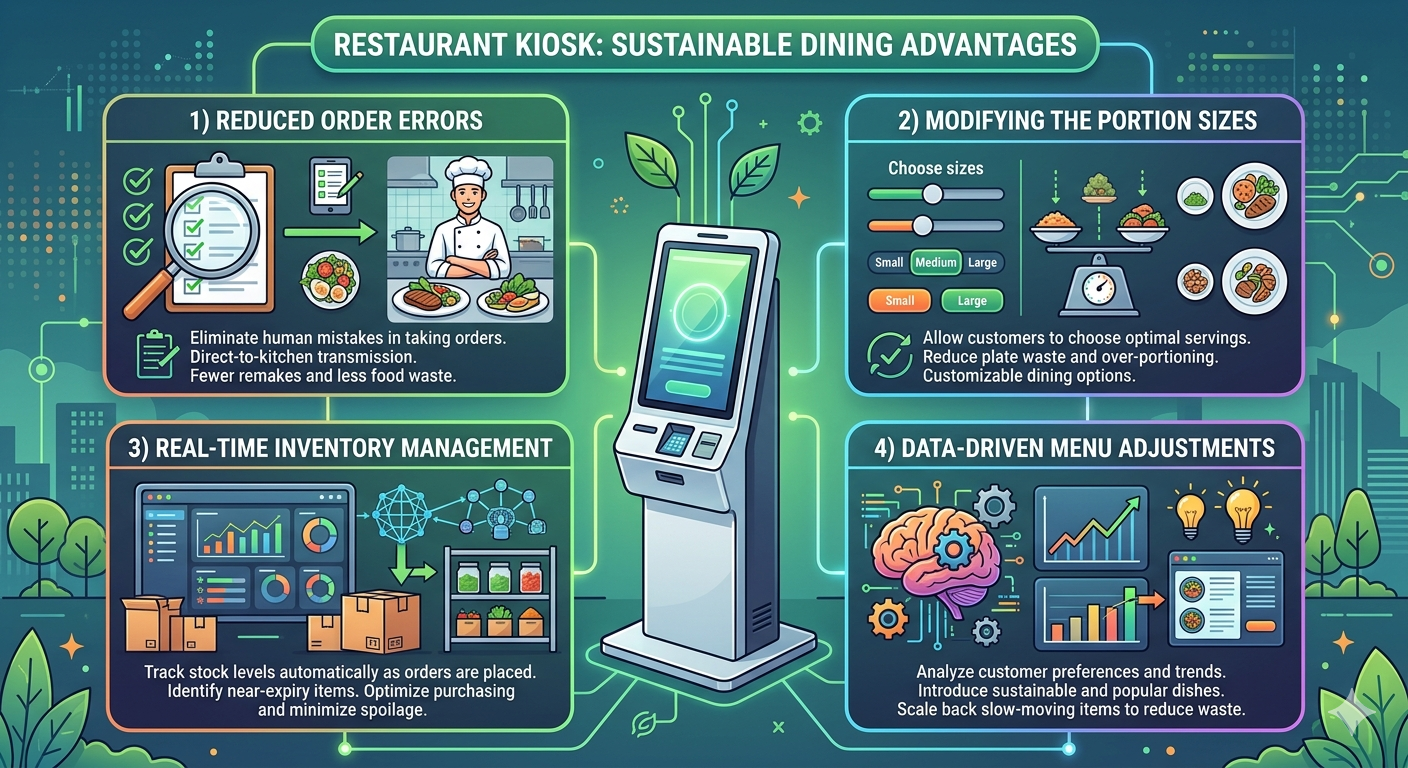
And, they contribute towards sustainable dining too. Here’s how!
- Reduced order errors – Customers can access the kiosk machine, take their time, go through the menu options, perform the needed customization, and even confirm the order before making the payment. Hence, any chances of order-related errors are reduced to a great extent.
- Modifying the portion sizes – Customers can even adjust or modify the portion sizes to their preferences, reducing chances of uneaten food waste
- Real-time inventory management – the kiosk terminal can be integrated with Restaurant inventory management systems, thereby, restaurants can promote meals based on inventory levels. For example: items that are closer to expiry date, can be promoted on the menu, or offered at a discounted rate. This reduces chances of food waste.
- Data-driven menu adjustments – restaurants can gather powerful insights related to customers preferences, and make use of these insights to optimize menu items. For example: From most popular dishes to the less-ordered ones, restaurants can effectively track customer preferences, and modify recipes and source ingredients accordingly.
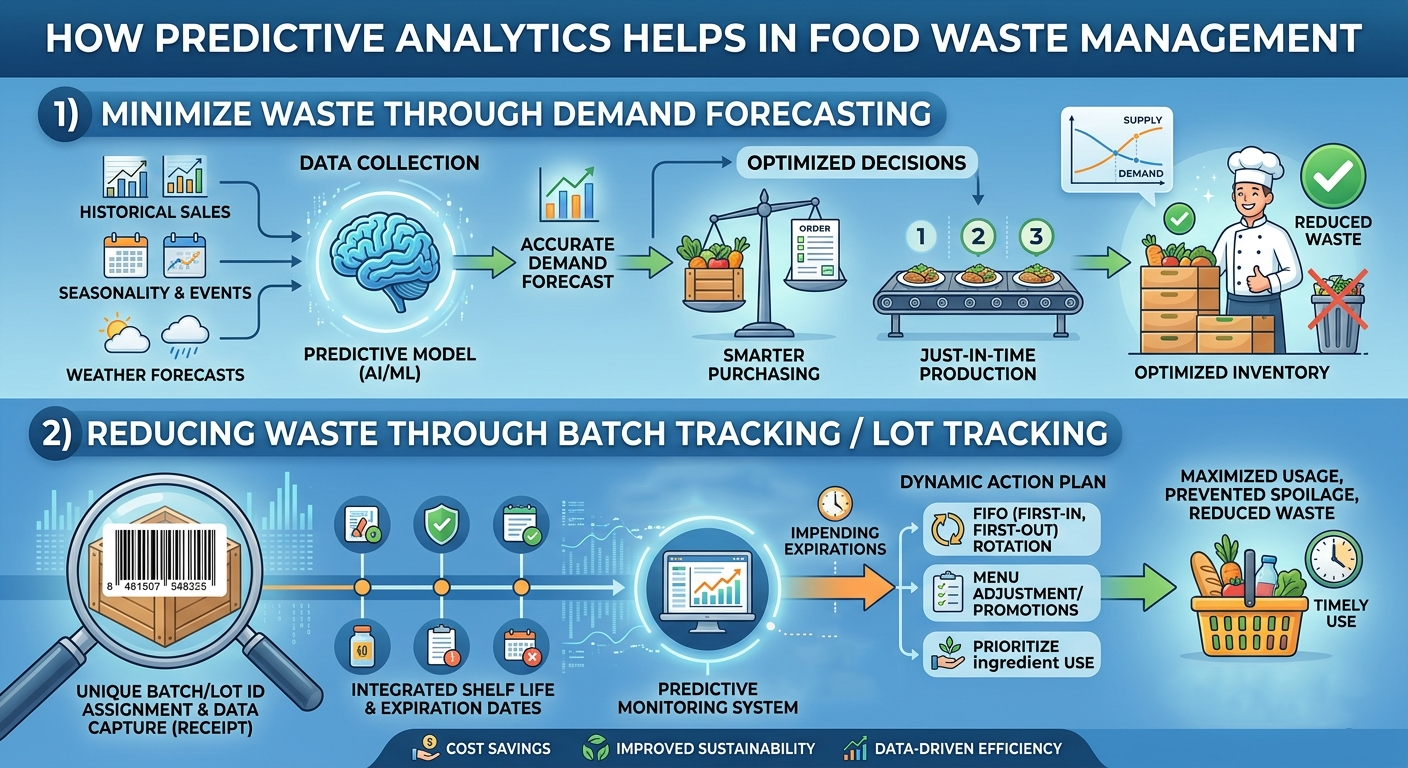
AI for food waste management – AI’s role in predictive analytics of consumption is considered one of the most anticipated developments in the food industry. It is expected to take place in the retail food sector in the coming years.
And here are the benefits offered by predictive analytics in connection with food waste management.
- Minimize waste through demand forecasting – Demand forecasting is nothing but forecasting future demands with the help of statistics. The statistics include historical data related to orders, trends, and seasonal aspects, to determine the food requirements for a particular day, week, or any timeframe. This data-assisted forecasting helps restaurants to order the right quantity of stocks, which helps in managing overstocking, and hence reducing waste. For example: Predictive analytics can identify a decline in demand for a particular food item after a major festival. This helps restaurants prevent overstocking the ingredients for the same food item.
-
Reducing waste through Batch tracking / Lot tracking – Batch tracking is vital for businesses that sell perishable stuffs, and therefore, has great importance in managing food waste. It is the process of tracking perishable products or ingredients that are purchased and stored for later use for some specific purpose.
By integrating with the restaurant’s inventory management, AI systems can identify perishable foods based on aspects like date of manufacture, expiry, supplier information etc. Figuring out the expiry date effectively can help restaurants use those ingredients that become unusable at the earliest.
IoT for Smart Inventory management
IoT is a network of interconnected devices embedded with sensors to facilitate data exchange with other systems. Due to the interconnectivity, these devices gather and share data. And they are widely used to automate tasks and improve the operational efficiency across various verticals. Let’s see how IoT enables smart inventory management.
- Real-time monitoring of inventory – IoT sensors can track the inventory on a 24/7 basis and determine the inventory-usage systematically. IoT sensors can effectively deal with both understocking and overstocking scenarios. The sensors send timely alerts to restaurant managers when a stock nears to expiry, so that it can be used at the earliest to avoid spoilage.
-
Temperature control – The storage environment plays a vital role in the longevity of the stored products and ingredients. Temperature and humidity of the storage area, if let unnoticed, can adversely impact the quality and freshness of the ingredients. Here, IoT sensors monitor these parameters effectively and predict spoilage well in advance.
It is necessary to check the temperature at regular intervals of time. Or else, things can horribly go wrong!
Refrigerators integrated with IoT technology can detect anomalies and malfunctioning, like temperature drop that cause irreversible damage to food stuffs. IoT makes it a lot easier and convenient by tracking the change in temperature and alerting the same to the employees instantly. This reduces the chances of spoilage.
3) Incorporating Plant-based alternatives
Incorporating plant-based alternatives can serve as an effective replacement for conventional meat-based dishes, thereby facilitating sustainable dining in hospitality industry. Here is how they bring in change.
- Better control over greenhouse gas emissions – Plant-based ingredients are always connected with reduced greenhouse gas emissions. Whereas, meat consumption requires extensive livestock farming, which results in the production of greenhouse gases. Sentientmedia reports that livestock farming contributes to around 11% to 20% of the total greenhouse emissions happening worldwide.
- Improved water conservation – Livestock farming requires large quantities of water. It is a highly water-intensive endeavor as animals require abundant quantity of water to drink. Water is also essential to grow the livestock feed and also for the purpose of sanitation. Even slaughterhouses, meat processing units, require plenty of water for their routine operations.
On the other side, water consumption is less for plant-based diets compared to the meat-based ones. Cultivation of vegetables, lentils etc. is not much water-intensive, and hence aids in water conservation. And, you all know that middle-east is an arid or semi-arid region, and therefore, experiences considerable water scarcity issues.
- Supports local farming practices – the incorporation of plant-based diets is a boost or encouragement for the local farmers in the middle-east. The local farmers cultivate a variety of crops like chickpeas, lentils, dates, vegetables like tomatoes, okra, zucchini, eggplants etc. Apart from facilitating sustainable dining, giving importance to crops and vegetables also helps to revive and support the local economy.
- Improved public health – Plant-based diets are rich in fiber-content and anti-oxidants, and therefore, the consumption has positive implications on body health. Consuming plant-based food helps in reducing weight, lowers the risk of heart disease, lowers inflammation and cancer, improves gut-health and strengthens immunity. Yes, the benefits are multifaceted. And, it’s no wonder, people these days turn to plant-based diets, limiting the intake of meat.
- Affordable dining option – Plant-based products can be produced with minimum resources, and hence the production cost is far less compared to that of livestock. Moreover, plants grow at a much faster rate than the livestock. For example, wheat gets ready for harvest in around 4 to 5 months, whereas, cattle take around 1.5 years to get ready for slaughter. To add on, animal products demand more complex and expensive processing and storage procedures.
Hence, plant-based diets turn out to be a far more affordable dining option.
Understanding the benefits associated with sustainable dining practices, several restaurants in the middle-east have started to develop their own green dining experiences.
The well-known restaurant chain, Al Safadi – Lebanese restaurant – offers plant-based alternatives of the conventional dishes like Kebab Kashkash and fried Kibbeh.
Similarly, the Spanish Restaurant BOCA, based in Dubai, includes locally-produced ingredients for their plant-based dishes to support the sustainability cause.
4) Sourcing local ingredients
Sourcing local ingredients have several benefits in terms of sustainable dining. And they are listed below.
- Reduced transportation requirements – if the ingredients are sourced locally, the restaurants can cut cost on transportation, which in turn reduces fuel consumption. Ingredients sourced locally are fresh, and therefore, the need for refrigeration and proper packaging is comparatively less. Reduced transportation requirements also reduce the emission of harmful vehicle emissions.
- Supports local farming communities – Sourcing ingredients locally helps farming communities. The farming communities receive money and the money gets rolling in the local economy. Moreover, local farmers have a greater chance of using sustainable farming practices like organic farming, which is not harmful for soil health. To add on, small-scale farming practices also ensure ecological biodiversity by growing different crop varieties. Growing the same crop again and again depletes the soil nutrients, and retards the growth of microorganisms in the soil.
- Facilitates the use of seasonal produce – Seasonal produces are fresh, have high nutritional content, and they even taste far better. As the ingredients are produced on a seasonal basis, they are consumed fully in specific seasons. Therefore, the need for storage and preservation becomes less.
The Spanish restaurant BOCA in Dubai gives much important to sustainable dining. The restaurant is well-known for its sustainability practice of sourcing local ingredients. Apart from sourcing ingredients from local producers, the restaurant has also devised strategies to deal with waste management and the use of single-use plastic.
The restaurant places itself on 5 sustainability pillars, and they are:
- Source local produce
- Proactive waste management
- Operates on 100% renewable energy
- Analyzing and reporting on carbon emissions.
- Devising community-based sustainability practices
The restaurant offers several unique and delicious dishes like Dibba Bay oysters, Charcuterie board, Arabian Gulf Kingfish, octopus, lions mane mushroom etc. If you have been into Boca, please let me know in the comment box.
Conclusion
“Full Taste, Zero waste” is a beautiful sustainability caption crafted by a Germany-based restaurant named Frea. And it’s not just a mere caption, they do their best to justify the larger Sustainability cause. Apart from offering a plant-based menu, they source ingredients from local famers, provide seasonal foods, and to take things further, have a full-fledged composting machine for waste recycling!
Restaurants in the middle-east are right now, adopting both innovative and sustainable practices to bring down waste, and promote ethical sourcing. From digital ordering platforms to IoT-enabled inventory management systems, plant-based alternatives, sustainability is not something out-of-the box. It’s soon turning out to be the industry norm. Sustainability is not anymore, the hot topic of environmentalists or the learnt elite, your customers now openly demand it.
With a bit of sustainability dining awareness, creativity and support from the local government bodies, even you can come up with excellent eco-conscious cuisine concepts, that perfectly align with the needs of your customers. It’s right time to bring about the most-needed upgrade to remain competitive in the ever-changing restaurant and hospitality industry.
As we move forward in 2026, the future of dining in the Middle East is set to be greener, smarter, and more sustainable than ever before.
Frequently
Asked Questions
Self-ordering kiosks serve as key technology enabler helping reduce waste, and optimize resources. They also align with both customer expectations and government’s sustainability initiatives. Due to the sustainability benefits, Restaurant kiosks are becoming a standard part of the green restaurant ecosystem.
Of course! The GCC food service market is experiencing rapid growth, and is projected to reach USD 109.91 billion by 2030. With a young, tech-savvy, and sustainability-conscious population, the Middle East is an ideal market for kiosk adoption.
Global restaurant chains like McDonald's, KFC, and Burger King have been using automated ordering kiosks for years. The kiosk technology has helped these brands improve both CX and operational efficiency.
Yes. Kiosks can be integrated with a restaurant's inventory management system. This helps restaurants promote or offer discount for menu items nearing expiry in real-time, thus actively reducing spoilage and wastage.
Kiosks support sustainable dining through the following ways:
- Reduce order errors.
- Enable real-time inventory-associated promotions that allows restaurants to use ingredients before they expire.
- Allow customers to adjust portion sizes to avoid uneaten leftovers.